New Semester
Started
Get
50% OFF
Study Help!
--h --m --s
Claim Now
Question Answers
Textbooks
Find textbooks, questions and answers
Oops, something went wrong!
Change your search query and then try again
S
Books
FREE
Study Help
Expert Questions
Accounting
General Management
Mathematics
Finance
Organizational Behaviour
Law
Physics
Operating System
Management Leadership
Sociology
Programming
Marketing
Database
Computer Network
Economics
Textbooks Solutions
Accounting
Managerial Accounting
Management Leadership
Cost Accounting
Statistics
Business Law
Corporate Finance
Finance
Economics
Auditing
Tutors
Online Tutors
Find a Tutor
Hire a Tutor
Become a Tutor
AI Tutor
AI Study Planner
NEW
Sell Books
Search
Search
Sign In
Register
study help
business
understanding management
Quantitative Techniques In Management 4th Edition N D VOHRA - Solutions
Differentiate between appropriate and inappropriate tactics in collaborative negotiation
Differentiate between appropriate and inappropriate tactics in competitive negotiation
Understand how the sixteen characteristics of emotional intelligence impact conflict management.
Recognize the advantages of identifying style differences and their impact on conflict
Explain how conflict styles differ across cultures
Differentiate among personality styles and other types of styles
Explain how style differences cause and/or escalate interpersonal conflict
Apply techniques to defuse emotion and reframe positional statements
Contrast the six types of listening and explain which are most useful to conflict managers
Explain the disadvantages of poor listening in competitive and cooperative conflict
Distinguish between helpful and unhelpful humor in conflict situations
Explain how trust impacts conflict management.
Differentiate between distributive and integrative views of power
Understand how research variables relate to the understanding of conflict management
Critique the collectivism/individualism culture dichotomy
Differentiate between earned and unearned privilege
Understand how race, culture, sex/gender, or generation might impact how behaviors are perceived during conflict
Explain the dynamic nature of goals
Differentiate among types of goals
Understand common causes of conflict
Relate the process of sense-making to conflict flashpoints
Differentiate among conflict causes and topics
Explain the difference between supportive and defensive climates
Explain the four myths of competition
Discriminate between situations that require competition and those where cooperation might result in better outcomes
Explain the assumptions of competitive and cooperative approaches
Explain attribution theory as it applies to conflict management
Differentiate between constructive and destructive conflict
Differentiate between nature and nurture theories
Understand the historical background of conflict theories
Explain how the seven assumptions affect the choices made by conflict scholars
Explain why conflict is an inherent and crucial part of the human condition
Differentiate between interpersonal conflict, argument, and negotiation
Explore the role of perception in communication and conflict
Identify the components in the definition of interpersonal conflict
13. Five swimmers are eligible to compete in a relay team which is to consist of four swimmers swimming four different swimming styles; back stroke, breast stroke, free style and butterfly. The time taken for the five swimmers-Anand, Bhaskar, Chandru, Dorai and Eswar-to cover a distance of 100
10. Discuss the similarities in the solution procedures for transportation and assignment models.
9. Illustrate, by taking a small example, how you would write the dual of an assignment problem.
8. Can there be multiple optimal solutions to an assignment problem? How would you identifY, if possible, the existence of multiple solutions in the (a) complete enumeration method, and (b)Hungarian assignment method?
7. What is an unbalanced assignment problem? How is the Hungarian Assignment Method applied in respect of such a problem?
6. How would you deal with the assignment problems where(a) some assignments are prohibited?(b) the objective function is of maximisation type?
5. Explain the Hungarian Assignment Method. Is it better than other methods of solving assignment problem? How?
4. State and discuss the methods employed for solving an assignment problem.
3. What do you understand by an assignment problem? Give a brief outline for solving it.
2. How can you formulate an assignment problem as a standard linear programming problem? Illustrate.
1. What is an assignment problem? Is it true to say that it is a special case of the transportation problem?Explain.
20. The variables of the dual problem of a given assignment problem shall be unrestricted in sign. Mark the statement as T (True) or F (False).
19. In case multiple zeros are obtained in all rows and columns, multiple optimal solutions are indicated.Mark the statement as T (True) or F (False).
18. If all entries in a row of the cost matrix are increased by a constant, it will not affect the optimal solution to the problem.Mark the statement as T (True) or F (False).
17. If a constant is subtracted from each element of the cost matrix of an assignment problem, it would not affect the optimal assignment schedule.Mark the statement as T (True) or F (False).
16. In an assignment problem involving assignment of salesmen to different zones to exploit their sales potential fully, if a salesman cannot be assigned to a particular zone, then the relevant cell (involving that salesman and the sales zone) value would be replaced by Mfor solving the
15. A maximising assignment problem can be converted into an equivalent minimisation problem by subtracting each element of the given matrix from a constant, K.Mark the statement as T (True) or F (False).Mark the statement as T (True) or F (False).
14. If the minimum number of lines covering all the zeros is smaller than n, then the least uncovered value in the table is added to each value lying at the intersection of lines and subtracted from every other value in the table.Mark the statement as T (True) or F (False).
13. The minimum number of lines required to cover all zeros cannot be more than n, the number of rows/columns.Mark the statement as T (True) or F (False).
12. The relevant cost element is replaced by a zero in case a certain worker is not to be assigned a particular job.Mark the statement as T (True) or F (False).
11. The solution to an assignment problem by transportation method would always be degenerate.Mark the statement as T (True) or F (False).
10. Balancing of an unbalanced assignment problem might involve the introduction of dummy row as well as columns.Mark the statement as T (True) or F (False).
9. All dummy rows/columns must have cost elements equal to zero.Mark the statement as T (True) or F (False).
8. Any unbalanced assignment problem can be balanced by introducing a dummy row or a dummy column.Mark the statement as T (True) or F (False).
7. The transportation method can be used to solve an assignment problem.Mark the statement as T (True) or F (False).
6. An assignment problem can be designed and solved as a transportation problem.Mark the statement as T (True) or F (False).
5. A job assignment problem is unbalanced when each of the given workers cannot do each of the given jobs.Mark the statement as T (True) or F (False).
4. An assignment problem is always solved on the assumption that the assignments are to be done on a one-to-one basis.Mark the statement as T (True) or F (False).
3. An assignment problem is said to be balanced when the number of rows in the given matrix matches with the number of columns.Mark the statement as T (True) or F (False).
2. The cost elements in the matrix ofa typical assignment problem indicate the cost of performing the particular jobs by particular personnel.Mark the statement as T (True) or F (False).
1. An assignment problem involving 6 workers and 5 jobs has 720 assignments possible, while an assignment problem with 6 workers and 4 jobs has 360 assignments possible. Mark the statement as T (True) or F (False).
Find the present value of Rs 8,000 payable at the end of 3 years when the interest rate is 10% per annum. Here S Rs 8,000, i = 0.10 and n = 3. Thus, P= 8,000 (1+0.10) = Rs 6,010.40. Alternatively, for i = 10% and n = 3, the present value factor (PV factor) for one rupee is 0.7513. Thus, P = 8,000
Find the amount of an annuity of Rs 1,000 in 10 years allowing a compound interest of 5%per annum.With A= 1,000, n = 10, i = 0.05, we have R = 1 + i = 1 + 0.05 = 1.05. Further 1,000 (1.05101) M= (1.05 - 1) Rs 12,577.9
A company wants to establish a sinking fund, beginning at the end of the year. Annual deposits would be made at the end of this year and the following 9 years. If deposits earn interest at the rate of 8% compounded annually, how much money must be deposited each year in order to have an amount of 8
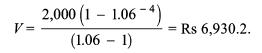
Determine the present value of an annuity if the amount of each payment is Rs 2,000, payable at the end of each year for 4 years and the interest rate is 6% compounded annually.With A= 2,000, n = 4, R = 1 + i = 1.06, we have 2,000 (11.06-4) (1.06 - 1) Rs 6,930.2.
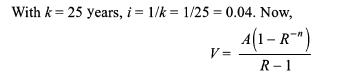
If a perpetual annuity is worth 25 years' purchase, find the annuity to continue for 3 years which can be purchased for Rs 5,000 With k 25 years, i 1/k 1/25=0.04. Now, A(1-R") V= R-1
An investment proposal requires an investment of Rs 40,000. The cash flows expected to be generated in different years are:Should the proposal be accepted if the maximum acceptable payback period be 3 years? Year 1 2 3 4 5 Cash flow 18,000 20,000 10,000 10,000 8,000
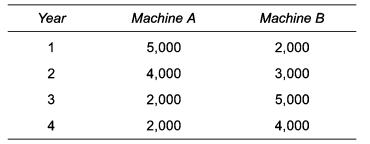
A company is trying to decide which of the two machines to purchase. Each will involve an investment of Rs 10,000. The expected net incremental cash flows are given here.The company's cost of capital is 10%. Calculate the NPV of each machine. If this is used as the basis of selection, which machine
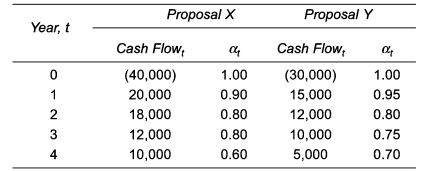
A company uses certainty equivalent approach in its evaluation of risky investments.The company has now to make a choice between two proposals X and Y. The necessary information is as follows:If the after-tax risk-free rate is 8%, which of the two alternatives should be selected? Proposal X
The management of the Play Toy Factory, a manufacturer of toys in New Delhi, is considering the introduction of a new type of a toy-remote control motorbike. In the past, the management has been quite conservative in making investments in new products and considers this project quite a risky one.
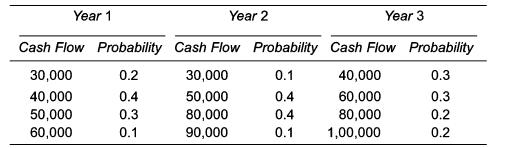
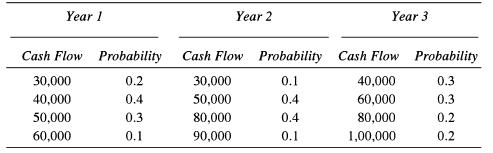
The New Electronic Company is considering to make investment in a proposal which requires an outlay of Rs 1,20,000. The project has a life of three years over which the following cash inflows are likely to be generatedThe management feels that the expected cash flows in the various periods may be
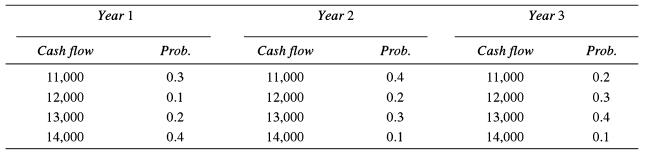
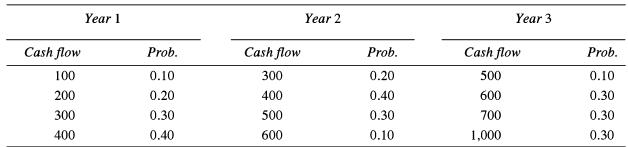
Measure the risk associated with the project, considered in Example 18.18 by standard deviation. Assume that the cash flows of the three years are independent. Also determine EVPI of the investment proposal.The pertinent information is reproduced here: Year 1 Year 2 Year 3 Cash Flow Probability
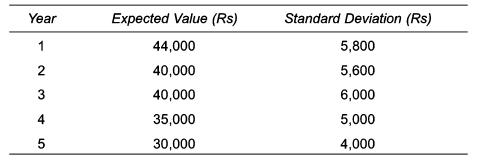
The XYZ company is considering whether or not to invest Rs 1,20,000 in an investment proposal to add a new product to its existing range. The management forecasts that the new plant will generate incremental net cash flows, each of which is assumed to be normally distributed random variable with
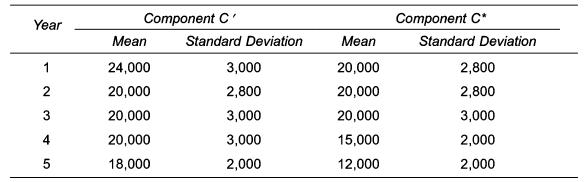
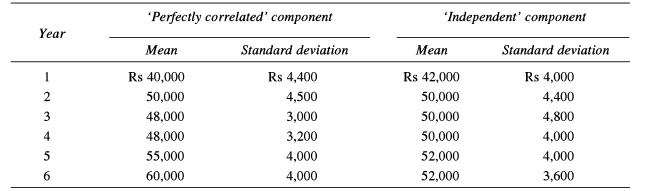
The management of ABC wants to invest in a project requiring an initial outlay of Rs 1,20,000, whose cash flows are assumed to be made up of two components-one of which varies independently over time, c;, and the other that is perfectly correlated, Ci. Each of them is normally distributed with the
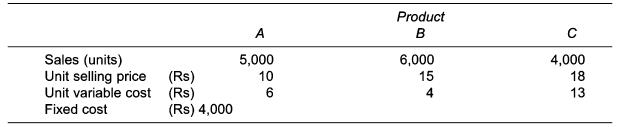
Determine the break-even sales in the following case: Product A B C Sales (units) 5,000 6,000 4,000 Unit selling price (Rs) 10 15 18 Unit variable cost (Rs) 6 4 13 Fixed cost (Rs) 4,000
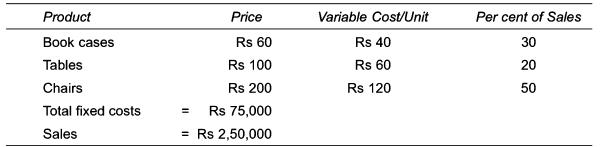
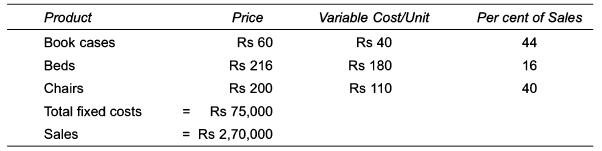
A manufacturer has three products with the following data:The manufacturer also has the following alternative with the following data:Which of the two alternatives would you recommend and Why? Product Book cases Tables Chairs Total fixed costs Sales Price Variable Cost/Unit Per cent of Sales Rs 60
For a project the relevant data on investment and projected cash flows are presented here:Assume that the cash flows are independently and normally distributed and the discount rate is 0.20.Compute:(a) the probability of the investment having a net present value of zero or less.(b) the expected
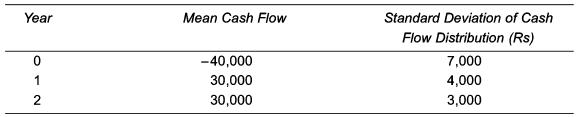
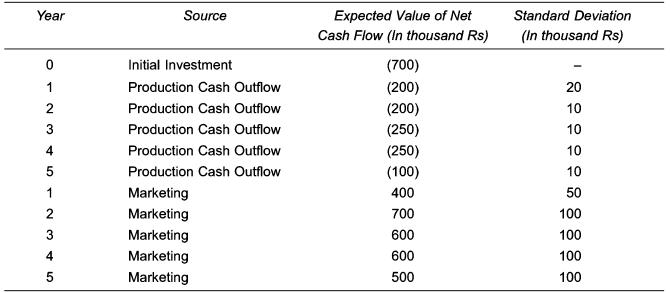
You are given the information on cash flows about a project to introduce a new product:Assume all the outflows to be independent and the marketing flows to be perfectly correlated. Taking 10% as the risk-free rate, determine the expected value of the NPV for the proposal and its standard deviation.
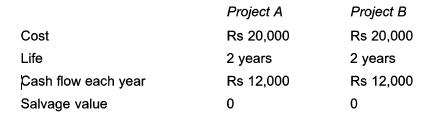
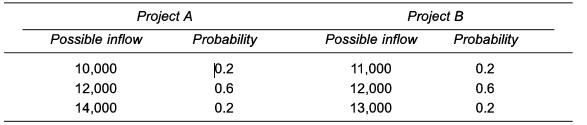
Two mutually exclusive investment proposals are being considered. The following information is available:Upon further analysis it was found that the probability of cash inflow each year, for the projects is as follows:Advise for selecting the proposal, assuming cost of capital 10%. Cost Life Cash
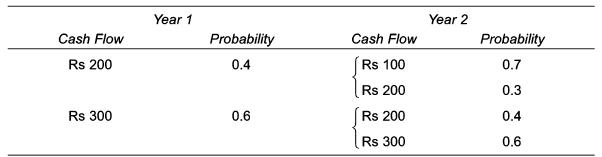
A company has invested Rs 300 in a new machinery with expected cash flow over two years as follows:Find expected NPV and its SD, assuming cost of capital as 20%. Year 1 Year 2 Cash Flow Probability Cash Flow Probability Rs 200 0.4 Rs 100 0.7 Rs 200 0.3 Rs 300 0.6 Rs 200 0.4 Rs 300 0.6
The Bluebird Corporation is considering a capital investment of Rs 10,00,000 in a project that is expected to yield the following cash flows:If the required rate of return is 14%, determine (a) NPV of the project, and (b) IRR of the project. Is the proposal an acceptable one? Years : 2 3 4 through
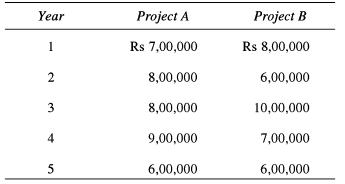
18. A company is considering two mutually exclusive projects. The initial investment required for both the projects is Rs 10,00,000 each. The projects have a life of 5 years and straight line method of depreciation is used. The required rate of return is 15% and the company pays 50% tax. The cash
19. The Risk-Less Company uses the certainty-equivalent approach to adjust for the project risk. It is considering a project which requires an initial outlay of Rs 64,000 with a useful life of 5 years, and no salvage value thereafter. The expected cash flows and their certainty equivalent
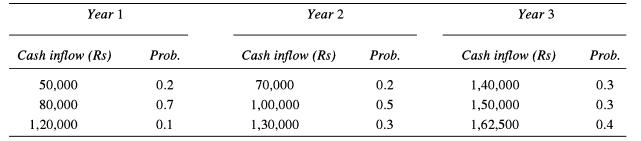
21. A company is presently considering an investment proposal involving Rs 25,000. It is found that probabilities for various net cash inflows expected to be generated by the proposal for three-year period are as follows:Compute expected monetary value EMV for each. Determine also (a) the expected
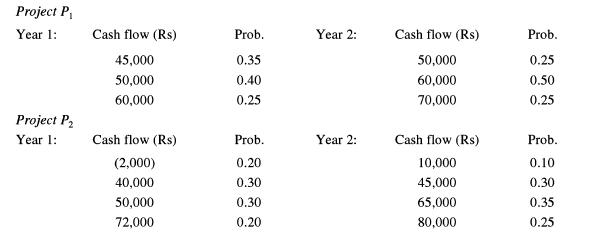
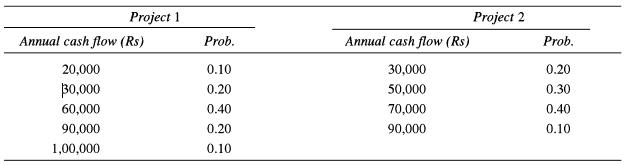
22. The All Good Company is considering two mutually exclusive capital budgeting projects. Each of these projects has a life of two years, and costs Rs 80,000. The cash flow data for the two projects are as follows:(a) Calculate the expected value of the annual cash flow for each of the
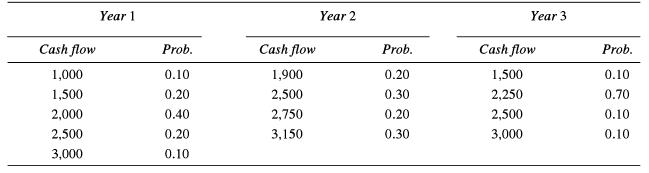
23. Obtain expected DCF and the associated risk as measured by standard deviation for the project A, if the cost of capital equals 10%, given probability distribution of cash flows as: Cash flow Year 1 Year 2 Year 3 Prob. Cash flow Prob. Cash flow Prob. 1,000 0.10 1,900 0.20 1,500 0.10 1,500 0.20
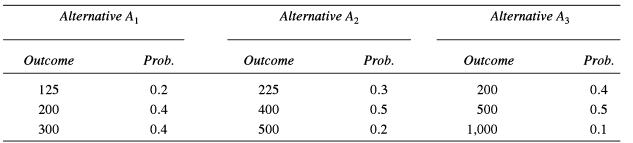
24. The possible outcomes (in thousand rupees) for three alternative investment proposals and their probabilities of occurrence are given here:Rank the three alternatives in terms of (i) expected value of outcome, and (ii) risk. Alternative A Alternative A Alternative A3 Outcome Prob. Outcome Prob.
25. Consider the alternative investment proposals 1 and 2. The cash flow estimates for these projects are:The initial cost of each of the proposals is Rs 2,00,000, while the cash flow estimates are valid for a period of six years in respect of each of them. Determine expected NPV for each of the
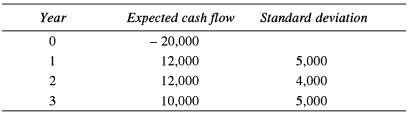
26. An investment proposal involves an outlay of Rs 2,20,000. The proposal is expected to have a life of 3 years only, and is likely to generate the following cash inflows at the year-ends.(a) Determine the expected cash flow for each of the 3 years and its standard deviation.(b) Using a 12%
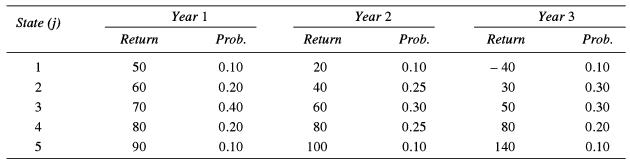
27. An investment proposal had the following discrete probability distributions of expected cash flows:Give (a) the expected return each year and net present worth of the total expected return, (b) standard deviation of the expected returns in each year; and also standard deviation of present value
28. A company has developed the following discrete probability distribution of cash flows for a particular capital budgeting proposal:Assume that the probability distributions of the flows for different years are perfectly correlated over time; the initial cost of the project is 1,000; and the
29. Assuming a discount rate of 0.10, and the following projected cash flows, determine (a) the expected NPV of the investment proposal, (b) the standard deviation of the present value distribution, and (c)the probability of the project to have a net present value lying between zero and Rs
30. The Fair Fax Company is attempting to decide whether or not to invest in a project that requires an initial outlay of Rs 3.4 lakhs. The cash flows of the project are known to be made up of two parts, one of which varies independently over time and the other one which displays perfect positive
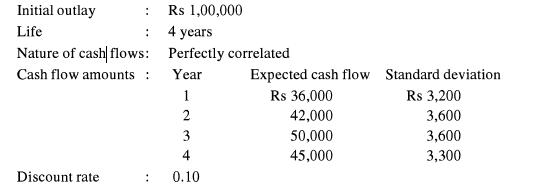
31. Determine expected value of perfect information (EVPI) in respect of a project regarding which the following information is available: Initial outlay : Rs 1,00,000 Life : 4 years Nature of cash flows: Cash flow amounts: Perfectly correlated Year Expected cash flow Standard deviation 1 Rs 36,000
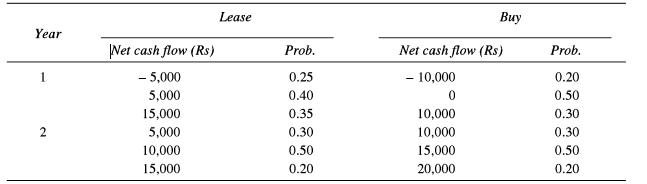
32. The management of Superfast Transport Company is considering whether to buy or lease an additional small truck it needs in order to extend its service. An analysis of costs and potential demand yields the following estimates of net cash flows (NCF) for each of the first two years.The two-year
Showing 900 - 1000
of 7324
First
3
4
5
6
7
8
9
10
11
12
13
14
15
16
17
Last
Step by Step Answers

 Get 50% OFF
Claim Now
Get 50% OFF
Claim Now