New Semester
Started
Get
50% OFF
Study Help!
--h --m --s
Claim Now
Question Answers
Textbooks
Find textbooks, questions and answers
Oops, something went wrong!
Change your search query and then try again
S
Books
FREE
Study Help
Expert Questions
Accounting
General Management
Mathematics
Finance
Organizational Behaviour
Law
Physics
Operating System
Management Leadership
Sociology
Programming
Marketing
Database
Computer Network
Economics
Textbooks Solutions
Accounting
Managerial Accounting
Management Leadership
Cost Accounting
Statistics
Business Law
Corporate Finance
Finance
Economics
Auditing
Tutors
Online Tutors
Find a Tutor
Hire a Tutor
Become a Tutor
AI Tutor
AI Study Planner
NEW
Sell Books
Search
Search
Sign In
Register
study help
business
understanding management
Quantitative Techniques In Management 4th Edition N D VOHRA - Solutions
3. Different criteria for making decisions under risk would always lead to the same optimal choice. Mark the statement as T (True) or F (False).
2. Regret is the amount of money paid for not adopting the optimal course of action. Mark the statement as T (True) or F (False).
1. Decision theory is concerned with determining optimal strategies where a decision-maker is faced with a number of alternatives and a risky pattern of future events. Mark the statement as T (True) or F (False).
A businessman has two independent investments A and B available to him, but he lacks the capital to undertake both of them simultaneously. He can choose to take A first and then stop, or if A is successful then take B, or vice versa. The probability of success on A is 0.7, while for Bit is 0.4.
A company has developed a new product in its R&D laboratory. The company has the option of setting up production facility to market this product straight away. If the product is successful, then over the three years expected product life, the returns will be Rs 120 lakh with a probability of 0.70.
A Finance Manager is considering drilling a well. In the past, only 70% of wells drilled were successful at 20 metres depth in that area. Moreover, on finding no water at 20 metres, some persons in that area drilled it further up to 25 metres but only 20% struck water at that level. The prevailing
The investment staff of TNC Bank is considering four investment proposals for a client:shares, bonds, real estate and savings certificate. These investments will be held for one year. The past data regarding the four proposals are given below:Shares: There is 25 per cent chance that shares will
An engineering company's plant maintenance budget for the month of May is showing an adverse cost variance of Rs 1,200 on a total budget of Rs 20,000. The factory manager is uncertain whether it would be worthwhile investigating the cost variance and taking any corrective action since he estimates
The Rs 8,00,000 property of the Goodwill India Co has one-tenth of one per cent chance of catching fire that will cause damage to the property to the extent of Rs 1,00,000; and a one-twentieth of one per cent chance of catching fire that will completely destroy the property. The management of the
ABC Company needs to increase its production beyond its existing capacity. It has narrowed the alternatives to two approaches to increase the production capacity:(1) expansion at a cost of Rs 8 million, or(2) modernisation, at a cost of Rs 5 million.Both approaches would require the same amount of
Informatics Corporation summarises international information reports (on a weekly basis), prints sophisticated data and forecasts, which are purchased weekly by mutual funds, banks and insurance companies. This information is very expensive and the demand for the reports is limited to a maximum of
A bookstore sells a particular book of tax laws for Rs 100. It purchases the book for Rs 80 per copy. Since some of the tax laws change every year, the copies unsold at the end of a year become outdated and can be disposed of for Rs 30 each. According to past experience, the annual demand for this
39. (a) PERT calculations yield the critical path length of a project to be 24 months with a variance of 9. What is the probability of its completion in 20 months? Within how many months would you expect the project to be completed with probability of 0.90?(b) In a PERT network, the expected
15. A company has Rs 1,00,000 available for investment. It is considering two competing investment strategies:(a) invest in Reliable Company's bonds with a guaranteed 8% rate of interest per annum, and (b)purchase new equipment costing Rs 1,00,000 which, if a favourable condition of the economy
16. The Indian Yatch Company has developed a new cabin cruiser which they have earmarked for the medium-to-large boat market. A market analysis has put a 30% probability of annual sales being 5,000 boats, a 40% probability of 4,000 annual sales and a 30% probability of 3,000 annual sales. The
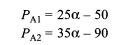
17. The paY-offfunctions in respect of two acts, A1 and A2, are given here(a) For what value of a would the two be the same?(b) Which of the acts is better for a = 10?(c) What is the regret of a poor strategy when a = 15 and a = 4? PAI - 25-50 PA2 35-90
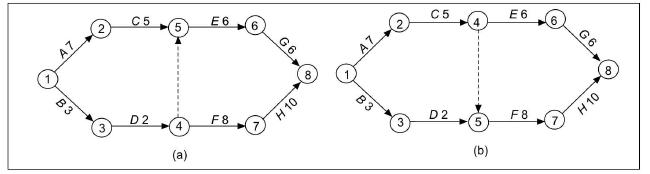
Consider the network diagrams given in Figures 12.51 (a) and (b ). Bring out the effect of the change in the direction of dummy activity on the scheduling of the activities and the project duration. A7 B3 C5 E6 5 6 D2 F8 4 (a) G6 H 10 8 B3 C5 E6 4 D2 F8 3 5 (b) G6 H 10 8
15. Consider each of the following statements and state whether it is true or false. In case it is false, write the correct position.(i) Every path in a PERT network would be critical if all activities were to start at their earliest finish time.(ii) PERT assumes that the distribution of completion
14. "PERT network will act as only wall decorators in a business enterprise, since there are slippages of the project despite all the PERT chart." Do you agree with this view? Explain.
13. (a) How do you distinguish between resource levelling and resource allocation problems? State and explain an algorithm for resource allocation.(b) Explain the following as they are used in PERT/CPM(i) Beta distribution, and (ii) Budget overrun.
12. Write a note on crashing.
11. What are the three time estimates used in the context of PERT? How are the expected duration of a project, and its standard deviation calculated?
10. Explain the concept of float. Distinguish clearly between the free, interfering and independent floats.
9. Why is the critical path of such importance in large project scheduling and control? Can a critical path change during the course of project? Why?
8. What is critical path? State the necessary and sufficient conditions of critical path. Can a project have multiple critical paths?
7. What are forward pass and backward pass? Explain the determination of the earliest and the latest start and completion times of the different activities of a project. Also explain how are the earliest and the latest event times obtained?
6. Illustrate (i) merge and burst events; (ii) appearance of a loop in a project network.
5. What is a dummy activity? Why do we need dummy activities? In this context, bring out clearly the difference between identity and logic dummies.
4. State the rules of constructing a project network.
3. What are the major comparative characteristics of the PERT model and the CPM model? What are their limitations, if any? Discuss.
2. A construction company has received a contract to build an office complex. It has frequently engaged itself in constructing such buildings. Which of the two network techniques, PERT and CPM, should in your opinion, be employed by the company? Why?
1. What kinds of decision-making situations may be analysed using PERT and CPM techniques? State the major similarities between PERT and CPM. Under what circumstances is CPM a better technique of project management than PERT?
55. Cost overrun refers to the excess of actual cost over the value of work done on a given activity. Mark the statement as T (True) or F (False).
54. If the actual time and actual cost are different from expected time and cost respectively, then it results in budget overrun. Mark the statement as T (True) or F (False).
53. PERT/Cost deals with planning, monitoring and controlling project costs. Mark the statement as T (True) or F (False).
52. PERT/Cost aims at cost reduction. Mark the statement as T (True) or F (False).
51. While activity times are variable in PERT, in CPM they are fixed and cannot be varied at all. Mark the statement as T (True) or F (False).
50. In case of more than one critical path for a PERT network, the one with the least variance is selected for making probability calculations. Mark the statement as T (True) or F (False).
49. The standard deviation of the project completion time is obtained by adding the standard deviations of the times of completing the critical activities. Mark the statement as T (True) or F (False).
48. Probability calculations in PERT represent only the probability of completing the activities on the critical path. It is implicitly assumed that the remaining activities would also be over by the time the critical path activities are completed. Mark the statement as T (True) or F (False).
4 7. In PERT calculations, the critical path is determined by using the optimistic times for various activities. Mark the statement as T (True) or F (False).
46. The pessimistic time for every activity in a PERT project must always be greater than its optimistic time. Mark the statement as T (True) or F (False).
45. The expected completion time of an activity is the weighted average of the optimistic, pessimistic and most-likely times, wherein the "most-likely time" is assigned four times as much weightage as the weightage to the optimistic and the pessimistic times each. Mark the statement as T (True) or
44. Completion time of each activity in a PERT network is assumed to follow beta distribution. Mark the statement as T (True) or F (False).
43. PERT is probabilistic in nature while CPM is deterministic. Mark the statement as T (True) or F (False).
42. The resource allocation programmes aim to allocate the variable resource supplies to activities of project with a view to complete the project in the minimum time. Mark the statement as T (True) or F (False).
41. Ordering the activities, which are eligible to be allocated the resources at a given point of time, on the basis of slack is identical to ordering them on the basis of their latest start times. Mark the statement as T (True) or F (False).
40. Resource levelling aims at smoothening of the resource usage rate without changing the project duration. Mark the statement as T (True) or F (False).
39. It is possible to reduce an activity's duration below its crash time by allocating more resources and funds to it. Mark the statement as T (True) or F (False).
38. When there are multiple critical paths, any of them may be reduced in duration when crashing. Mark the statement as T (True) or F (False).
37. An activity, may or may not be critical, with the minimum crashing cost should be crashed first. Mark the statement as T (True) or F (False).
36. In crashing, we should always concentrate on critical path and choose between critical activities only. Mark the statement as T (True) or F (False).
35. For an activity, incremental cost can be calculated as follows:Incremental cost per day= (normal cost- crash cost)/(normal time - crash time) Mark the statement as T (True) or F (False).
34. In case crashing is possible for a project, the minimum time in which a project can be completed would be given by the length of the critical path determined using crash times for various activities. Mark the statement as T (True) or F (False).
33. The optimal duration of a project is the minimum time in which it can be completed. Mark the statement as T (True) or F (False).
32. While the direct cost is concerned with individual activities of a project, the indirect cost, or overhead, is related to the whole project and is usually a function of time. Mark the statement as T (True) or F (False).
31. The total cost of doing a project is equal to the sum of the direct cost of completing the critical activities and the indirect cost, determined from the time taken to complete the project. Mark the statement as T (True) or F (False).
30. It is possible to reduce the normal duration of a project by employing additional resources. Mark the statement as T (True) or F (False).
29. Information about the float times for various activities is essential in effecting resource levelling. Mark the statement as T (True) or F (False).
28. If a non-critical activity has no free float, it implies that the start of one or more of its immediately succeeding activities is dependent on the completion time of this activity. Mark the statement as T (True) or F (False).
27. An activity with some free float cannot be a critical activity. Mark the statement as T (True) or F (False).
26. A non-critical activity must have a positive total float. Mark the statement as T (True) or F (False).
25. For each critical activity, total, free and independent floats are equal to zero. Mark the statement as T (True) or F (False).
24. Every non-critical activity can be scheduled at any time between its earliest and latest start times. Mark the statement as T (True) or F (False).
23. Total float is the aggregate of the free, interfering and independent floats. Mark the statement as T (True) or F (False).
22. Independent float, IF;_ j = Max { 0, ESj -k - LFh _; - t; _ j} Mark the statement as T (True) or F (False).
21. Interfering float is the excess of the total float over the free float. Mark the statement as T (True) or F (False).
20. Every critical activity has identical earliest and latest start times, and earliest and latest finish times. Mark the statement as T (True) or F (False).
19. The latest finish (LF) time of an activity is equal to the lowest of the latest start (LS) times of the successor activities. Mark the statement as T (True) or F (False).
18. The difference between the earliest start of the successor activity and the latest completion of the given activity is termed as free float. Mark the statement as T (True) or F (False).
17. The minimum time required to complete a project is given by the length of the shortest path of its network. Mark the statement as T (True) or F (False).
16. Earliest start and completion times of the various activities of a project are obtained by forward pass calculations while the latest start and completion times are obtained by backward pass calculations. Mark the statement as T (True) or F (False).
15. A delay in the completion of critical activities need not cause a delay in the completion of the whole project. Mark the statement as T (True) or F (False).
14. The critical path of a project network represents the minimum time needed to complete the project. Mark the statement as T (True) or F (False).
13. It is not possible for a network to have more than one critical path. Mark the statement as T (True) or F (False).
12. Critical path is the longest path in a project network. Mark the statement as T (True) or F (False).
11. Occasionally, a project network may contain a sequence of activities that form a loop. Mark the statement as T (True) or F (False).
10. For every activity, whether real or dummy, the terminal node should bear a number higher than the one born by the initial node. Mark the statement as T (True) or F (False).
9. Every activity which starts from an event has all the activities ending on that node as its immediate predecessors. Mark the statement as T (True) or F (False).
8. An activity cannot start unless all its immediate predecessors are completed. Mark the statement as T (True) or F (False).
7. Events marking the start of activities are called head-events. Mark the statement as T (True) or F (False).
6. Inclusion of more-than-desired number of dummy activities in a network can cause a delay in the completion of the project. Mark the statement as T (True) or F (False).
5. A dummy activity emanating from a given node is seen to extend all the activities which are terminating at that node. Mark the statement as T (True) or F (False).
4. Two activities, P and Q, share common predecessors and successors. Therefore, they can have common initial and final nodes. Mark the statement as T (True) or F (False).
3. It is desirable to have as many dummy activities in a project network as possible. Mark the statement as T (True) or F (False).
2. A dummy activity in a project network always has a zero duration. Mark the statement as T (True) or F (False).
I. A project network cannot have multiple initial and final nodes. Mark the statement as T (True) or F (False).
A project has fourteen activities A through M. The relationships which obtain among these activities are given here. Construct the network and number them.A is the first operation Band C can be performed in parallel and are immediate successors to A D, E, and F follow B Gfollows E H follows D, but
Given the following information on a small project: A is the first activity of the project and precedes the activities B and C. The activity D succeeds both B and C whereas only C is required to start activity E. D precedes F while G succeeds E. H is the last activity of the project and succeeds F
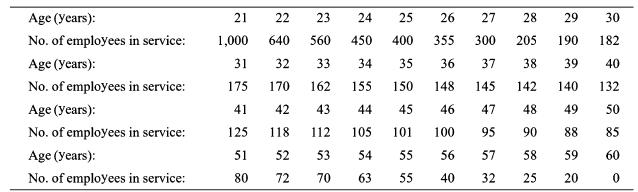
30. A public sector bank requires 400 clerks, 250 officers and 50 managers for a certain state. The employees are recruited at the age of21 Years as clerks. The promotions take place only from within on the basis of the length of service. You are given the following life table.Determine (a) how
29. There are 100 machines of a certain type which need repairing as they fail. Each machine repaired costs Rs 400 if it is serviced on individual basis. On the other hand, if all the machines are serviced simultaneously, it costs Rs 20,000, averaging Rs 200 per machine. From experience, the
28. Colour-Tech Ltd. has just started to hire out a total of 160 colour TV sets. According to market survey, the distribution of length of hire of sets is,(a) Determine the number of new rentals needed each Year for the next four years to maintain the company's total rental at 160. Also determine
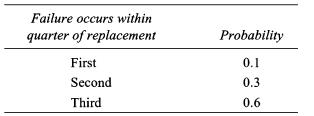
27. Given that cost of failure replacement is 3 times compared to the cost of common preventive replacement of Rs 100 per item in a system of 1,000 items and the following data, suggest the strategy between failure replacement and common preventive replacement that should be followed for cost
26. An organisation is considering periodic replacement of 2,000 units of an item which follows sudden failure mechanism. It is now following a policy ofreplacing items as they fail at a cost of Rs 800 per item. The organisation feels that it can cut its per item replacement cost by Rs 150 using
25. A computer has a large number of components all of which have to be fully working and failures have to be replaced to maintain operational efficiency. Past observations have shown the following mortality pattern. If the component is replaced individually, then cost of a single replacement is Rs
24. The administrator for a large mid-western city continually seeks ways to reduce costs without cutting service. The administrator has asked all department heads to review their operations to determine if cost saving procedures can be implemented.The Department of Streets is responsible for the
23. An electronic assembly contains 1,600 units of a particular component, failure of any of them stops the functioning of that assembly and hence the failed components need immediate replacement when the failure occurs.The mortality pattern of these components based on the past data is as
22. Perfect Machine Tools Ltd. has 40 lathes in service. The cost ofrepairing a breakdown is Rs 1,000 per lathe. A preventive maintenance programme costing Rs 300 per lathe per month can prevent the breakdowns.Records indicate that the possibility of a breakdown is as follows:(a) What is the
21. An electronic assembly has 200 units of a particular chip. The failure of any of these causes the assembly to stop functioning. Accordingly, any failed component need to be immediately replaced.Based on the past data, the mortality pattern of this chip is found to be as follows:The cost of chip
20. The distribution of life ofa special type of bulb used by a company is as follows:The cost of replacing an individual bulb when it fails is Rs 5 while the cost when replaced on a group basis is Rs 2 per bulb. The company has one thousand bulbs of this type installed.(a) Calculate average life
Showing 1500 - 1600
of 7324
First
9
10
11
12
13
14
15
16
17
18
19
20
21
22
23
Last
Step by Step Answers

 Get 50% OFF
Claim Now
Get 50% OFF
Claim Now