







Question: An improper integral I = a (x) dx is called absolutely convergent if a |(x)| dx converges. It can be shown
An improper integral I = ∫∞a ƒ(x) dx is called absolutely convergent if ∫∞a |ƒ(x)| dx converges. It can be shown that if I is absolutely convergent, then it is convergent.
Let ƒ(x) = sin x/x and I = ∫∞0 ƒ(x) dx.We define ƒ(0) = 1. Then ƒ is continuous and I is not improper at x = 0.
(a) Show that
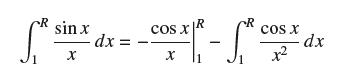
(b) Show that ∫∞1 (cos x/x2) dx converges. Conclude that the limit as R→∞of the integral in (a) exists and is finite.
(c) Show that I converges.
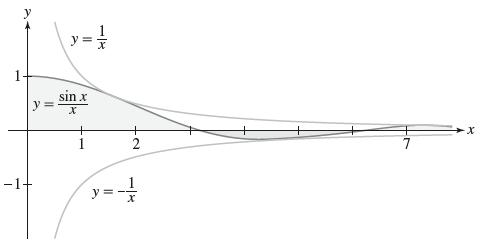
It is known that I = π/2. However, I is not absolutely convergent. The convergence depends on cancellation, as shown in Figure 13.
R R COS X COS X S * Sinx dx = cox x* - * cos x d. dx X X x
Step by Step Solution
3.25 Rating (151 Votes )
There are 3 Steps involved in it
a Use Integration by Parts with u and dv sin x dx Then du dxx v cos x and we have CR R sin ... View full answer

Get step-by-step solutions from verified subject matter experts
 Study Help