



Question: Suppose that the observer in Exercise 62 moves off to infinitythat is, d . What do you expect the limiting value of the observed
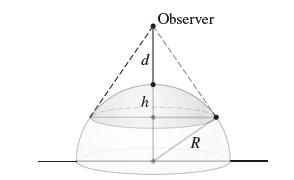
Suppose that the observer in Exercise 62 moves off to infinity—that is, d → ∞. What do you expect the limiting value of the observed area to be? Check your guess by using the formula for the area in the previous exercise to calculate the limit.
Data From Exercise 62
Prove that the portion of a sphere of radius R seen by an observer located at a distance d above the North Pole has area A = 2πdR2/(d + R). According to Exercise 52, the cap has surface area 2πRh. Show that h = dR/(d + R) by applying the Pythagorean Theorem to the three right triangles in Figure 22.
Data From Exercise 52
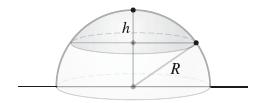
Show that a spherical cap of height h and radius R (Figure 19) has surface area 2πRh.
h Observer R
Step by Step Solution
3.53 Rating (153 Votes )
There are 3 Steps involved in it
We would assume the observed surfac... View full answer

Get step-by-step solutions from verified subject matter experts