







Question: We define the first difference of a function by (x) = (x + 1) (x). Show that if then P
We define the first difference δ ƒ of a function ƒ by δ ƒ(x) = ƒ(x + 1) − ƒ(x).
Show that if
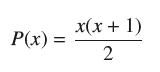
then δP = (x + 1). Then apply Exercise 46 to conclude that
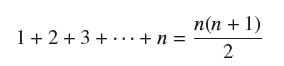
Data From Exercise 46
We define the first difference δ ƒ of a function ƒ by δ ƒ(x) = ƒ(x + 1) − ƒ(x).
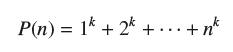
Suppose we can find a function P such that δP(x) = (x + 1)k and P(0) = 0. Prove that P(1) = 1k , P(2) = 1k + 2k, and, more generally, for every whole number n,
P(x)= x(x + 1) 2
Step by Step Solution
★★★★★
3.32 Rating (152 Votes )
There are 3 Steps involved in it
1 Expert Approved Answer
Step: 1 Unlock

Let Px xx 12 Then x 1x2 xx 1 2 ... View full answer
Question Has Been Solved by an Expert!
Get step-by-step solutions from verified subject matter experts
Step: 2 Unlock
Step: 3 Unlock
 Study Help