







Question: Consider the optimal design problem in Section 7.3, but now suppose that the capital cost of the reactor increases with volume as V, <
Consider the optimal design problem in Section 7.3, but now suppose that the capital cost of the reactor increases with volume as Vα, α
Section 7.3 Optimal design problem
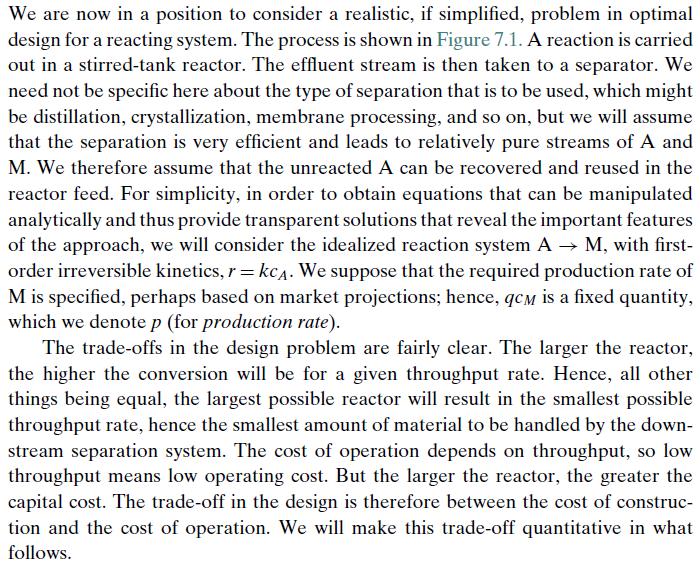
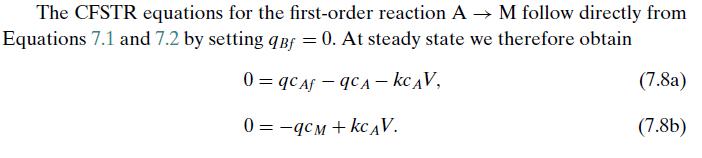
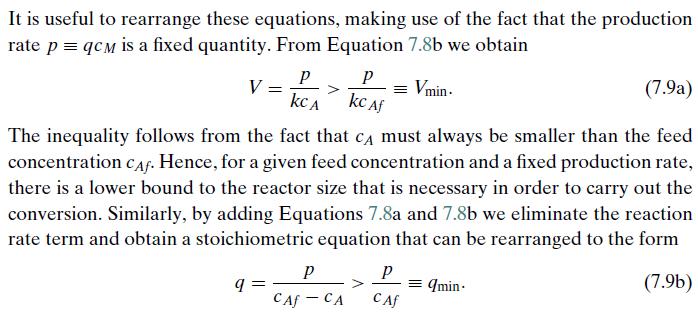
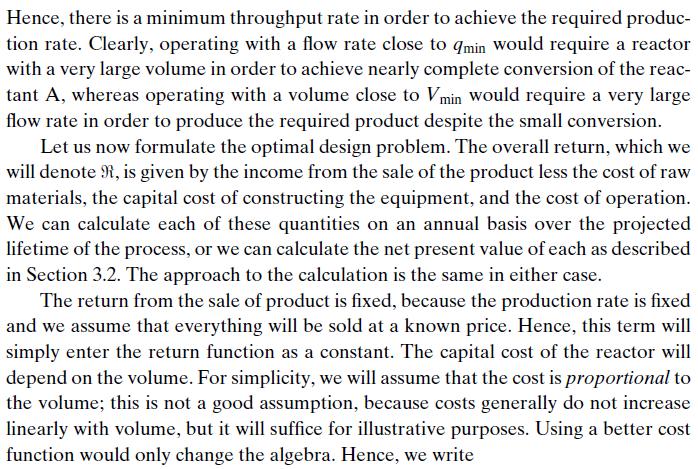
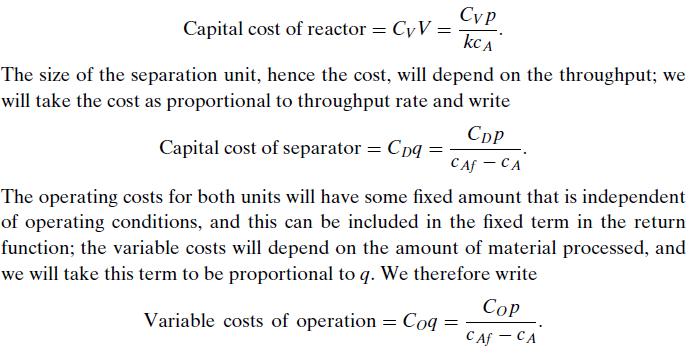
We are now in a position to consider a realistic, if simplified, problem in optimal design for a reacting system. The process is shown in Figure 7.1. A reaction is carried out in a stirred-tank reactor. The effluent stream is then taken to a separator. We need not be specific here about the type of separation that is to be used, which might be distillation, crystallization, membrane processing, and so on, but we will assume that the separation is very efficient and leads to relatively pure streams of A and M. We therefore assume that the unreacted A can be recovered and reused in the reactor feed. For simplicity, in order to obtain equations that can be manipulated analytically and thus provide transparent solutions that reveal the important features of the approach, we will consider the idealized reaction system A M, with first- order irreversible kinetics, r = kc. We suppose that the required production rate of M is specified, perhaps based on market projections; hence, qc is a fixed quantity, which we denote p (for production rate). The trade-offs in the design problem are fairly clear. The larger the reactor, the higher the conversion will be for a given throughput rate. Hence, all other things being equal, the largest possible reactor will result in the smallest possible throughput rate, hence the smallest amount of material to be handled by the down- stream separation system. The cost of operation depends on throughput, so low throughput means low operating cost. But the larger the reactor, the greater the capital cost. The trade-off in the design is therefore between the cost of construc- tion and the cost of operation. We will make this trade-off quantitative in what follows.
Step by Step Solution
3.44 Rating (157 Votes )
There are 3 Steps involved in it

Get step-by-step solutions from verified subject matter experts
 Study Help