







Question: Repeat Example 15-10 but with a mass transfer coefficient that is 10 times larger (use (delta=0.001 mathrm{~m})). Report (mathrm{x}_{mathrm{NH} 3}, mathrm{y}_{mathrm{NH} 3, text { surface
Repeat Example 15-10 but with a mass transfer coefficient that is 10 times larger (use \(\delta=0.001 \mathrm{~m})\). Report \(\mathrm{x}_{\mathrm{NH} 3}, \mathrm{y}_{\mathrm{NH} 3, \text { surface }}, \mathrm{N}_{\text {water }}\), and \(\mathrm{N}_{\mathrm{NH} 3}\).
Example 15-10
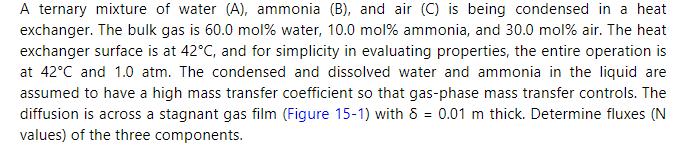
A ternary mixture of water (A), ammonia (B), and air (C) is being condensed in a heat exchanger. The bulk gas is 60.0 mol% water, 10.0 mol% ammonia, and 30.0 mol% air. The heat exchanger surface is at 42C, and for simplicity in evaluating properties, the entire operation is at 42C and 1.0 atm. The condensed and dissolved water and ammonia in the liquid are assumed to have a high mass transfer coefficient so that gas-phase mass transfer controls. The diffusion is across a stagnant gas film (Figure 15-1) with 8 = 0.01 m thick. Determine fluxes (N values) of the three components.
Step by Step Solution
3.46 Rating (169 Votes )
There are 3 Steps involved in it

Get step-by-step solutions from verified subject matter experts
 Study Help