



Question: Spherical particles are used in many practical applications including adsorption and ion exchange. Mass transfer in such particles can be described starting with a differential
Spherical particles are used in many practical applications including adsorption and ion exchange. Mass transfer in such particles can be described starting with a differential material balance in spherical coordinates. If the intraparticle diffusivity is constant, starting with an initially uniform concentration  and with a uniform surface concentration
  , the average concentration in the particle
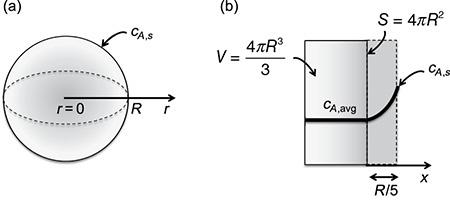
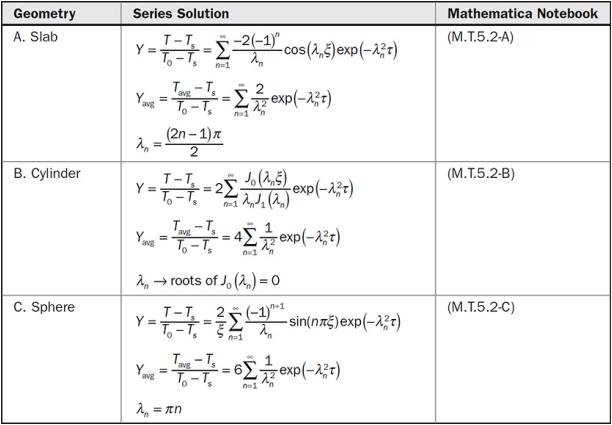
  is given in dimensionless form by item C in Table 5.2. With reference to Fig.P.15.4, an approximate solution of this mass transfer problem can be found using a pseudo-steady-state approximation by assuming that the mass transfer resistance in the sphere is represented by diffusion through a solid film with thickness
  where R is the actual particle radius. With a constant diffusivity,
  , the diffusion flux of A across this film is:
FIGURE P.15.4:
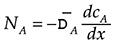
Assuming pseudo-steady-state,  is constant across the film. Thus,integrating this equation across the film we obtain:
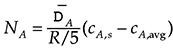
A material balance yields the following equation:
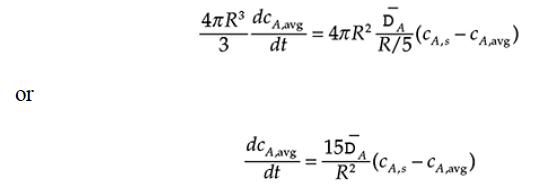
Separating the variables and integrating gives:
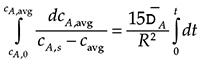
The final result is:

where  . Although this expression is only approximate, thissimplified approach has the advantage that it can be easily extended to cases where the diffusivity is composition dependence. In the adsorption field, this is called the linear driving force approximation (LDF) and is used extensively in lieu of the more complex description of transport in spherical coordinates.
(a) Compare the result of the film model approximation above for the case of constant  with the exact solution by item C in Table 5.2 by plotting
  vs.
vs.  in both cases.
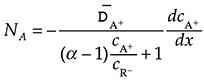
(b) Extend the film model approximation analysis to the ion exchange of two ions A and B with diffusivities  and
and  assuming
  and
and  . In this case, the flux is given by:
(c) Compare the results of your extension with the exact solution for diffusion in a spherical ion-exchange particle (Eq. (15.61)) by plotting 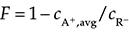 vs.
vs.  in the two cases for
  and
and  .
.
TABLE 5.2:
A,0
Step by Step Solution
3.33 Rating (159 Votes )
There are 3 Steps involved in it

Get step-by-step solutions from verified subject matter experts