







Question: In an electric eel, each electrocyte can develop a voltage of (150 mathrm{mV}) for a short time. For a total voltage of (450 mathrm{~V}), how
In an electric eel, each electrocyte can develop a voltage of \(150 \mathrm{mV}\) for a short time. For a total voltage of \(450 \mathrm{~V}\), how many electrocytes must be connected in series?
A. 300 B. 450 C. 1500 D. 3000 The voltage produced by a single nerve or muscle cell is quite small, but there are many species of fish that use multiple action potentials in series to produce significant voltages. The electric organs in these fish are composed of specialized disk-shaped cells called electrocytes. The cell at rest has the usual potential difference between the inside and the outside, but the net potential difference across the cell is zero. An electrocyte is connected to nerve fibers that initially trigger a depolarization in one side of the cell but not the other. For the very short time of this depolarization, there is a net potential difference across the cell, as shown in Figure P23.86. Stacks of these cells connected in series can produce a large total voltage. Each stack can produce a small current; for more total current, more stacks are needed, connected in parallel.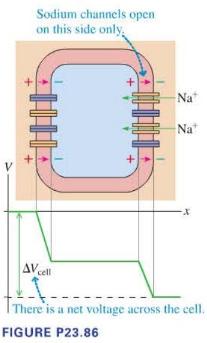
Sodium channels open on this side only Na Na -x AV cell There is a net voltage across the cell. FIGURE P23.86
Step by Step Solution
3.53 Rating (153 Votes )
There are 3 Steps involved in it
To find out how many electrocytes must be connected in series to produce a tota... View full answer

Get step-by-step solutions from verified subject matter experts
 Study Help