







Question: Table 16.1 lists the energy that can be extracted from various foods, and Table 16.2 gives the rate at which work is done and heat
Table 16.1 lists the energy that can be extracted from various foods, and Table 16.2 gives the rate at which work is done and heat is generated by a person engaged in various activities.
Use these data to analyze the following cases.
(a) How much heat energy is generated during a normal night (8 h) of sleep? How many apples must a person consume to compensate for this energy loss? (Round to the next highest whole number.)
(b) What is the total energy expended when a person runs for 30 min at a moderate pace? How many soft drinks does this energy correspond to? (Round to the next highest whole number.)
(c) What is the total energy expended when an elite cyclist races for 6 h at a rapid pace (i.e., at the Tour de France bicycle race)? How many hamburgers does this energy correspond to? (Round to the next highest whole number.)
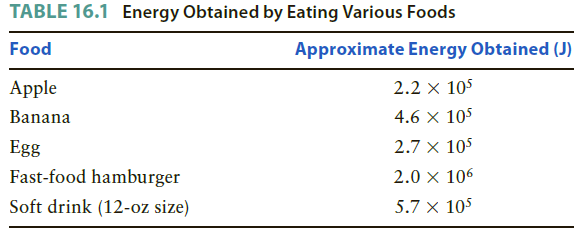
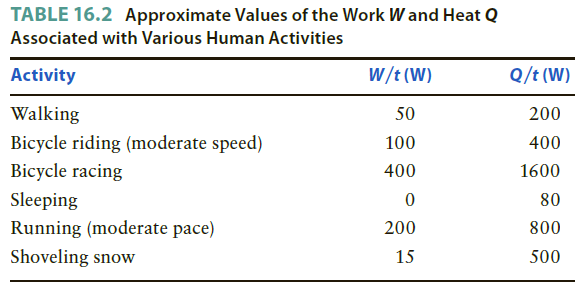
TABLE 16.1 Energy Obtained by Eating Various Foods Food Approximate Energy Obtained (J) Apple 2.2 105 4.6 x 10⁵ Banana 2.7 x 10⁵ Egg Fast-food hamburger 2.0 106 Soft drink (12-oz size) 5.7 x 10⁵ TABLE 16.2 Approximate Values of the Work W and Heat Q Associated with Various Human Activities Activity w/t (W) Q/t (W) Walking 50 200 Bicycle riding (moderate speed) 100 400 Bicycle racing 400 1600 Sleeping 80 Running (moderate pace) 200 800 Shoveling snow 15 500
Step by Step Solution
3.34 Rating (184 Votes )
There are 3 Steps involved in it
We can use the times given together with the power values in Table 162 to find the total energies Th... View full answer

Get step-by-step solutions from verified subject matter experts
 Study Help