







Question: The surfaces where bones meet are lubricated by a fluid like substance, which makes the coefficient of friction between bones very small (see Table 3.2).
The surfaces where bones meet are lubricated by a fluid like substance, which makes the coefficient of friction between bones very small (see Table 3.2). What is the approximate lateral (i.e., horizontal) force required to make the bones in a typical knee joint slide across each other? For simplicity, assume the surfaces in the knee are flat and horizontal, and consider an adult of average mass.
Table 3.2
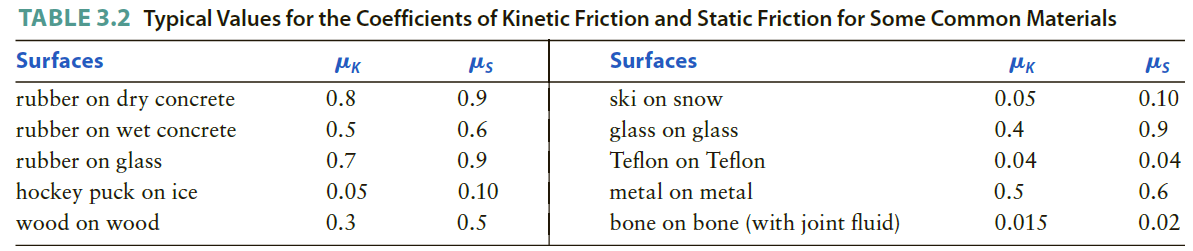
TABLE 3.2 Typical Values for the Coefficients of Kinetic Friction and Static Friction for Some Common Materials Surfaces Surfaces Us us rubber on dry concrete rubber on wet concrete rubber on glass hockey puck on ice ski on snoW 0.8 0.9 0.05 0.10 0.4 glass on glass 0.9 0.5 0.6 Teflon on Teflon metal on metal bone on bone (with joint fluid) 0.7 0.9 0.04 0.04 0.05 0.10 0.5 0.6 wood on wood 0.3 0.5 0.015 0.02
Step by Step Solution
3.40 Rating (163 Votes )
There are 3 Steps involved in it
Using the estimated mass we can find the maximum static frictional force between the bones Forces gr... View full answer

Get step-by-step solutions from verified subject matter experts
 Study Help