







Question: For a high-performance system such as a B-tree index for a database, the page size is determined mainly by the data size and disk performance.
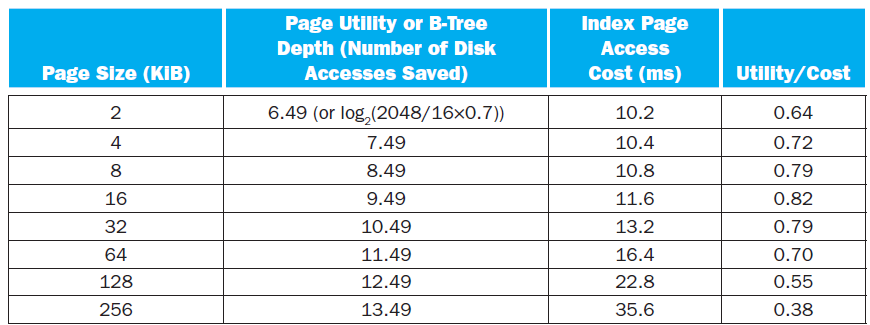
1. What is the best page size if entries now become 128 bytes?
2. Based on 5.10.1, what is the best page size if pages are half full?
3. Based on 5.10.2, what is the best page size if using a modern disk with a 3 ms latency and 100 MB/s transfer rate? Explain why future servers are likely to have larger pages.
Keeping €œfrequently used€ (or €œhot€) pages in DRAM can save disk accesses, but how do we determine the exact meaning of €œfrequently used€ for a given system? Data engineers use the cost ratio between DRAM and disk access to quantify the reuse time threshold for hot pages. The cost of a disk access is $Disk/accesses_per_sec, while the cost to keep a page in DRAM is $DRAM_MiB/page_size. The typical DRAM and disk costs and typical database page sizes at several time points are listed below:

4. What are the reuse time thresholds for these three technology generations?
5. What are the reuse time thresholds if we keep using the same 4K page size? What€™s the trend here?
6. What other factors can be changed to keep using the same page size (thus avoiding soft ware rewrite)? Discuss their likeliness with current technology and cost trends.
Page Utility or B-Tree Depth (Number of Disk Accesses Saved) Index Page Access Cost (ms) Page Size (KIB) Utility/Cost 6.49 (or log,(2048/16x0.7)) 10.2 2 0.64 4 7.49 10.4 0.72 8.49 10.8 0.79 9.49 0.82 16 11.6 10.49 32 64 0.79 13.2 11.49 16.4 0.70 128 12.49 22.8 0.55 13.49 256 35.6 0.38 Page Size (KIB) DRAM Cost Disk Cost Disk Access Rate ($/MIB) ($/disk) (access/sec) Year 1987 5000 15,000 15 1997 15 8 2000 64 0.05 64 2007 80 83
Step by Step Solution
3.42 Rating (155 Votes )
There are 3 Steps involved in it
You can change the disk latency transfer rate and optimal pa... View full answer

Get step-by-step solutions from verified subject matter experts
 Study Help