







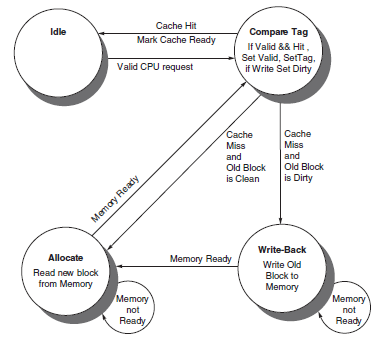
Question: In this exercise, we will explore the control unit for a cache controller for a processor with a write buffer. Use the finite state machine
Figure 5.40
1. What should happen if the processor issues a request that hits in the cache while a block is being written back to main memory from the write buffer?
2. What should happen if the processor issues a request that misses in the cache while a block is being written back to main memory from the write buffer?
3. Design a finite state machine to enable the use of a write buffer.×
Cache Hit Idle Compare Tag Mark Cache Ready If Valid && Hit, Set Valid, SetTag, if Write Set Dirty Valid CPU request Cache Cache Miss Miss and and Old Block is Dirty Old Block is Clean Memary Ready Write-Back Allocate Memory Ready Write Old Block to Memory Read new block from Memory Memory Memory not Ready not Ready
Step by Step Solution
3.36 Rating (159 Votes )
There are 3 Steps involved in it
1 The cache should be able to satisfy the request since it is otherwise idle when the write buffer i... View full answer

Get step-by-step solutions from verified subject matter experts
 Study Help