New Semester
Started
Get
50% OFF
Study Help!
--h --m --s
Claim Now
Question Answers
Textbooks
Find textbooks, questions and answers
Oops, something went wrong!
Change your search query and then try again
S
Books
FREE
Study Help
Expert Questions
Accounting
General Management
Mathematics
Finance
Organizational Behaviour
Law
Physics
Operating System
Management Leadership
Sociology
Programming
Marketing
Database
Computer Network
Economics
Textbooks Solutions
Accounting
Managerial Accounting
Management Leadership
Cost Accounting
Statistics
Business Law
Corporate Finance
Finance
Economics
Auditing
Tutors
Online Tutors
Find a Tutor
Hire a Tutor
Become a Tutor
AI Tutor
AI Study Planner
NEW
Sell Books
Search
Search
Sign In
Register
study help
computer science
fundamentals of database systems
Fundamentals Of Database Systems 7th Edition Ramez Elmasri, Shamkant Navathe - Solutions
Describe the rules of inheritance in SQL 2008.
In the traditional relational model, creating a table defined both the table type (schema or attributes) and the table itself (extension or set of current tuples). How can these two concepts be separated in SQL 2008?
Discuss how each of the following features is realized in SQL 2008: object identifier, type inheritance, encapsulation of operations, and complex object structures.
Discuss the concept of polymorphism/operator overloading.
How do regular inheritance, multiple inheritance, and selective inheritance differ?
What is the difference between persistent and transient objects? How is persistence handled in typical OO database systems?
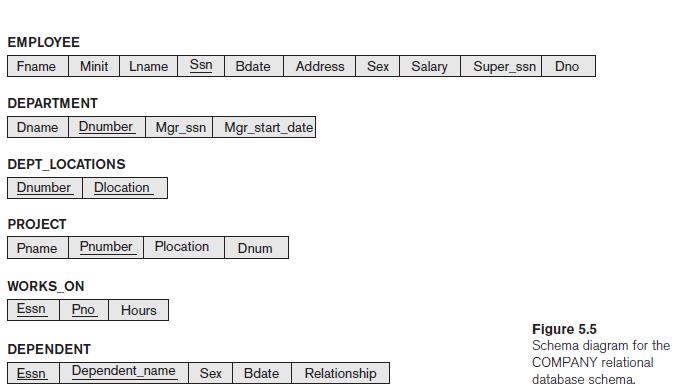
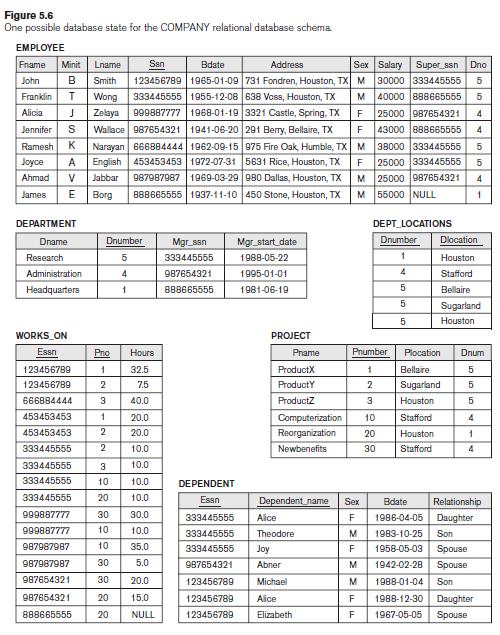
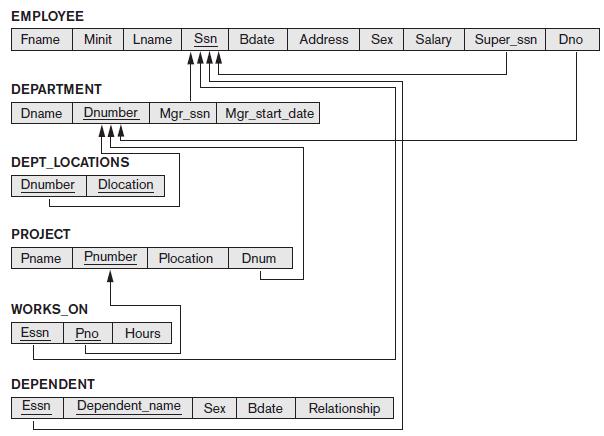
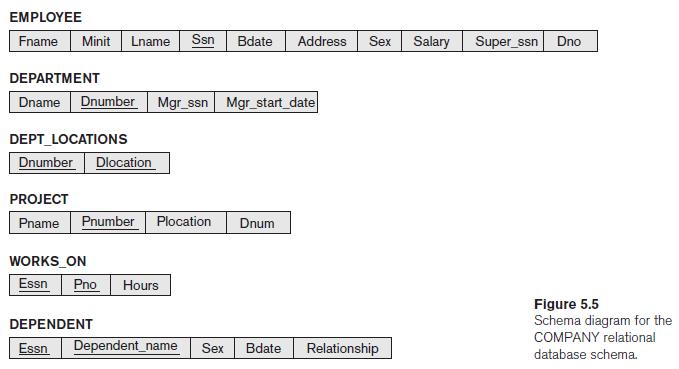
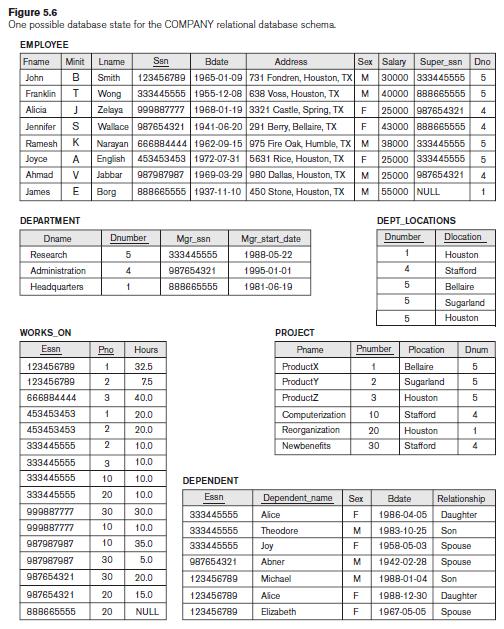
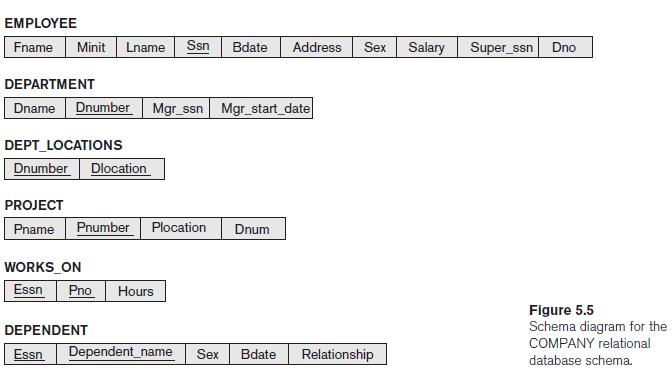
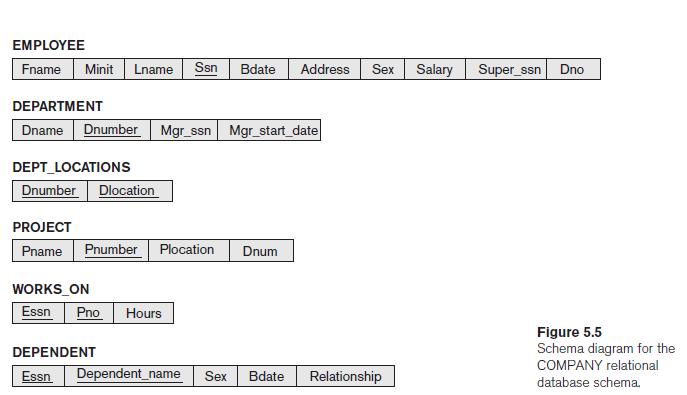
Specify queries a, b, c, e, f, i, and j of Exercise 8.16 in both tuple and domain relational calculus.Exercise 8.16Specify the following queries on the COMPANY relational database schema shown in Figure 5.5 using the relational operators discussed in this chapter. Also show the result of each query
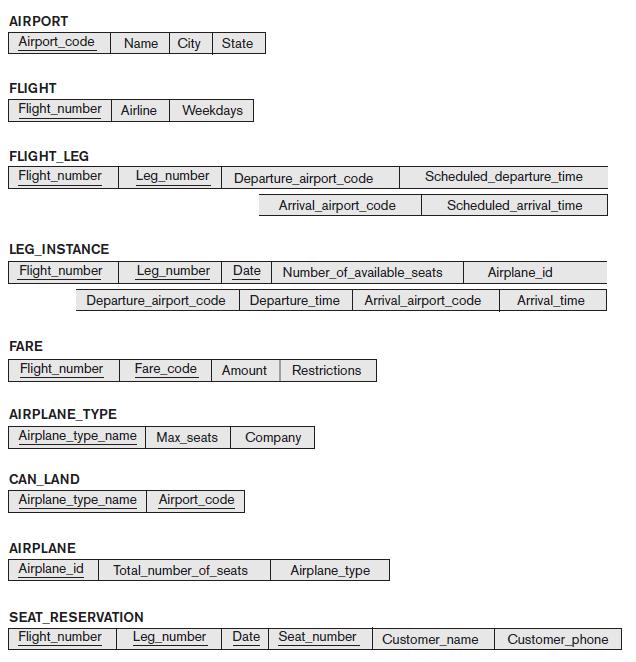
Specify queries a, b, c, and d of Exercise 8.17 in both tuple and domain relational calculus.Exercise 8.17Consider the AIRLINE relational database schema shown in Figure 5.8, which was described in Exercise 5.12. Specify the following queries in relational algebra:a. For each flight, list the
Specify queries c, d, and f of Exercise 8.18 in both tuple and domain relational calculus.Exercise 8.18Consider the LIBRARY relational database schema shown in Figure 8.14, which is used to keep track of books, borrowers, and book loans. Referential integrity constraints are shown as directed arcs
In a tuple relational calculus query with n tuple variables, what would be the typical minimum number of join conditions? Why? What is the effect of having a smaller number of join conditions?
Consider this query: Retrieve the Ssns of employees who work on at least those projects on which the employee with Ssn=123456789 works. This may be stated as (FORALL x) (IF P THEN Q), where■ x is a tuple variable that ranges over the PROJECT relation.■ P ≡ employee with Ssn=123456789 works on
A nested query is a query within a query. More specifically, a nested query is a parenthesized query whose result can be used as a value in a number of places, such as instead of a relation. Specify the following queries on the database specified in Figure 5.5 using the concept of nested queries
State whether the following conclusions are true or false:a. NOT (P(x) OR Q(x)) → (NOT (P(x)) AND (NOT (Q(x)))b. NOT (∃x) (P(x)) → ∀ x (NOT (P(x))c. (∃x) (P(x)) → ∀ x ((P(x))
Specify and execute the following queries in relational algebra (RA) using the RA interpreter on the COMPANY database schema in Figure 5.5.a. List the names of all employees in department 5 who work more than 10 hours per week on the ProductX project.b. List the names of all employees who have a
Consider a database that consists of the following relations.SUPPLIER(Sno, Sname)PART(Pno, Pname)PROJECT(Jno, Jname)SUPPLY(Sno, Pno, Jno)The database records information about suppliers, parts, and projects and includes a ternary relationship between suppliers, parts, and projects. This
Specify and execute the following queries for the database in Exercise 5.16 using the RA interpreter.a. Retrieve the names of students who have enrolled in a course that uses a textbook published by Addison-Wesley-Longman.b. Retrieve the names of courses in which the textbook has been changed at
(a) Discuss the correspondences between the ER model constructs and the relational model constructs. Show how each ER model construct can be mapped to the relational model and discuss any alternative mappings.(b) Discuss the options for mapping EER model constructs to relations, and the conditions
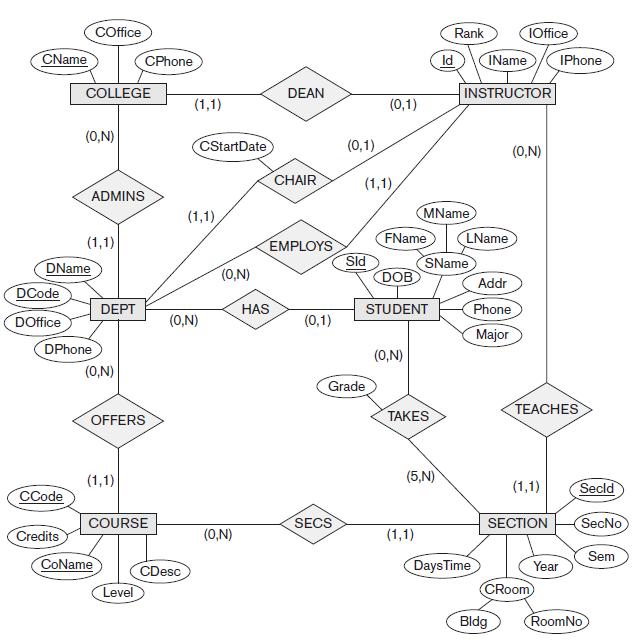
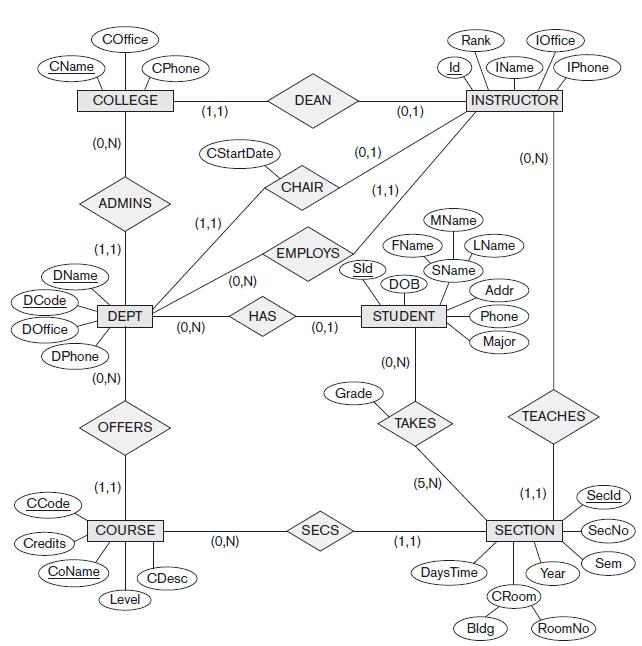
Map the UNIVERSITY database schema shown in Figure 3.20 into a relational database schema.Figure 3.20 Coffice Rank 1Office CName CPhone ld IName IPhone COLLEGE DEAN INSTRUCTOR (1,1) (0,1) (0,N) CstartDate (0,1) (0,N) CHAIR (1,1), ADMINS (1,1) MName (1,1) EMPLOYS FName LName DName Sld SName (0,N)
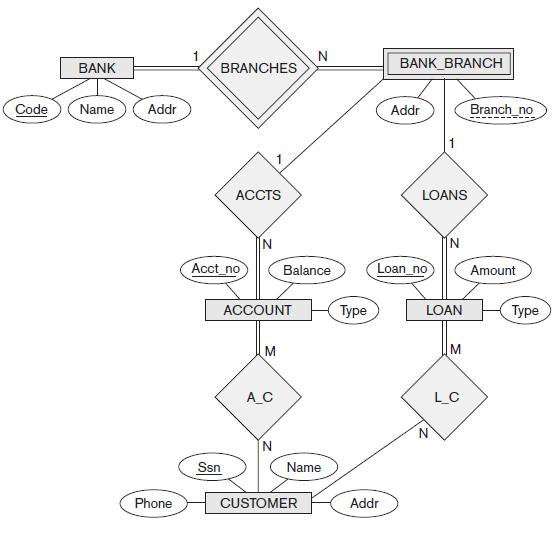
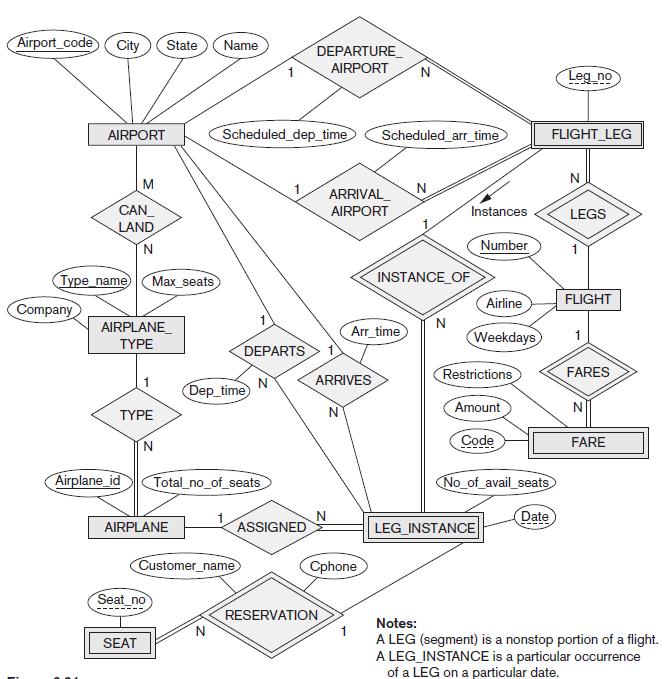
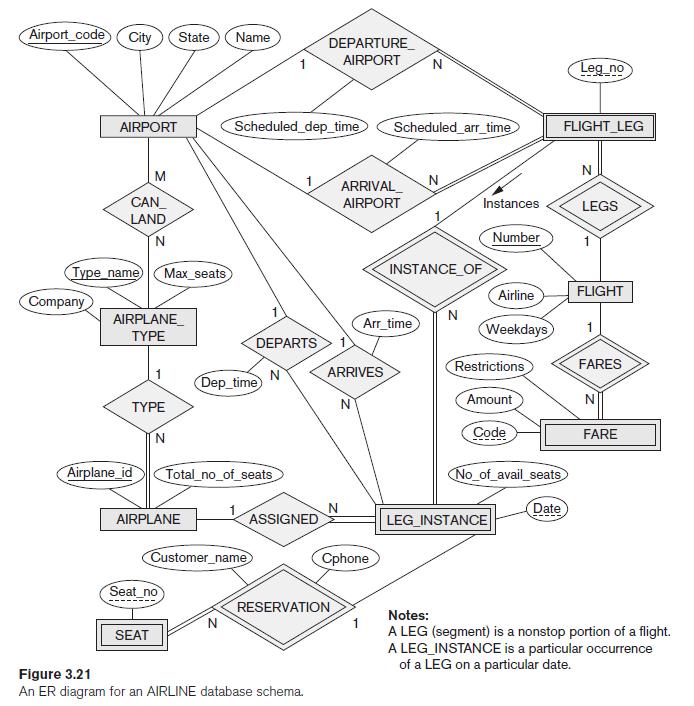
Map the BANK ER schema of Exercise 3.23 (shown in Figure 3.21) into a relational schema. Specify all primary keys and foreign keys. Repeat for the AIRLINE schema (Figure 3.20) of Exercise 3.19 and for the other schemas for Exercises 3.16 through 3.24.Exercise 3.23Consider the ER diagram shown in
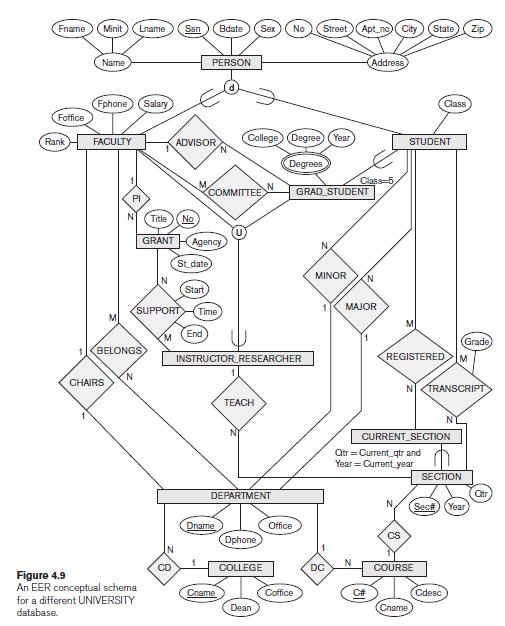
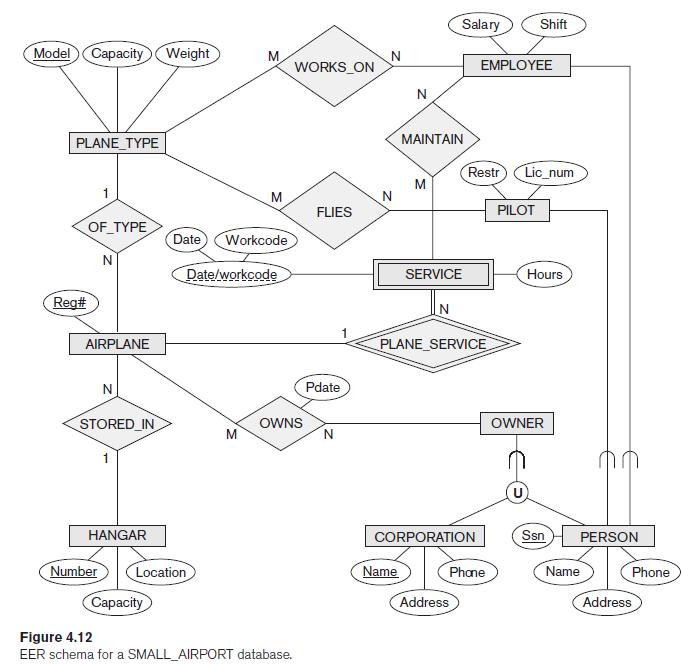
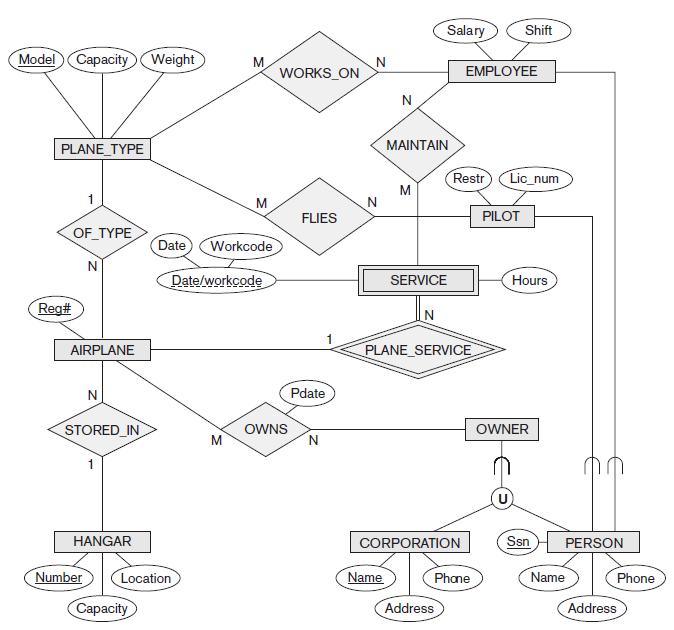
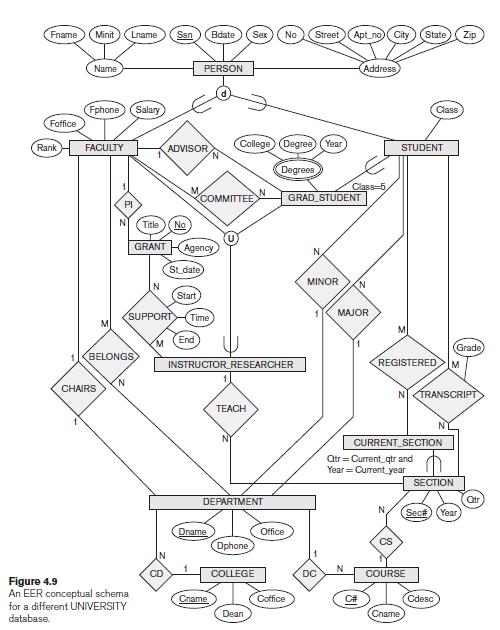
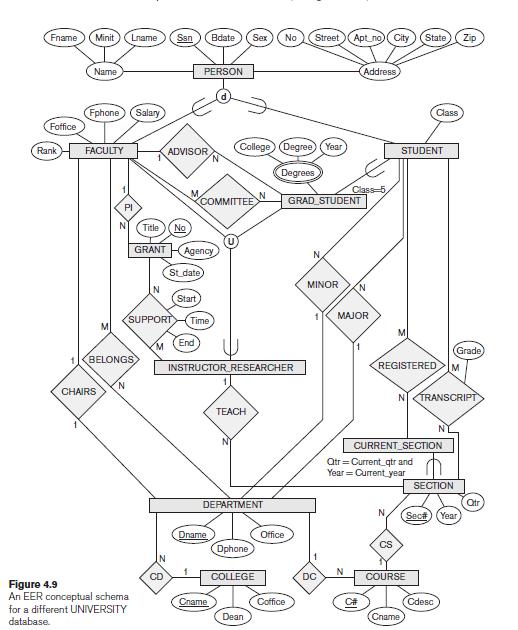
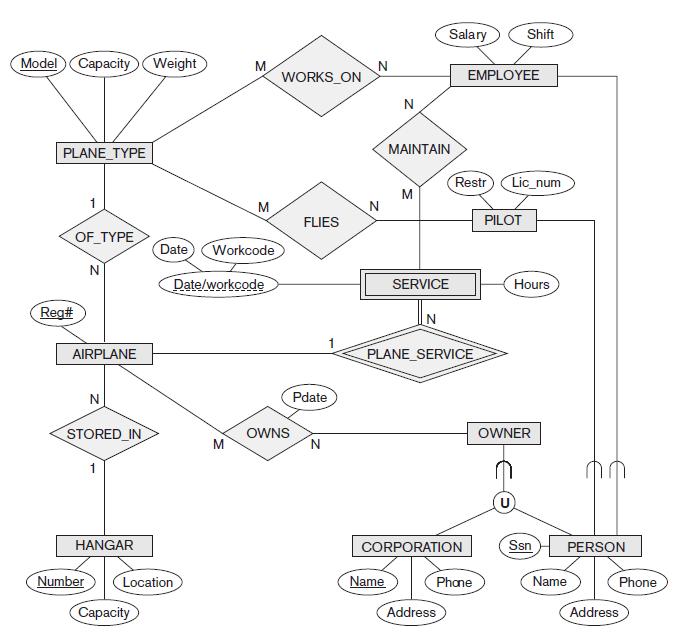
Map the EER diagrams in Figures 4.9 and 4.12 into relational schemas. Justify your choice of mapping options.Figures 4.9Figure 4.12 Salary Shift Model Capacity Weight M. WORKS ON N EMPLOYEE N PLANE_TYPE ΜΑINΤΑIΝ Restr Lic_num M N 1 M FLIES PILOT OF TYPE Date Workcode N Date/workcode SERVICE
Is it possible to successfully map a binary M:N relationship type without requiring a new relation? Why or why not?
Using the attributes you provided for the EER diagram in Exercise 4.27, map the complete schema into a set of relations. Choose an appropriate option out of 8A thru 8D from Section 9.2.1 in doing the mapping of generalizations and defend your choice.Exercise 4.27Consider the following EER diagram
Consider the ER design for the MAIL_ORDER database that was modeled using a tool like ERwin or Rational Rose in Laboratory Exercise 3.32. Using the SQL schema generation feature of the modeling tool, generate the SQL schema for an Oracle database.Exercise 3.32Consider a MAIL_ORDER database in which
Consider the EER design for the GRADE_BOOK database that was modeled using a tool like ERwin or Rational Rose in Laboratory Exercise 4.28. Usingthe SQL schema generation feature of the modeling tool, generate the SQL schema for an Oracle database.Exercise 4.28Consider a GRADE_BOOK database in which
Consider the EER design for the ONLINE_AUCTION database that was modeled using a tool like ERwin or Rational Rose in Laboratory Exercise 4.29. Using the SQL schema generation feature of the modeling tool, generate the SQL schema for an Oracle database.Exercise 4.29Consider an ONLINE_AUCTION
What is ODBC? How is it related to SQL/CLI?
What is JDBC? Is it an example of embedded SQL or of using function calls?
What is the impedance mismatch problem? Which of the three programming approaches minimizes this problem?
Describe the concept of a cursor and how it is used in embedded SQL.
What is SQLJ used for? Describe the two types of iterators available in SQLJ.
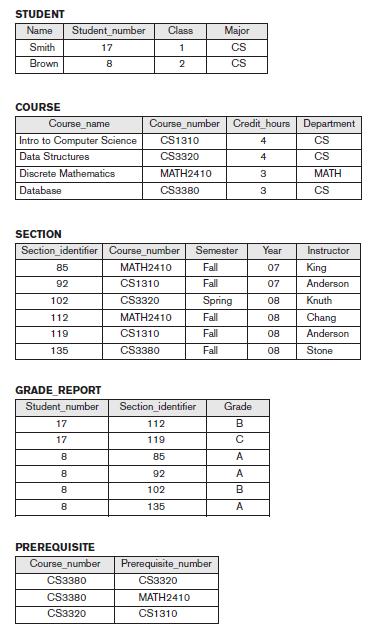
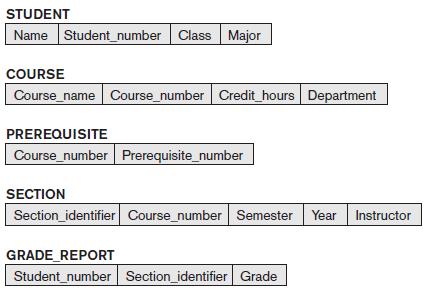
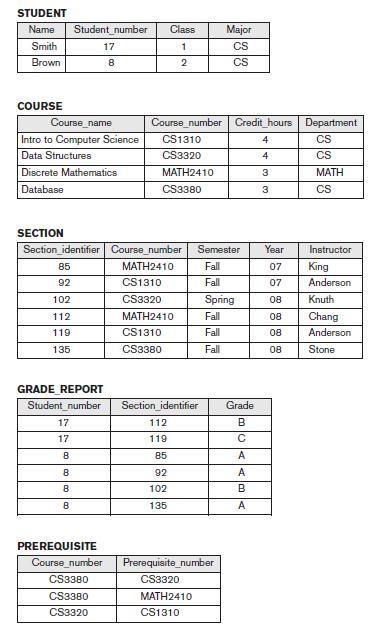
Consider the database shown in Figure 1.2, whose schema is shown in Figure 2.1. Write a program segment to read a student’s name and print his or her grade point average, assuming that A = 4, B = 3, C = 2, and D = 1 points. Use embedded SQL with C as the host language.Figure 1.2Figure 2.1 STUDENT
Repeat Exercise 10.7, but use SQLJ with Java as the host language.Consider the database shown in Figure 1.2, whose schema is shown in Figure 2.1. Write a program segment to read a student’s name and print his or her grade point average, assuming that A = 4, B = 3, C = 2, and D = 1 points. Use
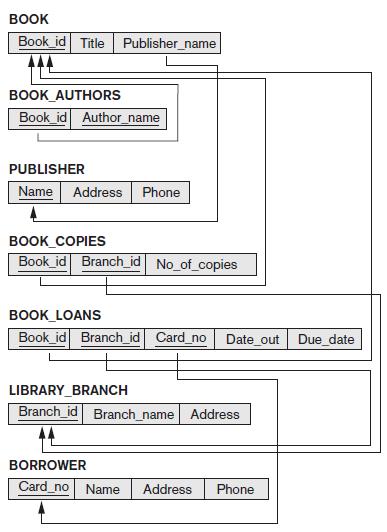
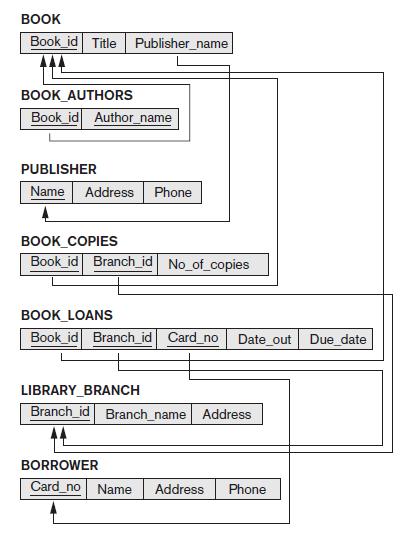
Consider the library relational database schema in Figure 6.6. Write a program segment that retrieves the list of books that became overdue yesterday and that prints the book title and borrower name for each. Use embedded SQL with C as the host language.Figure 6.6 BOOK Book id Title Publisher_name
Repeat Exercise 10.9, but use SQLJ with Java as the host language.Consider the library relational database schema in Figure 6.6. Write a program segment that retrieves the list of books that became overdue yesterday and that prints the book title and borrower name for each. Use embedded SQL with C
Repeat Exercises 10.7 and 10.9, but use SQL/CLI with C as the host language.Exercise 10.7Consider the database shown in Figure 1.2, whose schema is shown in Figure 2.1. Write a program segment to read a student’s name and print his or her grade point average, assuming that A = 4, B = 3, C = 2,
Repeat Exercises 10.7 and 10.9, but use JDBC with Java as the host language.Exercise 10.7Consider the database shown in Figure 1.2, whose schema is shown in Figure 2.1. Write a program segment to read a student’s name and print his or her grade point average, assuming that A = 4, B = 3, C = 2,
Create a function in PSM that computes the median salary for the EMPLOYEE table shown in Figure 5.5.Figure 5.5 EMPLOYEE Fname Minit Lname Ssn Sex Salary Super_ssn Dno Bdate Address DEPARTMENT Dname Dnumber Mgr_ssn Mgr_start_date DEPT LOCATIONS Dnumber Dlocation PROJECT Pname Pnumber Plocation Dnum
Repeat Exercise 10.7, but write a function in SQL/PSM.Exercise 10.7Consider the database shown in Figure 1.2, whose schema is shown in Figure 2.1. Write a program segment to read a student’s name and print his or her grade point average, assuming that A = 4, B = 3, C = 2, and D = 1 points. Use
Why are scripting languages popular for programming Web applications? Where in the three-tier architecture does a PHP program execute? Where does a JavaScript program execute?
What type of programming language is PHP?
Discuss the different ways of specifying strings in PHP.
Discuss the different types of arrays in PHP.
What are PHP auto-global variables? Give some examples of PHP autoglobal arrays, and discuss how each is typically used.
What is PEAR? What is PEAR DB?
Discuss the main functions for accessing a database in PEAR DB, and how each is used.
Discuss the different ways for looping over a query result in PHP.
What are the origins of the object-oriented approach?
Discuss the various type constructors. How are they used to create complex object structures?
Write a PHP program that creates Web forms for entering the information about a new BORROWER entity. Repeat for a new BOOK entity.
Discuss the concept of encapsulation, and tell how it is used to create abstract data types.
What is the relationship between a type and its subtype in a type hierarchy? What is the constraint that is enforced on extents corresponding to types in the type hierarchy?
Discuss the main categories of data models. What are the basic differences among the relational model, the object model, and the XML model?
Describe the three-schema architecture. Why do we need mappings among schema levels? How do different schema definition languages support this architecture?
What is the difference between logical data independence and physical data independence? Which one is harder to achieve? Why?
Discuss the different types of user-friendly interfaces and the types of users who typically use each.
With what other computer system software does a DBMS interact?
What is the difference between the two-tier and three-tier client/server architectures?
What is the additional functionality incorporated in n-tier architecture (n > 3)?
List the various cases where use of a NULL value would be appropriate.
Define the following terms: entity, attribute, attribute value, relationship instance, composite attribute, multivalued attribute, derived attribute, complex attribute, key attribute, and value set (domain).
Explain the difference between an attribute and a value set.
What is a relationship type? Explain the differences among a relationship instance, a relationship type, and a relationship set.
What is a participation role? When is it necessary to use role names in the description of relationship types?
Describe the two alternatives for specifying structural constraints on relationship types. What are the advantages and disadvantages of each?
Under what conditions can an attribute of a binary relationship type be migrated to become an attribute of one of the participating entity types?
When is the concept of a weak entity used in data modeling? Define the terms owner entity type, weak entity type, identifying relationship type, and partial key.
Design an ER schema for keeping track of information about votes taken in the U.S. House of Representatives during the current two-year congressional session. The database needs to keep track of each U.S. STATE’s Name (e.g., ‘Texas’, ‘New York’, ‘California’) and include the Region of
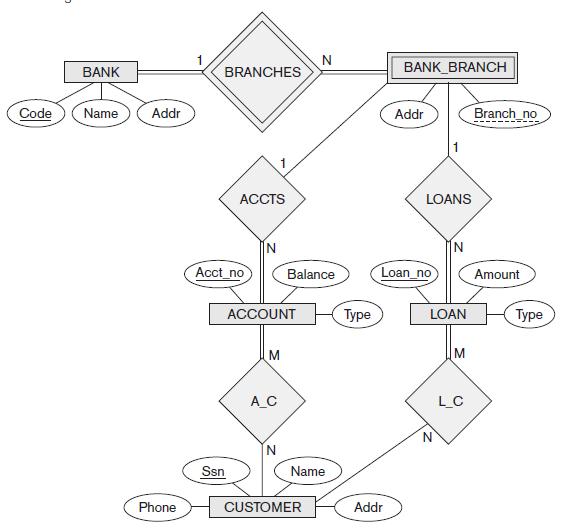
Consider the ER diagram shown in Figure 3.22 for part of a BANK database. Each bank can have multiple branches, and each branch can have multiple accounts and loans.a. List the strong (nonweak) entity types in the ER diagram.b. Is there a weak entity type? If so, give its name, partial key, and
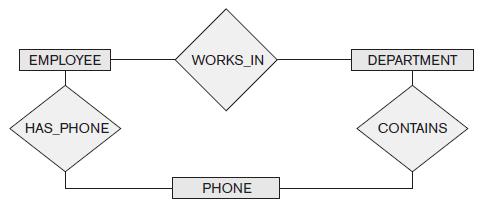
Consider the ER diagram in Figure 3.23. Assume that an employee may work in up to two departments or may not be assigned to any department. Assume that each department must have one and may have up to three phone numbers. Supply (min, max) constraints on this diagram. State clearly any additional
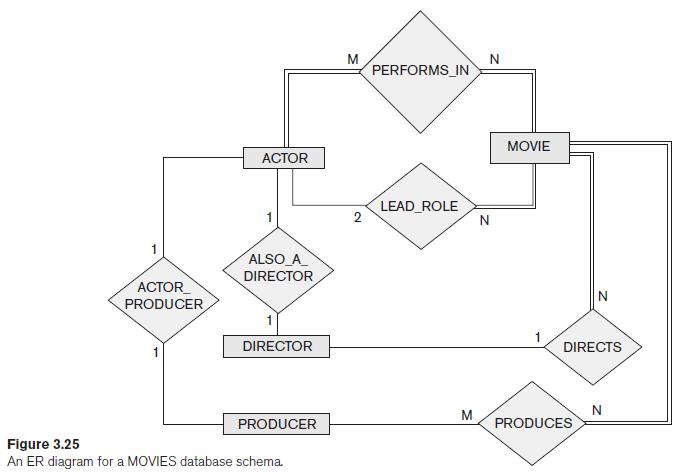
Consider the ER schema for the MOVIES database in Figure 3.25. Assume that MOVIES is a populated database. ACTOR is used as a generic term and includes actresses. Given the constraints shown in the ER schema, respond to the following statements with True, False, or Maybe. Assign a response of Maybe
Given the ER schema for the MOVIES database in Figure 3.25, draw an instance diagram using three movies that have been released recently. Draw instances of each entity type: MOVIES, ACTORS, PRODUCERS, DIRECTORS involved; make up instances of the relationships as they exist in reality for those
Consider a MAIL_ORDER database in which employees take orders for parts from customers. The data requirements are summarized as follows:■ The mail order company has employees, each identified by a unique employee number, first and last name, and Zip Code.■ Each customer of the company is
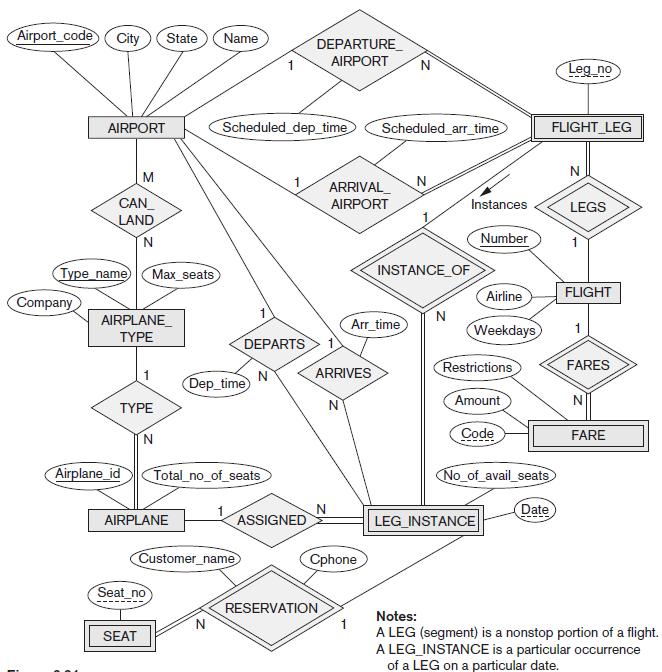
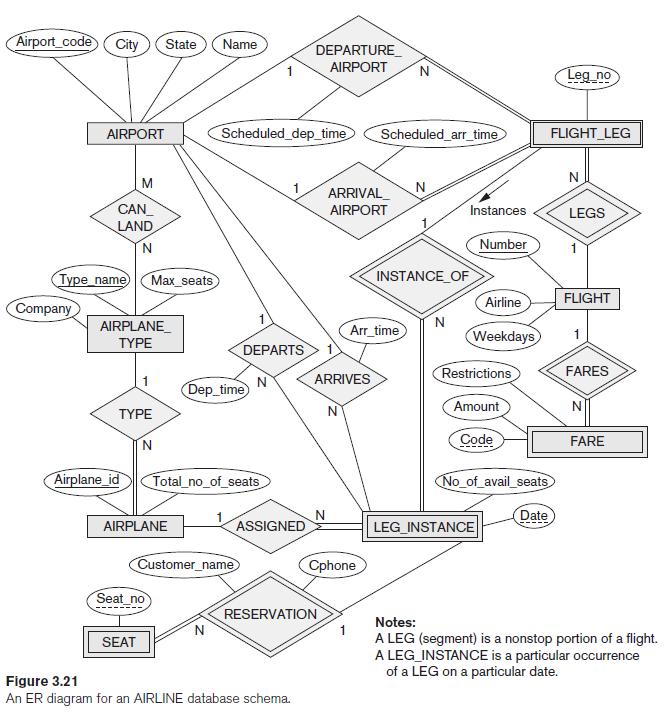
Consider the ER diagram for the AIRLINE database shown in Figure 3.21. Build this design using a data modeling tool such as ERwin or Rational Rose.Figure 3.21 Airport_code City State Name DEPARTURE_ 1 AIRPORT N Leg no AIRPORT Scheduled_dep_time Scheduled_arr_time FLIGHT_LEG 1 ARRIVAL_ N CAN_ LAND
Define the following terms: superclass of a subclass, superclass/subclass relationship, IS-A relationship, specialization, generalization, category, specific (local) attributes, and specific relationships.
Discuss the mechanism of attribute/relationship inheritance. Why is it useful?
Discuss user-defined and attribute-defined specializations, and identify the differences between the two.
Discuss user-defined and predicate-defined subclasses, and identify the differences between the two.
How does a category differ from a regular shared subclass? What is a category used for? Illustrate your answer with examples.
Discuss the main differences between the notation for EER schema diagrams and UML class diagrams by comparing how common concepts are represented in each.
Discuss the two main types of constraints on specializations and generalizations.
List the various data abstraction concepts and the corresponding modeling concepts in the EER model.
What are the main similarities and differences between conceptual database modeling techniques and knowledge representation techniques?
What aggregation feature is missing from the EER model? How can the EER model be further enhanced to support it?
Discuss the similarities and differences between an ontology and a database schema.
Consider the BANK ER schema in Figure 3.21, and suppose that it is necessary to keep track of different types of ACCOUNTS (SAVINGS_ACCTS, CHECKING_ACCTS, … ) and LOANS (CAR_LOANS, HOME_LOANS, … ). Suppose that it is also desirable to keep track of each ACCOUNT’s TRANSACTIONS (deposits,
Figure 4.12 shows an example of an EER diagram for a small-private-airport database; the database is used to keep track of airplanes, their owners, airport employees, and pilots. From the requirements for this database, the following information was collected: Each AIRPLANE has a registration
Show how the UNIVERSITY EER schema in Figure 4.9 may be represented in UML notation.Figure 4.9 Fname Minit Lname San Bdate Sex No Street Apt_no City State Zip Name PERSON Address Fphone Salary Class Foffice Rank ADVISOR College (Degree Year FACULTY STUDENT Degrees Class-5 M. COMMITTEE GRAD_STUDENT
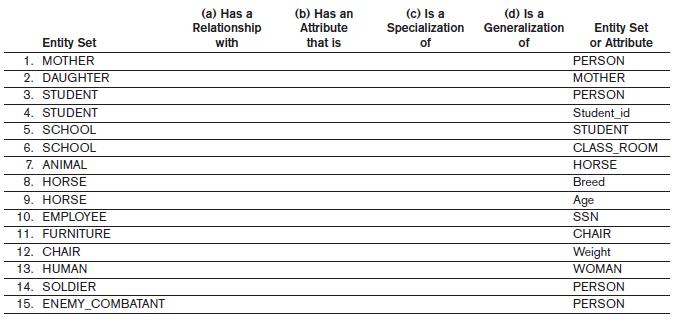
Consider the entity sets and attributes shown in the following table. Place a checkmark in one column in each row to indicate the relationship between the far left and far right columns.a. The left side has a relationship with the right side.b. The right side is an attribute of the left side.c. The
Draw a UML diagram for storing a played game of chess in a database. You may look at http://www.chessgames.com for an application similar to what you are designing. State clearly any assumptions you make in your UML diagram. A sample of assumptions you can make about the scope is as follows:1. The
Draw an EER diagram for a game of chess as described in Exercise 4. 24. Focus on persistent storage aspects of the system. For example, the system would need to retrieve all the moves of every game played in sequential order.Exercise 4. 24Draw a UML diagram for storing a played game of chess in a
Consider a GRADE_BOOK database in which instructors within an academic department record points earned by individual students in their classes. The data requirements are summarized as follows:■ Each student is identified by a unique identifier, first and last name, and an e-mail address.■ Each
Consider a database system for a baseball organization such as the major leagues. The data requirements are summarized as follows:■ The personnel involved in the league include players, coaches, managers, and umpires. Each is identified by a unique personnel id. They are also described by their
Consider the EER diagram for the UNIVERSITY database shown in Figure 4.9. Enter this design using a data modeling tool such as ERwin or Rational Rose. Make a list of the differences in notation between the diagram in the text and the corresponding equivalent diagrammatic notation you end up using
Consider the EER diagram for the small AIRPORT database shown in Figure 4.12. Build this design using a data modeling tool such as ERwin or Rational Rose. Be careful how you model the category OWNER in this diagram.Figure 4.12 Salary Shift Model Capacity Weight M. WORKS ON ΕMPLOYE N PLANE_TYPE
Define the following terms as they apply to the relational model of data: domain, attribute, n-tuple, relation schema, relation state, degree of a relation, relational database schema, and relational database state.
Consider the ER diagram in Figure 3.21, which shows a simplified schema for an airline reservations system. Extract from the ER diagram the requirements and constraints that produced this schema. Try to be as precise as possible in your requirements and constraints specification.Figure 3.21 Airport
Consider Figure 1.2.a. If the name of the ‘CS’ (Computer Science) Department changes to ‘CSSE’ (Computer Science and Software Engineering) Department and the corresponding prefix for the course number also changes, identify the columns in the database that would need to be updated.b. Can
Define the following terms: data model, database schema, database state, internal schema, conceptual schema, external schema, data independence, DDL, DML, SDL, VDL, query language, host language, data sublanguage, database utility, catalog, client/server architecture, three-tier architecture, and
Define the following terms: data, database, DBMS, database system, database catalog, program-data independence, user view, DBA, end user, canned transaction, deductive database system, persistent object, meta-data, and transaction-processing application.
Discuss the main characteristics of the database approach and how it differs from traditional file systems.
Showing 500 - 600
of 606
1
2
3
4
5
6
7
Step by Step Answers

 Get 50% OFF
Claim Now
Get 50% OFF
Claim Now