







Question: Consider a 5-bit floating-point representation based on the IEEE floating-point format, with one sign bit, two exponent bits (k = 2), and two fraction bits
Consider a 5-bit floating-point representation based on the IEEE floating-point format, with one sign bit, two exponent bits (k = 2), and two fraction bits (n = 2).
The exponent bias is 22−1 − 1= 1.
The table that follows enumerates the entire nonnegative range for this 5-bit floating-point representation. Fill in the blank table entries using the following directions:
e : The value represented by considering the exponent field to be an unsigned integer
E : The value of the exponent after biasing 2E: The numeric weight of the exponent
f : The value of the fraction
M : The value of the significand 2E ×M: The (unreduced) fractional value of the number
V : The reduced fractional value of the number
Decimal: The decimal representation of the number
Express the values of 2E, f , M, 2E × M, and V either as integers (when possible) or as fractions of the form x/y , where y is a power of 2. You need not fill in entries marked -.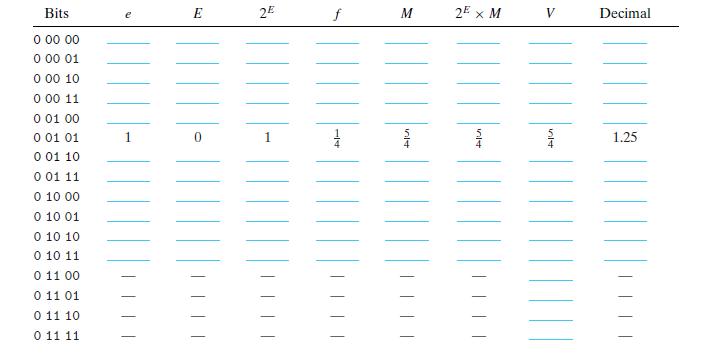
Bits 0 00 00 0 00 01 0 00 10 0 00 11 0 01 00 0 01 01 0 01 10 0 01 11 0 10 00 0 10 01 0 10 10 0 10 11 0 11 00 0 11 01 0 11 10 0 11 11 E 0 2E H f 1 M inl+ 2E x M FIS 2 FIS Decimal 1.25
Step by Step Solution
3.35 Rating (161 Votes )
There are 3 Steps involved in it
Working through floatingpoint representations for very ... View full answer

Get step-by-step solutions from verified subject matter experts
 Study Help