







Question: Use the same information for this problem as you did for Problem 12-47, except that the discount rate is 10% (not 12%), the investment is
Use the same information for this problem as you did for Problem 12-47, except that the discount rate is 10% (not 12%), the investment is subject to taxes, and the projected pretax operating cash inflows are as follows:
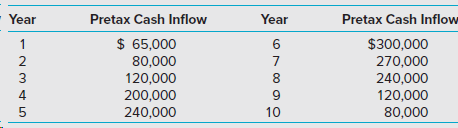
Jensen has been paying 25% for combined federal, state, and local income taxes, a rate that is not expected to change during the period of this investment. The firm uses straight-line depreciation. Assume, for simplicity, that MACRS depreciation rules do not apply.
Required
Using Excel, compute the following for the proposed investment:
1. The payback period (in years), under the assumption that the cash inflows occur evenly throughout the year. Round your answer to 1 decimal place.
2. The accounting (book) rate of return based on (a) initial investment, and (b) average investment. Round both answers to 1 decimal place (e.g., 13.417% = 13.4%).
3. The net present value (NPV), rounded to the nearest whole dollar.
4. The present value payback period of the proposed investment under the assumption that the cash inflows occur evenly throughout the year. (Note: Use the formula at the bottom of Appendix C, Table 1 to calculate present value factors.)
5. The internal rate of return (IRR), rounded to 1 decimal place (e.g., 5.491% = 5.5%).
Year Pretax Cash Inflow Year Pretax Cash Inflow $ 65,000 $300,000 80,000 120,000 200,000 240,000 270,000 3 4 8. 240,000 120,000 10 80,000
Step by Step Solution
3.56 Rating (153 Votes )
There are 3 Steps involved in it
1 Unadjusted Payback Period as shown by the above schedule the payback period is between 5 and 6 years Under the assumption that the cash inflows occu... View full answer

Get step-by-step solutions from verified subject matter experts
 Study Help