







Question: Padding may not always be appropriate. For example, one might wish to store the encrypted data in the same memory buffer that originally contained the
Padding may not always be appropriate. For example, one might wish to store the encrypted data in the same memory buffer that originally contained the plaintext. In that case, the ciphertext must be the same length as the original plaintext. A mode for that purpose is the ciphertext stealing (CTS) mode. Figure 6.12a shows an implementation of this mode.
a. Explain how it works.
b. Describe how to decrypt Cn-1 and Cn.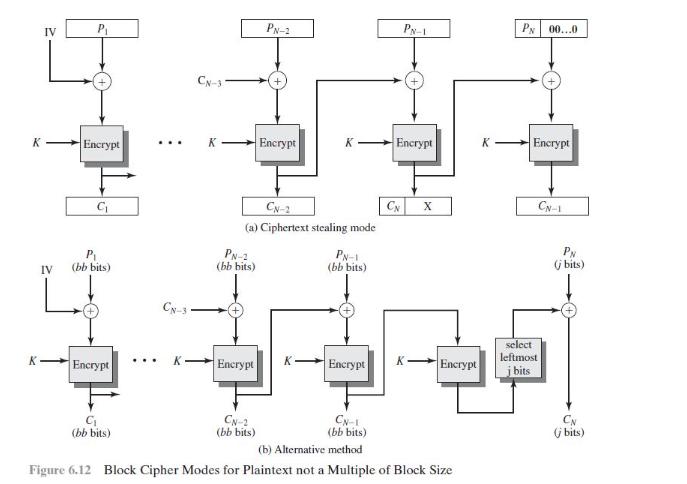
K K IV P Encrypt C P IV (bb bits) Encrypt (bb bits) ... CN-3 K CN-31 K PN-2 (bb bits) Encrypt PN-2 CN-2 (a) Ciphertext stealing mode CN-2 (bb bits) Encrypt K K PN-1 (bb bits) Encrypt CN-1 (bb bits) PN-1 Encrypt CN K X Encrypt (b) Alternative method Figure 6.12 Block Cipher Modes for Plaintext not a Multiple of Block Size K PN 00...0 Encrypt CN-1 select leftmost j bits PN (j bits) (j bits)
Step by Step Solution
3.44 Rating (147 Votes )
There are 3 Steps involved in it
a Assume that the last block of plaintext is only L bytes long where L 2 w 8 The encryptio... View full answer

Get step-by-step solutions from verified subject matter experts
 Study Help