







Question: (a) Find the conditions on a transfer function G(z) such that its dc gain is zero. Prove your result. (b) For find the conditions of
(a) Find the conditions on a transfer function G(z) such that its dc gain is zero. Prove your result.
(b) For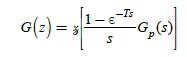
find the conditions of Gp (s) such that the de gain of G(z) is zero. Prove your result.
(c) Normally, a pole at the origin in the s-plane transforms into a pole at z = 1 in the z-plane. The function in the brackets in part (b) has a pole at the origin in the s-plane. Why does this pole not transform into a pole at z = 1?
(d) Find the conditions on G(z) such that its dc gain is unbounded. Prove your result.
(e) For G(z) as given in part (b), find the conditions of Gp (s) such that the dc gain of G(z) is unbounded. Prove your result.
-Ts G(z) = $ 1-6-6, (6) -G (0)| S
Step by Step Solution
3.48 Rating (148 Votes )
There are 3 Steps involved in it
a b c d e dc gain Gz10 Gz has a zero at z 1 de gain GzG s 0G... View full answer

Get step-by-step solutions from verified subject matter experts
 Study Help