







Question: Use recursive least squares to estimate the transfer function for the LTI model given in Example 10-2 using the impulse response data y(k). Verify that
Use recursive least squares to estimate the transfer function for the LTI model given in Example 10-2 using the impulse response data y(k). Verify that the poles of this transfer function match the eigenvalues of the system matrix identified in Example 10.2.
Example 10.2
Consider the following impulse response data for a SISO discrete-time LTI system with
a sampling time of T = 0.01 s. The output is measured at the sampling time instants
t = 0, 0.01, 0.02, c, 0.08, as shown in Fig. 10-2.
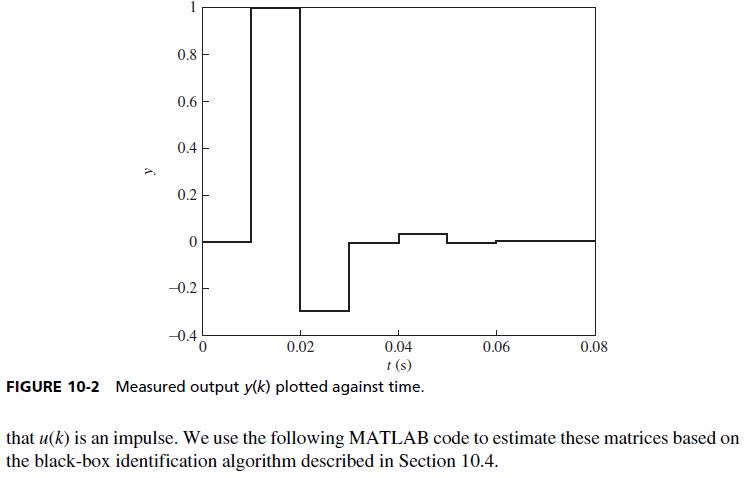
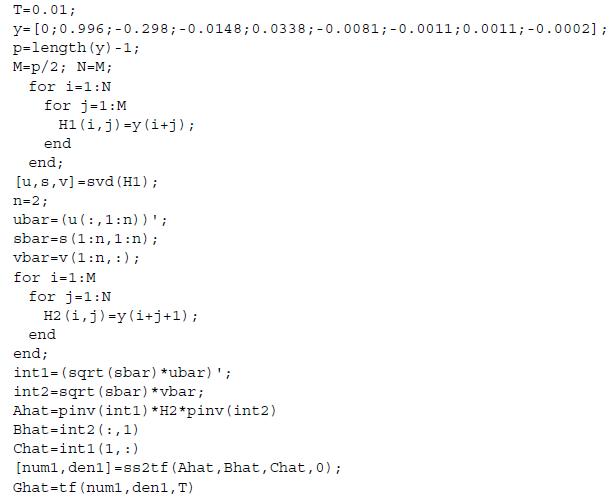
k y(k) 0 0 1 0.996 2 -0.298 3 4 5 6 7 8 -0.0148 0.0338 -0.0081 -0.0011 0.0011 -0.0002 Our objective is to identify a similarity transformation of the system matrices A, B, and C, and the corresponding transfer function, using the given values of y(k) and with the information
Step by Step Solution
3.37 Rating (153 Votes )
There are 3 Steps involved in it

Get step-by-step solutions from verified subject matter experts
 Study Help