







Question: TheilNagar Ï estimate based on d statistic. Theil and Nagar have suggested that, in small samples, instead of estimating Ï as (1 d/2), it should
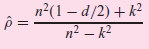
where n = total number of observations, d = Durbin€“Watson d, and k = number of coefficients (including the intercept) to be estimated. Show that for large n, this estimate of Ï is equal to the one obtained by the simpler formula (1 ˆ’ d/2).
n2(1 d/2) + k2 p = n k2 %3D
Step by Step Solution
★★★★★
3.50 Rating (153 Votes )
There are 3 Steps involved in it
1 Expert Approved Answer
Step: 1 Unlock

Dividing the numerator and denominato... View full answer
Question Has Been Solved by an Expert!
Get step-by-step solutions from verified subject matter experts
Step: 2 Unlock
Step: 3 Unlock
Document Format (2 attachments)

1529_605d88e1d4a91_656804.pdf
180 KBs PDF File

1529_605d88e1d4a91_656804.docx
120 KBs Word File
 Study Help