







Question: For the doublet mechanics Flamant solution in Example 15.15, develop contour plots (similar to Fig. 15.22) for the microstresses p 1 and p 2 .
For the doublet mechanics Flamant solution in Example 15.15, develop contour plots (similar to Fig. 15.22) for the microstresses p1 and p2. Are there zones where these microstresses are tensile?
Data from example 15.15
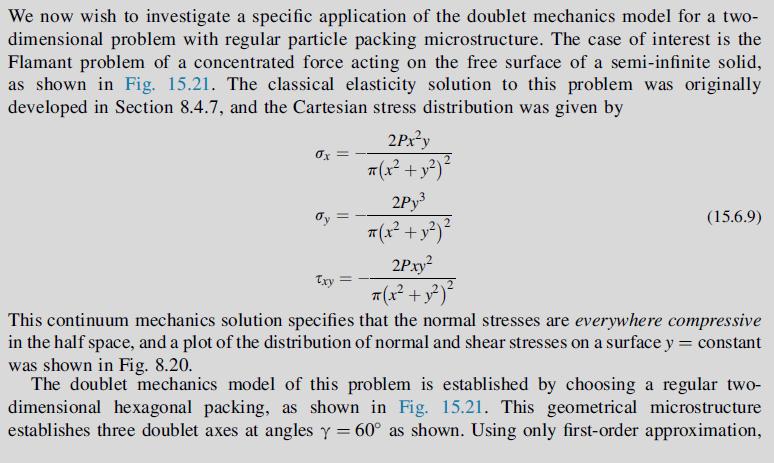
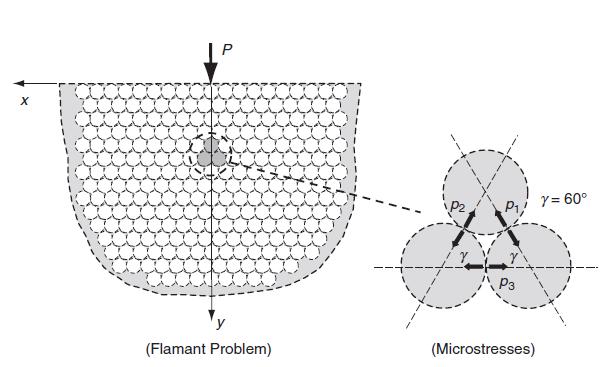
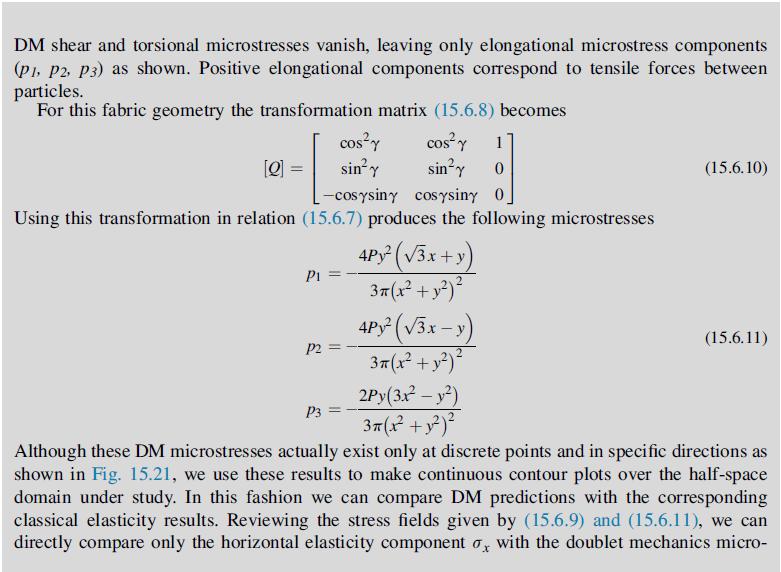
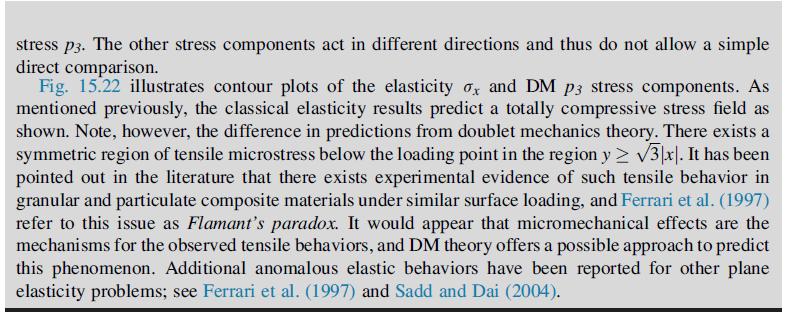
Fig 15.22
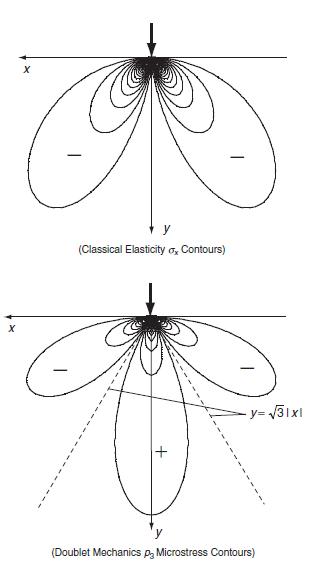
We now wish to investigate a specific application of the doublet mechanics model for a two- dimensional problem with regular particle packing microstructure. The case of interest is the Flamant problem of a concentrated force acting on the free surface of a semi-infinite solid, as shown in Fig. 15.21. The classical elasticity solution to this problem was originally developed in Section 8.4.7, and the Cartesian stress distribution was given by 0x = - dy Txy = 2Pxy (x + y) 2Py3 (x + y) 2Pxy (x +1) (15.6.9) This continuum mechanics solution specifies that the normal stresses are everywhere compressive in the half space, and a plot of the distribution of normal and shear stresses on a surface y constant was shown in Fig. 8.20. The doublet mechanics model of this problem is established by choosing a regular two- dimensional hexagonal packing, as shown in Fig. 15.21. This geometrical microstructure establishes three doublet axes at angles y = 60 as shown. Using only first-order approximation,
Step by Step Solution
3.43 Rating (162 Votes )
There are 3 Steps involved in it
MATLAB Contour Plots of ... View full answer

Get step-by-step solutions from verified subject matter experts
 Study Help