Question: Under the race set up in Section8.1.2, think a scenario when you may have left truncation issue. 8.1.2 Truncation Another issue arising in the analysis
Under the race set up in Section8.1.2, think a scenario when you may have left truncation issue.8.1.2 Truncation Another issue arising in the analysis of time to event

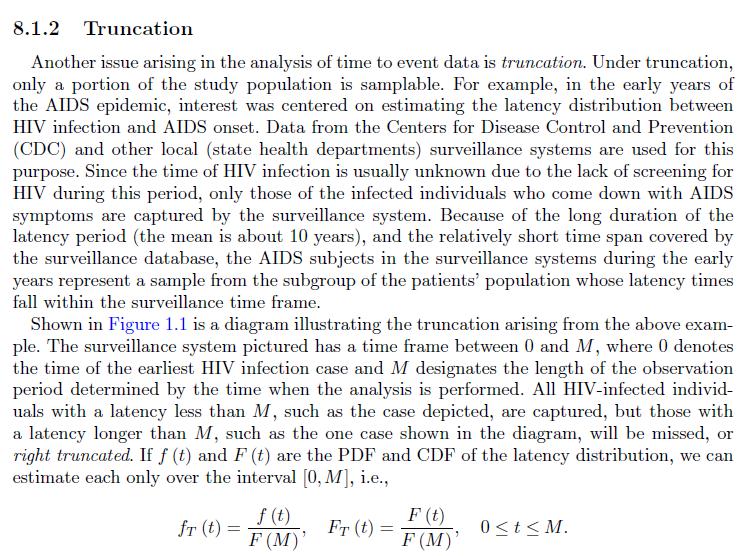
8.1.2 Truncation Another issue arising in the analysis of time to event data is truncation. Under truncation, only a portion of the study population is samplable. For example, in the early years of the AIDS epidemic, interest was centered on estimating the latency distribution between HIV infection and AIDS onset. Data from the Centers for Disease Control and Prevention (CDC) and other local (state health departments) surveillance systems are used for this purpose. Since the time of HIV infection is usually unknown due to the lack of screening for HIV during this period, only those of the infected individuals who come down with AIDS symptoms are captured by the surveillance system. Because of the long duration of the latency period (the mean is about 10 years), and the relatively short time span covered by the surveillance database, the AIDS subjects in the surveillance systems during the early years represent a sample from the subgroup of the patients' population whose latency times fall within the surveillance time frame. Shown in Figure 1.1 is a diagram illustrating the truncation arising from the above exam- ple. The surveillance system pictured has a time frame between 0 and M, where 0 denotes the time of the earliest HIV infection case and M designates the length of the observation period determined by the time when the analysis is performed. All HIV-infected individ- uals with a latency less than M, such as the case depicted, are captured, but those with a latency longer than M, such as the one case shown in the diagram, will be missed, or right truncated. If f (t) and F (t) are the PDF and CDF of the latency distribution, we can estimate each only over the interval [0, M], i.e., fr (t) = f (t) F(M)' FT (t) = = F (t) F(M)' 0

Step by Step Solution

3.41 Rating (164 Votes )

There are 3 Steps involved in it

1 Expert Approved Answer
Step: 1 Unlock

Based on the information in the image you sent and your question about left truncationheres a scenario where left truncation might be an issue in the ... View full answer

blur-text-image
Question Has Been Solved by an Expert!

Get step-by-step solutions from verified subject matter experts

Step: 2 Unlock
Step: 3 Unlock

Students Have Also Explored These Related Elementary Statistics In Social Research Questions!