







Question: Using the correlation coefficient results from Problem 32, calculate the statistical significance of the relationship. Can the null hypothesis be rejected? In other words, does
Using the correlation coefficient results from Problem 32, calculate the statistical significance of the relationship. Can the null hypothesis be rejected? In other words, does this relationship hold true for the population?
Data From Problem 32
It has become common, though potentially inaccurate, to believe that playing classical music to infants can increase their brain development, spatial awareness, and creativity. A child development specialist wants to test whether the exposure to Mozart’s calming compositions does in fact increase childhood neural development. He gathers a sample of 10 children chosen at random and tracks them from infancy through college. When each of his subjects turns 16, he administers an IQ test and then compares the results with the average hours a year the participant was played Mozart’s melodies as an infant. Calculate Pearson’s correlation coefficient and interpret the strength and direction of the results.
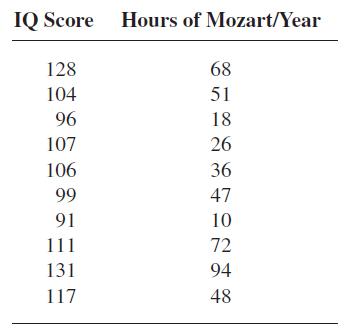
IQ Score 128 104 96 107 106 99 91 111 131 117 Hours of Mozart/Year 68 51 18 26 36 47 10 72 94 48
Step by Step Solution
3.37 Rating (169 Votes )
There are 3 Steps involved in it
Solution I can say that this relationship does exist 06709 I know this because the p is less than ... View full answer

Get step-by-step solutions from verified subject matter experts
 Study Help