New Semester
Started
Get
50% OFF
Study Help!
--h --m --s
Claim Now
Question Answers
Textbooks
Find textbooks, questions and answers
Oops, something went wrong!
Change your search query and then try again
S
Books
FREE
Study Help
Expert Questions
Accounting
General Management
Mathematics
Finance
Organizational Behaviour
Law
Physics
Operating System
Management Leadership
Sociology
Programming
Marketing
Database
Computer Network
Economics
Textbooks Solutions
Accounting
Managerial Accounting
Management Leadership
Cost Accounting
Statistics
Business Law
Corporate Finance
Finance
Economics
Auditing
Tutors
Online Tutors
Find a Tutor
Hire a Tutor
Become a Tutor
AI Tutor
AI Study Planner
NEW
Sell Books
Search
Search
Sign In
Register
study help
engineering
elements of electromagnetics
Elements Of Electromagnetics 7th Edition Matthew Sadiku - Solutions
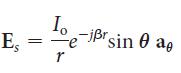
An antenna has a far-field electric field given bywhere Io is the maximum input current. Determine the value of Io to radiate a power of 50 mW. Es || ܘܢ r ,-iPrsin 0 ae
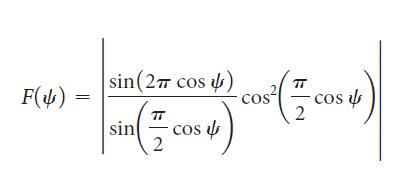
An array of isotropic elements has the group patternUse MATLAB to plot F(Ψ) for 0° < Ψ < 180°. F(4) sin (27 cos) sin cos 2 cos² cas (= cos 4) 2
The field due to an isotropic (or omnidirectional) antenna is given bywhere a is a constant. Determine the radiation resistance of the antenna. Ε = al r
Find the directive gain and directivity of the small loop antenna.
A quarter-wavelength monopole antenna is used at 1.2 MHz for AM transmission.The antenna is vertically placed above a conducting surface. Determine(a) The length of the antenna(b) The radiation resistance(c) The directivity of the antenna
Find the radiation intensity of a small loop antenna.
Determine the fraction of the total power radiated by the elemental (Hertzian) antenna over 0 < θ < 60º.
A telemetry transmitter situated on the moon transmits 120 mW at 200 MHz. The gain of the transmitting antenna is 15 dB. Calculate the gain (in dB) of the receiving antenna (situated on earth) in order to receive 4 nW. Assume that the moon is 238,857 miles away from the earth and that 1 mile =
In a communication system, suppose the transmitting and receiving antennas have gains 25 dB and 20 dB, respectively, and are 42 km apart. Find the minimum power that must be transmitted in order to deliver a minimum of 3 μW. The channel frequency is 3 GHz.
A communication link uses a half-wave dipole antenna for transmission and another half-wave dipole antenna for reception. The link operates at 20 MHz and the two antennas are separated by a distance of 80 km. If the receiving antenna must receive an average power of 0.5 μW, determine the minimum
A monostatic radar operates at 4 GHz and has a directive gain of 30 dB. The radar is used to track a target 10 km away, and the radar cross section of the target is 12 m2. If the antenna of the radar transmits 80 kW, calculate the power intercepted by the target.
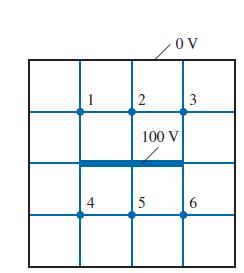
Consider the shielded microstrip problem shown in Figure 14.65. Use the finite difference method to find the potential at points 1 to 6. Five iterations are sufficient. 1 4 2 OV 100 V 5 برا 3 6
A 4 GHz radar antenna with effective area of 2 m2 transmits 60 kW. A target with cross section of 5 m2 is located 160 km away. Calculate: (a) The round trip travel time, (b) The power received, (c) The maximum detectable range, assuming that the minimum detectable power is 8 pW.
It is required to double the range capacity of a radar. What percentage increase in transmitter power is necessary to achieve this?
(a) For an RL filter with L = 50 nH and R = 20 Ω, find the insertion loss in dB at 300 MHz.(b) Repeat part (a) if an RC filter with C = 60 pF and R = 10 kΩ is used instead.
Within a shielded enclosure, the electric field is 6 V/m. It is required that the electric field outside the shield be no more than 20 μV/m. Find the shielding effectiveness in dB.
At the point (1, 2, 0) in an electric field due to coplanar point charges, E = 0.3 ax – 0.4 ay V/m. A differential displacement of 0.05 m on an equipotential line at that point will lead to point(a) (1.04, 2.03, 0) (b) (0.96, 1.97, 0) (c) (1.04, 1.97, 0)(d) (0.96, 2.03, 0)
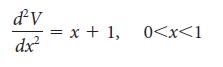
A boundary-value problem is defined bySubject to V(0) = 0 and V(1) = 1. Use the finite difference method to find V(0.5). You may take Δ = 0.25 and perform 5 iterations. Compare your result with the exact solution. d'V dx² x + 1, 0
Use the program developed in Example 14.1 or your own equivalent code to plot the electric field lines and equipotential lines for the following cases:(a) Three point charges of –1 C, 2 C, and 1 C placed at (–1, 0), (0, 2), and (1, 0), respectively.(b) Five identical point charges of 1 C
(a) Obtain dV / dx and d2 V /dx2 at x = 0.15 from the following table.(b) The data in the table are obtained from V = 10 sinh x. Compare your result in part (a) with the exact values. 0.1 V 1.0017 0.25 0.3 0.15 0.2 1.5056 2.0134 2.5261 3.0452
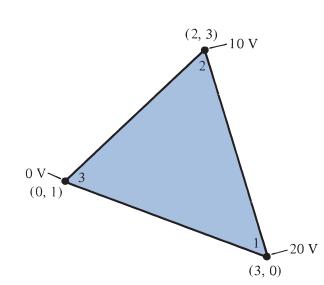
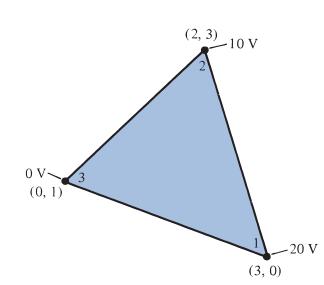
The triangular element of Figure 14.41 is in free space. The approximate value of the potential at the center of the triangle is(a) 10 V(b) 7.5 V (c) 5 V(d) 0 V OV3 (0, 1) (2, 3) -10 V (3, 0) -20 V
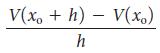
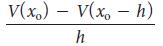
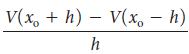
Which of the following is not a correct finite difference approximation to dV/dx at xo if h = Δx?4(a)(b)(c)(d)(e) V(x + h) V(x) h
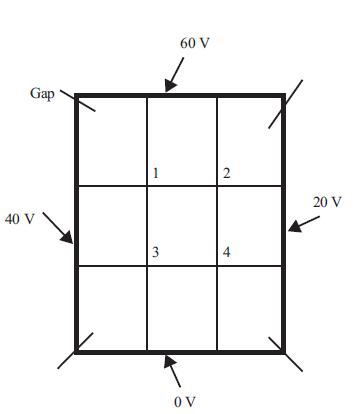
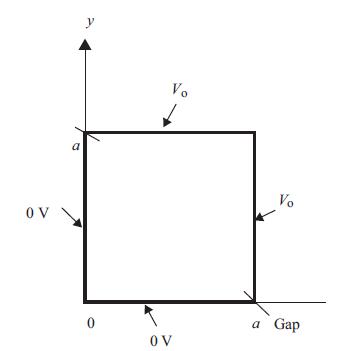
For the potential problem in Figure 14.43, use the finite difference method to determine V1 to V4. Five iterations are enough. Gap 40 V 1 دیا 60 V OV 2 4 20 V
The area of the element in Figure 14.41 is(a) 14(b) 8 (c) 7(d) 4 OV3 (0, 1) (2, 3) -10 V (3, 0) -20 V
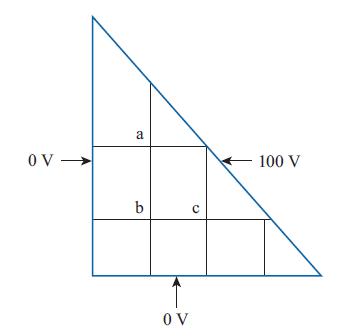
Use the finite difference method to obtain the potential at points a, b, and c in Figure 14.44. Five iterations are enough. OV a b OV с 100 V
For finite difference analysis, a rectangular plate measuring 10 by 20 cm is divided into eight subregions by lines 5 cm apart parallel to the edges of the plates. How many free nodes are there if the edges are connected to some source? (a) 15(b) 12(c) 9(d) 6(e) 3
Using the difference equation Vn = Vn–1 + Vn+1 with Vo = V5 = 1 and starting with initial values Vn = 0 for 1 ≤ n ≤ 4, the value of V2 after the third iteration is(a) 1 (b) 3(c) 9 (d) 15(e) 25
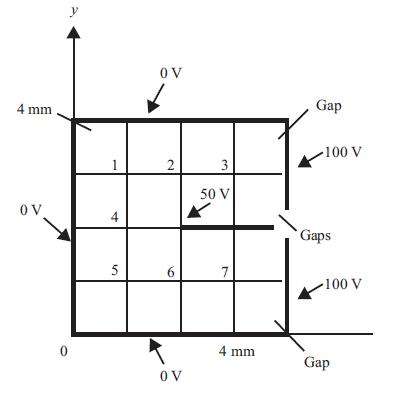
Use the finite difference method to find the potentials at nodes 1 to 7 in the grid shown in Figure 14.49. 4 mm OV y 0 1 4 5 OV ↑ 2 6 OV 3 50 V 7 4 mm Gap -100 V Gaps -100 V Gap
The cross section of a long conducting pipe is shown in Figure 14.45. For the indicated boundary conditions:(a) Find the potential distribution V(x, y) by solving Laplace’s equation.(b) Find the potential at the center of the region using the finite difference method. Take a = 1 m and Vo =
The four sides of a square trough are maintained at potentials 10 V, – 40 V, 50 V, and 80 V. Determine the potential at the center of the trough.
The coefficient matrix [A] obtained in the moment method does not have one of these properties:(a) It is dense (i.e., has many nonzero terms).(b) It is banded.(c) It is square and symmetric.(d) It depends on the geometry of the given problem.
For the rectangular region shown in Figure 14.46, the electric potential is zero on the boundaries and the charge distribution ρv is 50 nC/m3. Although there are six free nodes, there are only four unknown potentials (V1 – V4) because of symmetry. Solve for the unknown potentials.
A major difference between the finite difference and the finite element methods is that(a) Using one, a sparse matrix results in the solution.(b) In one, the solution is known at all points in the domain.(c) One applies to solving partial differential equation.(d) One is limited to time-invariant
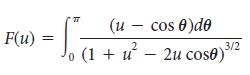
The electric field due to a circular loop placed at the origin with charge r per unit length at a distance x from origin is given bywhereand u = x/a. Use MATLAB to plot F(u) for 0 < u < 2. Ex k Р 2 2πea (u - cos 0) de (1+² - 2u cose)³ 3/2 0 P Υπερα - F(u)
If the plate of Review Question 14.4 is to be discretized for finite element analysis such that we have the same number of grid points, how many triangular elements are there?(a) 32(b) 16(c) 12 (d) 9
Which of these statements is not true about shape functions?(a) They are interpolatory in nature.(b) They must be continuous across the elements.(c) Their sum is identically equal to unity at every point within the element.(d) The shape function associated with a given node vanishes at any other
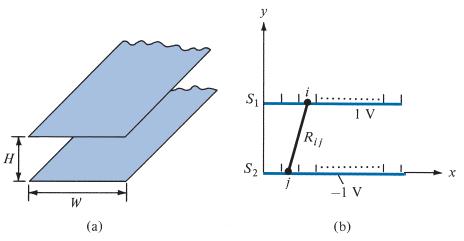
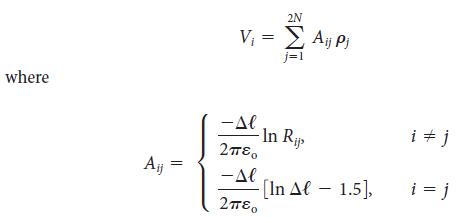
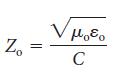
Given an infinitely long thin strip transmission line shown in Figure 14.52(a), use the moment method to determine the characteristic impedance of the line. We divide each strip into N subareas as in Figure 14.52(b) so that on subarea i,Rij is the distance between the ith and jth subareas, and Vi =
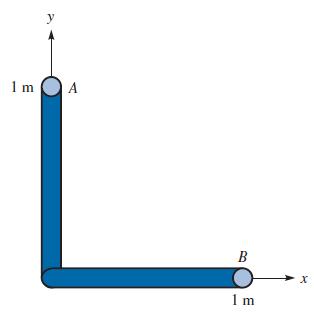
Consider an L-shaped thin wire of radius 1 mm as shown in Figure 14.53. If the wire is held at a potential V = 10 V, use the method of moments to find the charge distribution on the wire. Take Δ = 0.1. 1 m y A B 1 m X
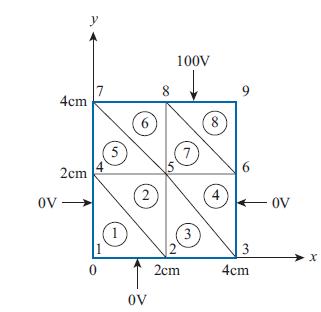
Use the MATLAB code in Figure 14.33 to determine the potentials at node 5 of the system shown in Figure 14.63. y 4cm 2cm OV- 17 0 5 2 OV 100V 2cm 3 8 3 4cm OV X
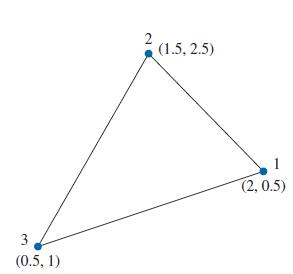
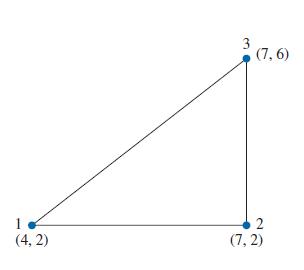
Determine the element coefficient matrices of the triangular elements in Figure 14.57.(a)(b) 3 (0.5, 1) (1.5, 2.5) (2, 0.5)
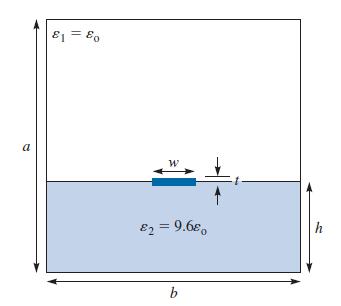
Determine the characteristic impedance of the microstrip line shown in Figure 14.67.Take a = 2.02, b = 7.0, h = 1.0 = w, t = 0.01. h b °39'6 = ¹3 M º3 = ¹3 D
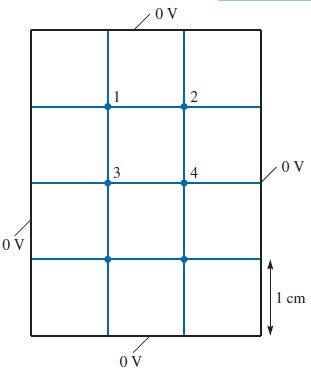
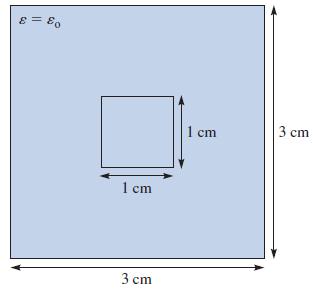
The cross section of a transmission line is shown in Figure 14.68. Use the finite difference method to compute the characteristic impedance of the line. 8 = 80 1 cm 3 cm 1 cm 3 cm
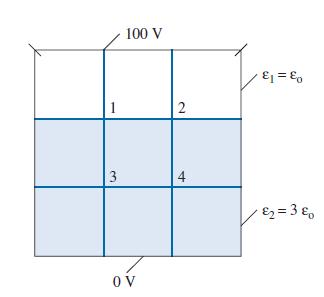
Refer to the square mesh in Figure 14.66. By setting the potential values at the free nodes equal to zero, find (by hand calculation) the potentials at nodes 1 to 4 for five or more iterations. 1 3 برا 100 V OV 2 4 / £1 = Eo E = 3 E
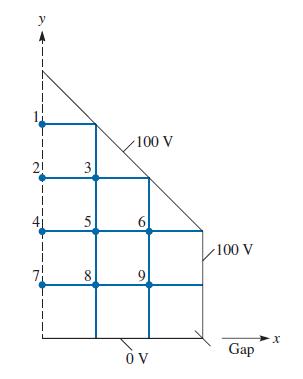
Half a solution region is shown in Figure 14.69 so that the y-axis is a line of symmetry. Use finite difference to find the potential at nodes 1 to 9. Five iterations are sufficient if you use an iterative method. y 25 3 5 8 100 V 6 9 OV -100 V Gap X
Show that when a square mesh is used in the finite difference method, we obtain the same result in the finite element method when the squares are cut into triangles.
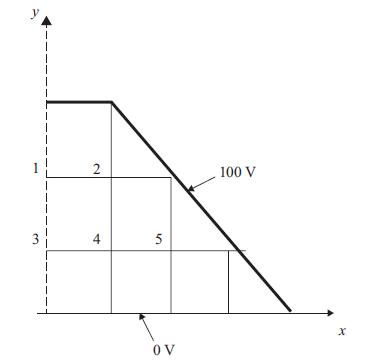
The potential system in Figure 14.70 is symmetric about the y-axis. Set the initial values at the free nodes equal to zero and calculate the potentials at nodes 1 to 5 for five iterations. 2 4 5 OV 100 V
A 1 mC charge with velocity 10ax – 2ay + 6az m/s enters a region where the magnetic flux density is 25az Wb/m2.(a) Calculate the force on the charge.(b) Determine the electric field intensity necessary to make the velocity of the charge constant.
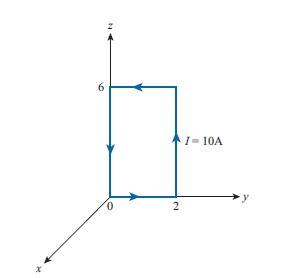
A rectangular loop shown in Figure 8.38 carries current I = 10 A and is situated in the field B = 4.5(ay – az) Wb/m2. Find the torque on the loop. X 6 N 0 2 I= 10A
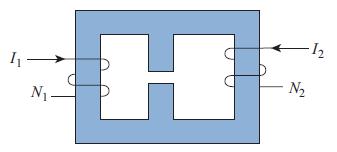
For the magnetic circuit shown in Figure 8.44, draw the equivalent electric circuit. Assume that all the sections have constant cross-sectional areas. ₁- N₁ H -12 N₂
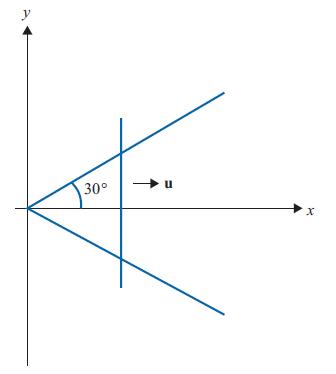
Determine the induced emf in the V-shaped loop of Figure 9.25. Take B = 0.6xaz Wb/m2 and u = 5ax m/s. Assume that the sliding rod starts at the origin when t = 0. y 30° u X
In a source-free region, H = Ho cos(wt – βz)ax A/m. Find the displacement current density.
An ac voltage source is connected across the plates of a parallel-plate capacitor so that E = 25sin(103t)az V/m. Calculate the total current crossing a 2 x 5 m area placed perpendicular to the electric field. Assume that the capacitor is air filled.
Show that fieldsdo not satisfy all of Maxwell’s equations. E = E, cos x cos ta, and H= E -sin x sin ta po
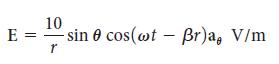
The electric field intensity of a spherical wave in free space is given byFind the corresponding magnetic field intensity H. 10 E = sin cos(wt - Br)a, V/m r
In a certain region for which σ = 0, μ = 2o, and ε = 10εo J = 60 sin(109t – βz)ax mA/m2(a) Find D and H.(b) Determine β.
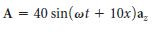
Check whether the following fields are genuine EM fields (i.e., they satisfy Maxwell’s equations). Assume that the fields exist in charge-free regions.(a)(b)(c)(d) A = 40 sin(at + 10x)a
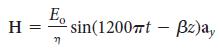
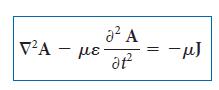
An AM radio signal propagating in free space has E = Eo sin(1200πt – βz)axDetermine β and ηsatisfies the wave equation in eq. (9.52). Find the corresponding V. Take c as the speed of light in free space. E H = sin(1200πt - Bz)ay 27
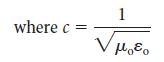
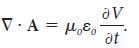
In free space, the retarded potentials are given by V = x(z – ct)V, A = x(z/c – t)az Wb/m(a) Prove that (b) Determine E. where c = 1 Vμ Hoo
Let A = Ao sin(ωt – βz)ax Wb/m in free space. (a) Find V and E. (b) Express β in terms of ω, εo, and μo.
Determine the phasor forms of the following instantaneous vector fields:(a) H = –10cos(106t + π/3)ax(b) E = 4cos(4y)cos(104t – 2x)az(c) D = 5sin(104t + π/3)ax – 8cos(104t – π/4)ay
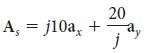
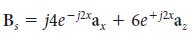
Find the instantaneous form for each of the following phasors:(a)(b)(c) A, = j10a, + 20 j ay
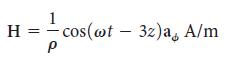
In a source-free vacuum region,(a) Express H in phasor form.(b) Find the associated E field.(c) Determine ω. H = -cos(wt 32)a, A/m P
A current element of length L carries current I in the z direction. Show that at a very distant point, Find B. A HIL 4πr a
Prove in cylindrical coordinates that(a) ∇ x 1 (∇V) = 0(b) ∇ · (∇ x A) = 0
In a hydrogen atom, an electron revolves at velocity 2.2 x 10⁶ m/s. Calculate the magnetic flux density at the center of the electron’s orbit. Assume that the radius of the orbit is R = 5.3 x 10⁻¹¹m.
In free space, the magnetic flux density is B = y2 ax + z2ay + x2az Wb/m2(a) Show that B is a magnetic field(b) Find the magnetic flux through x = 1, 0 < y < 1, 1 < z < 4.(c) Calculate J.(d) Determine the total magnetic flux through the surface of a cube defined by 0 < x
Let H = y2 ax + x2ay A/m. (a) Find J. (b) Determine the current through the strip z = 1, 0 < x < 2, 1 < y < 5.
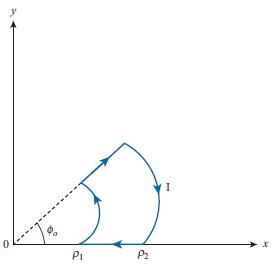
Figure 7.34 shows a portion of a circular loop. Find H at the origin. go P₁ P₂ I
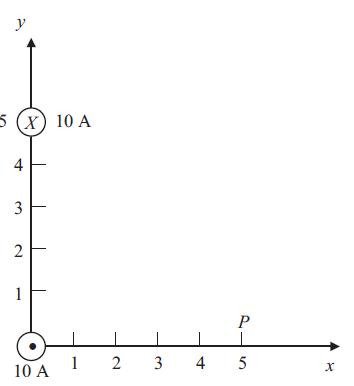
Two infinitely long wires, placed parallel to the z-axis, carry currents 10 A in opposite directions as shown in Figure 7.28. Find H at point P. y 5 (X) 10 A 4 3 نیا 2 1 10 A 1 2 3 4 P 5 X
A square conducting loop of side 4 cm lies on the z = 0 plane and is centered at the origin. If it carries a current 5 mA in the counterclockwise direction, find H at the center of the loop.
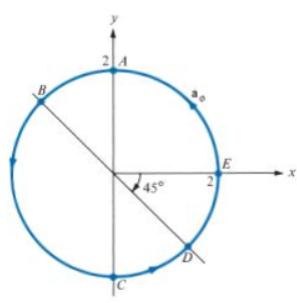
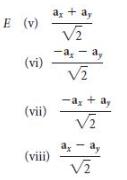
Consider points A, B, C, D, and E on a circle of radius 2 as shown in Figure 7.25. The items in the right-hand list are the values of af at different points on the circle. Match these items with the points in the list on the left.(a) A (i) ax(b) B (ii)–ax(c) C (iii) ay(d) D (iv) –ay(e)
A long, straight wire carries current 2A. Calculate the distance from the wire when the magnetic field strength is 10 mA/m.
If A = 2xax – z2ay + 3xyaz, find the flux of A through a surface defined by ρ = 2, 0 < Φ < π/2, 0 < z < 1.
Determine the unit vector along the direction OP, where O is the origin and P is point (4, –5, 1).
Points A(4, –6, 2), B(–2, 0, 3), and C(10, 1, –7) form a triangle. Show that rAB + rBC + rCA = 0.
If A = 4ax – 2ay + 6az and B = 12ax + 18ay – 8az, determine:(a) A – 3B(b) (2A + 5B) /|B|(c) ax X A(d) (B X ax ) ∙ ay
Let A = 4ax + 2ay – az and B = αax + βay + 3az(a) If A and B are parallel, find α and β(b) If A and B are perpendicular, find α and β
Let A = 20ax + 15ay – 10az and B = ax + ay. Find: (a) A ∙ B, (b) A X B, (c) The component of A along B.
The cylindrical coordinates of point Q are ρ = 5, Φ = 120°, z = 1. Express Q as rectangular and spherical coordinates.
One of the following is not a source of magnetostatic fields:(a) A dc current in a wire(b) A permanent magnet(c) An accelerated charge(d) An electric field linearly changing with time(e) A charged disk rotating at uniform speed
Identify the statement that is not true of ferromagnetic materials.(a) They have a large xm.(b) They have a fixed value of μr.(c) Energy loss is proportional to the area of the hysteresis loop.(d) They lose their nonlinearity property above the curie temperature.
Given that H = 0.5 e–0.1x sin(106t – 2x)az A/m, which of these statements are incorrect?(a) α = 0.1 Np/m(b) β = –2 rad/m(c) ω = 106 rad/s(d) The wave travels along ax.(e) The wave is polarized in the z-direction.(f) The period of the wave is 1 μs.
What is the major factor for determining whether a medium is free space, a lossless dielectric, a lossy dielectric, or a good conductor?(a) Attenuation constant(b) Constitutive parameters (σ, ε, μ)(c) Loss tangent(d) Reflection coefficient
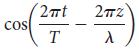
Which of these is not a correct form of the wave Ex = cos(ωt –βz)?(a) cos(βz – ωt)(b) sin(βz – ωt – π/2)(c)(d) Re(ej(ωt – βz))(e) cos β(z – ut) COS 2πt T 2772 A λ
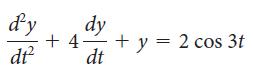
Given thatSolve for y by using phasors. d'y dy +4 + y = 2 cos 3t dt² dt
The electric field component of a wave in free space is given by E = 10 cos(107t + kz)ay V/m. It can be inferred that(a) The wave propagates along ay.(b) The wavelength λ = 188.5 m.(c) The wave amplitude is 10 V/m.(d) The wave number k = 0.33 rad/m.(e) The wave attenuates as it travels.
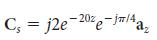
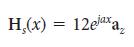
The magnetic phasor of a plane wave propagating in air isDetermine α and Es(x). Assume ω = 109 rad/s. H₂(x) = 12e¹axa₂
Which of the following statements is not true of waves in general?(a) The phenomenon may be a function of time only.(b) The phenomenon may be sinusoidal or cosinusoidal.(c) The phenomenon must be a function of time and space.(d) For practical reasons, it must be finite in extent.
Calculate the wavelength for plane waves in vacuum at the following frequencies:(a) 60 Hz (power line)(b) 2 MHz (AM radio)(c) 120 MHz (FM radio)(d) 2.4 GHz (microwave oven)
Which of these functions does not satisfy the wave equation?(a) 50ejω(t – 3z)(b) sin ω(10z + 5t)(c) (x + 2t)(d) cos2 (y + 5t)(e) sin x cos t(f) cos(5y + 2x)
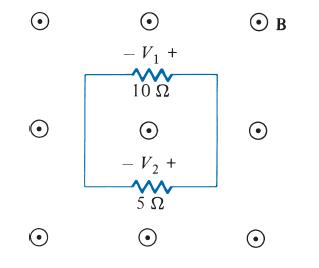
A rectangular loop is placed in the time-varying magnetic field B = 0.2 cos150 πtaz Wb/m2 as shown in Figure 9.19. V1 is not equal to V2.(a) True (b) False O O - V₁ + 10 Ω O - V₂ + www 552 B
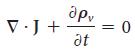
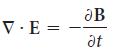
Identify which of the following expressions are not Maxwell’s equations for time varying fields:(a)(b)(c)(d)(e) V.J+ дру at = 0
An airplane with a metallic wing of span 36 m flies at 410 m/s in a region where the vertical component of the earth’s magnetic field is 0.4 μWb/m2. Find the emf induced on the airplane wing.
A dielectric material with μ = μo, ε = 9εo σ = 4 S/m is placed between the plates of a parallel-plate capacitor. Calculate the frequency at which the conduction and displacement currents are equal.
Which of the following statements is not true of a phasor?(a) It may be a scalar or a vector.(b) It is a time-dependent quantity.(c) A phasor Vs may be represented as .(d) It is a complex quantity. Voor Voe where V₁ = |V₂|.
In seawater (σ = 4 S/m, ε = 81εo μ = μo), find the ratio of the conduction to the displacement currents at 10 MHz.
Assume that dry soil has σ = 10–4 S/m, ε = 3εo, and μ = μo. Determine the frequency at which the ratio of the magnitudes of the conduction current density and the displacement current density is unity.
An EM field is said to be nonexistent or not Maxwellian if it fails to satisfy Maxwell’s equations and the wave equations derived from them. Which of the following fields in free space are not Maxwellian?(a) H = cos x cos 106t ay(b) E = 100 cos ωt ax(c) De 10 sin(10³t - 10y) a
In a dielectric (σ = 10–4 S/m, μr = 1, εr = 4.5), the conduction current density is given as Jc = 0.4 cos (2π x 108 t) A/m2. Determine the displacement current density.
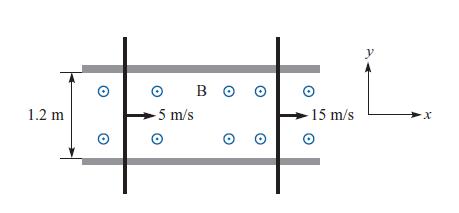
Two conducting bars slide over two stationary rails, as illustrated in Figure 9.22. If B = 0.2az Wb/m2, determine the induced emf in the loop thus formed. 1.2 m O -5 m/s О BO О О О 15 m/s О y -X
Showing 200 - 300
of 669
1
2
3
4
5
6
7
Step by Step Answers

 Get 50% OFF
Claim Now
Get 50% OFF
Claim Now