New Semester
Started
Get
50% OFF
Study Help!
--h --m --s
Claim Now
Question Answers
Textbooks
Find textbooks, questions and answers
Oops, something went wrong!
Change your search query and then try again
S
Books
FREE
Study Help
Expert Questions
Accounting
General Management
Mathematics
Finance
Organizational Behaviour
Law
Physics
Operating System
Management Leadership
Sociology
Programming
Marketing
Database
Computer Network
Economics
Textbooks Solutions
Accounting
Managerial Accounting
Management Leadership
Cost Accounting
Statistics
Business Law
Corporate Finance
Finance
Economics
Auditing
Tutors
Online Tutors
Find a Tutor
Hire a Tutor
Become a Tutor
AI Tutor
AI Study Planner
NEW
Sell Books
Search
Search
Sign In
Register
study help
engineering
elements of electromagnetics
Elements Of Electromagnetics 7th Edition Matthew Sadiku - Solutions
Equation ∇ · (–ε∇V) = ρv may be regarded as Poisson’s equation for an inhomogeneous medium.(a) True (b) False
If ∇ · D = ε∇ · E and ∇ · J = σ∇ · E in a given material, the material is said to be(a) Linear(b) Homogeneous(c) Isotropic (d) Linear and homogeneous(e) Linear and isotropic(f) Isotropic and homogeneous
Conducting sheets are located at y = 1 and y = 3 planes. The space between them is distributionn C/m3 and ε = 4 ε0. Assuming that V(y = 1) = 0 and V(y = 3) = 50 V, find V(y = 2). Pv y 477
Two potential functions V1 and V2 satisfy Laplace’s equation within a closed region and assume the same values on its surface. V1 must be equal to V2.(a) True (b) False(c) Not necessarily
In free space, V = 10ρ0.8 V. Find E and the volume charge density at ρ = 0.6 cm.
Which of the following is not true?(a) –5 cos 3x is a solution to Φ" (x) + 9 Φ(x) = 0(b) 10 sin 2x is a solution to Φ" (x) – 4 Φ(x) = 0(c) –4 cosh 3y is a solution to R" (y) – 9R(y) = 0(d) sinh 2y is a solution to R" (y) – 4R(y) = 0(e) g" (x) g(x) h" (y) h(y) = f(z) = -1 where
Which of the following potentials does not satisfy Laplace’s equation?(a) V = 2x + 5 (b) V + 10 xy(c) V + r cos Φ(d) V + 10 / r(e) V = ρ cos Φ + 10
Two large flat metal sheets are located at z = 0 and z = d and are maintained at 0 and Vo, respectively. The charge density between the sheets is ρv(z) = ρoz/d, where ρo is a constant. Determine the potential at all points between the plates.
If V1 = X1Y1 is a product solution of Laplace’s equation, which of these are not solutions of Laplace’s equation?(a) –10X1Y1(b) X1Y1 +2xy(c) X1 Y1 – x + y(d) X1 + Y1(e) (X1 –2) (Y1 + 3)
The capacitance of a capacitor filled by a linear dielectric is independent of the charge on the plates and the potential difference between the plates.(a) True (b) False
In cylindrical coordinates, V = 0 at ρ = 2 m and V = 60 V at ρ = 5 m due to charge distribution ρv = 10/ρ pC/m3. If εr = 3.6, find E.
A potential difference Vo is applied to a mercury column in a cylindrical container. The mercury is now poured into another cylindrical container of half the radius and the same potential difference Vo applied across the ends. As a result of this change of space, the resistance will be
A parallel-plate capacitor connected to a battery stores twice as much charge with a given dielectric as it does with air as dielectric. The susceptibility of the dielectric is(a) 0(b) 1(c) 2(d) 3(e) 4
The region between two cylinders ρ = a and ρ = b has charge density ro. Determine the potential distribution V.
The dielectric region (ε = 6εo) between a pair of concentric spheres ρ = 1 and ρ = 4 has charge distribution ρv = 10 / r nC/m3. If V(r = 1) = 0 and V(r = 4) = 50 V, determine V(r = 2).
Two conducting plates are inclined at an angle 30° to each other with a point charge between them. The number of image charges is(a) 12(b) 11(c) 6(e) 3(d) 5
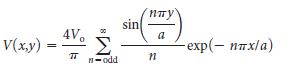
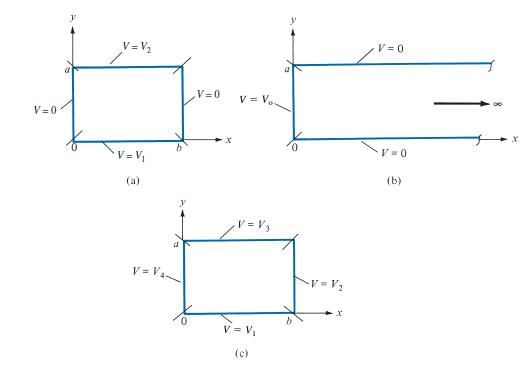
A conducting strip is defined as shown in Figure 6.35(b). The potential distribution is Find the electric field E. V(x,y) = 4Vo π Σ n-odd sin μπν a n -exp(- Μπχ/a)
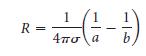
A spherical shell has inner and outer radii a and b, respectively. Assume that the shell has a uniform conductivity and that it has copper electrodes plated on the inner and outer surfaces. Show that the leakage conductance between the electrode and earth is 2πaσ. 1 - ( - ) Απο b R =
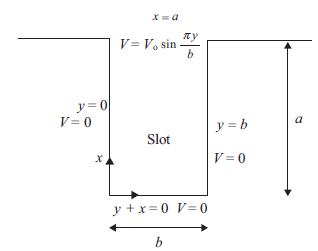
Figure 6.36 shows the cross-sectional view of an infinitely long rectangular slot. Find the potential distribution in the slot. y=0 V=0 X x = a V = V₁ sin Slot ny b y + x = 0 V = 0 b y = b V=0 a
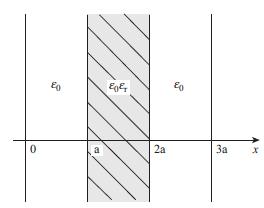
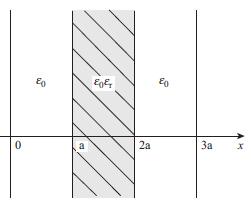
A capacitor consists of two infinitely large plates of area A and 3a apart as shown in Figure 6.39. If a dielectric slab of thickness a is located midway between the plates, determine the capacitance. 0 ६० ६०६ 2a ६० 3a x
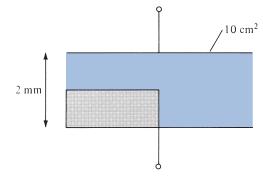
The parallel-plate capacitor of Figure 6.40 is quarter-filled with mica (εr = 6). Find the capacitance of the capacitor. 2 mm 10 cm²
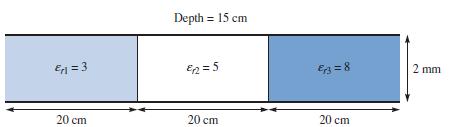
Calculate the capacitance of the parallel-plate capacitor shown in Figure 6.38. Erl=3 20 cm Depth = 15 cm &12=5 20 cm €73 = 8 20 cm 2 mm
A cylindrical capacitor has inner radius a and outer radius b. The region between the cylinders has conductivity σ. Determine the conductance per unit length of the capacitor.
A coaxial cable with inner radius a and outer radius b has a steady-state voltage V across it. Determine the power loss per unit length. Assume that the conductivity of the region between the cylinders is σ.
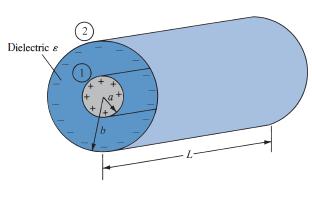
The coaxial cable in Figure 6.14 has two dielectrics with εr1 for a < ρ < c and εr2 for c < r < b where a < c < b. Determine the capacitance of the system. Dielectric e 2
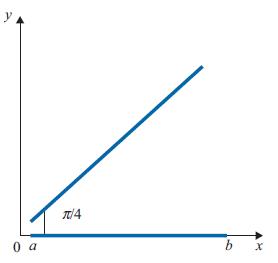
A capacitor consists of two plates with equal width (b – a), and a length L in the z-direction. The plates are separated by Φ = π/4, as shown in Figure 6.43. Assume that the plates are separated by a dielectric material (ε = εoεr) and ignore fringing. Determine the capacitance. 0 a TT/4 b X
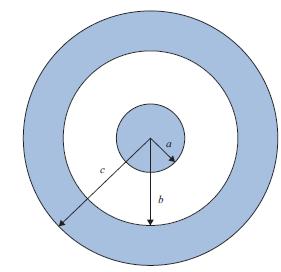
Determine the capacitance of a conducting sphere surrounded by a thick spherical shell as shown in Figure 6.42. O
To appreciate the physical size of 1 F capacitor, consider a parallel-plate capacitor filled with air and with separation distance of 1 mm. Find the area of the plates to provide a capacitance of 1 F.
The capacitance of a parallel-plate capacitor is 56 μF when the dielectric material is in place. The capacitance drops to 32 μF when the dielectric material is removed. Calculate the dielectric constant εr of the material.
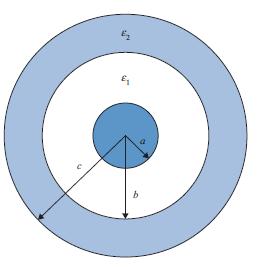
The cross section of a cable is shown in Figure 6.45. Determine the capacitance per unit length. %2 O b
A parallel-plate capacitor has a 4 mm plate separation, 0.5 m2 surface area per plate, and a dielectric with εr = 6.8. If the plates are maintained at 9 V potential difference, calculate(a) The capacitance, (b) The charge density on each plate.
A parallel-plate capacitor remains connected to a voltage source while the separation between the plates changes from d to 3d. Express new values of C, Q, E, and W in terms of the old values C0, Q0, E0, and W0.
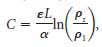
A segment of the cylindrical capacitor is defined by ρ1 < ρ < ρ2, 0 < Φ < α. If V(Φ = 0) = 0 and V(Φ = α) = Vo, show that the capacitance of the segment is where L is the length and ε is the permittivity of the dielectric. C = EL α In el P₁/
A parallel-plate capacitor has plate area 40 cm2. The dielectric has two layers with permittivity ε1 = 4εo and ε2 = 6εo, and each layer is 2 mm thick. If the capacitor is connecte to a voltage 12 V, calculate: (a) The capacitance of the capacitor, (b) The total charge on
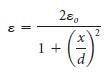
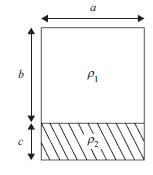
Two parallel conducting plates are located at x = d and x = –d. The plate at x = –d is held at Vo, while the plate at x = –d is grounded. If the space between the plates is filled with an inhomogeneous dielectric medium with find the capacitance. Assume that each plate has an area S. ε
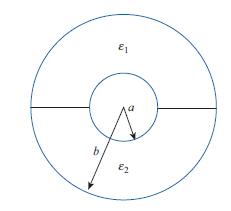
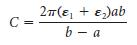
One half of the dielectric region of a spherical capacitor has permittivity ε1 while the other half has ε2 as shown in Figure 6.46. Show that the capacitance of the system is given by b E1 82
A coaxial cable has inner radius of 5 mm and outer radius of 8 mm. If the cable is 3 km long, calculate its capacitance. Assume ε = 2.5εo.
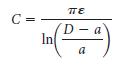
A two-wire transmission line is formed with two identical wires which are widely separated. If the radius of each wire is a and the center-to-center spacing is D, the approximate formula for the capacitance per unit length iswhere D >> a. For ε = 4 εo and D/a = 12, calculate C. C
A spherical capacitor has inner radius of a = 2 cm and outer radius of b = 4 cm. The interior is a dielectric material with εo εr . The outer conductor is grounded while the inner one is maintained at 100 V. (a) Determine εr if the surface charge density on the inner conductor is
If the earth is regarded as a spherical capacitor, what is its capacitance?Assume the radius of the earth to be approximately 6370 km.
A capacitor is formed by two coaxial metal cylinders of radii a = 1 mm and b = 5 mm. If the space between the cylinders is filled with a dielectric having εr = 3 (1 + ρ), a < ρ < b, and ρ is in millimeters, determine the capacitance per meter.
Given vectors A = 2ax + 4ay + 10az and B = 25aρ+ aΦ – 3az, find(a) A + B at P(0, 2, –5)(b) The angle between A and B at P(c) The scalar component of A along B at P
Find the length of a path from P1(4, 0°, 0) to P2(4, 30°,0).
Let V(x, y, z) = 4xyez. Find the maximum rate of change of V at (3, 1, –2) and the direction in which it occurs.
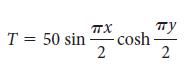
The heat flow vector H = k ∇ T, where T is the temperature and k is the thermal conductivity. Show that if then π.Χ. T Τ = 50 sin " cosh- 2 пу 2
Let H = 4r2aρ – zaz. Verify the divergence theorem for the cylindrical region defined by ρ = 10, 0 < Φ < 2π, 0 < z < 3.
Apply the divergence theorem to evaluate where A = x2ax + y2ay + z2az and S is the surface of the solid bounded by the cylinder ρ = 1 and planes z = 2 and z = 4. A. ds, Js
Verify the divergence theorem for the function A = r2ar + r sin θ cos Φ aθ over the surface of a quarter of a hemisphere defined by 0 < r < 3, 0 < Φ < π/2, 0, θ, π/2.
A cube with 2 m sides (0 < x, y, z < 2 m) carries a charge with density ρv = 12xyz mC/m3.(a) Calculate the total charge. (b) Find the total outward flux from the cube.
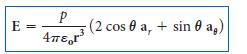
A z-directed dipole has E in eq. (4.82). Determine the values of θ that will make E have no z-component. E = P 4πer³ (2 cos 0 a, sin 0 a.)
Which is not an example of convection current?(a) A moving charged belt(b) Electronic movement in a vacuum tube(c) An electron beam in a television tube(d) Electric current flowing in a copper wire
Let the current density be J = e–x cos 4 yax + e–x sin 4 yay A/m2. Determine the current crossing the surface x = 2, 0 < y < π/3, 0 < z < 4.
What happens when a steady potential difference is applied across the ends of a conducting wire?(a) All electrons move with a constant velocity.(b) All electrons move with a constant acceleration.(c) The random electronic motion will, on the average, be equivalent to a constant velocity of each
The formula R = ℓ /(σS) is for thin wires.(a) True (b) False(c) Not necessarily
Given that J = 10 / ρ sin Φ aρ A/m2, determine the current flowing through the surface ρ = 2, 0 < Φ < π, 0 < z < 5 m.
Seawater has εr = 80. Its permittivity is(a) 81(b) 79(c) 5.162 × 10⁻¹⁰ F/m(d) 7.074 × 10⁻¹⁰ F/m
In a cylindrical conductor of radius 4 mm, the current density is J = 5e–10ρaz A/m2. Find the current through the conductor.
Both εo and Xe are dimensionless.(a) True (b) False
A 1 MΩ resistor is formed by a cylinder of graphite–clay mixture having a length of 2 cm and a radius of 4 mm. Determine the conductivity of the resistor.
A dielectric material is linear if D = εE holds, that is, if ε is independent of E. It is homogeneous if ε is independent of position. It is isotropic if ε is a scalar.
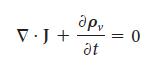
The principle of charge conservation, the basis of Kirchhoff’s current law, is stated in the continuity equation V.J+ дру at = 0
A conducting wire is 2 mm in radius and 100 m in length. When a dc voltage of 9 V is applied to the wire, it results in a current of 0.3 A. Find: (a) The E-field in the wire,(b) The conductivity of the wire.
The cross section of a conductor made with two materials with resistivities ρ1 and ρ2 is shown in Figure 5.19. Find the resistance of length ℓ of the conductor. b a P₁ P₂
A 12 V voltage is applied across the ends of a silver wire of length 12.4 m and radius 0.84 mm. Determine the current through the wire.
A 10 mC point charge is embedded in wood, which has ε = 4.0. Assuming that the charge is located at the origin, find P at r = 1 m.
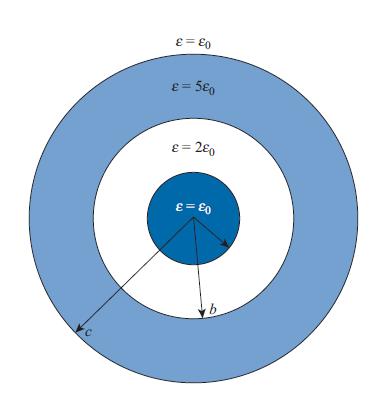
Concentric spheres r = a, r = b, and r = c have charges 4 C, –6 C, and 10 C, respectively, placed on them. If the regions separating them are filled with different dielectrics as shown in Figure 5.20, find E, D, and P everywhere. ε = 80 € = 5€0 ε = 280 ε = £0 b
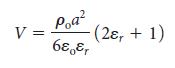
A solid sphere of radius a and dielectric constant εr has a uniform volume charge density of ρo.(a) At the center of the sphere, show that(b) Find the potential at the surface of the sphere. V = P₁a² 680&r (2ɛ, + 1)
In a certain dielectric for which εr = 3.5, given that P = 100 /ρaρ nC/m2, find E and D at ρ = 2 m.
A cylindrical slab has a polarization given by P = ρo ρaρ. Find the polarization charge density ρpv inside the slab and its surface charge densityρρs.
A spherical shell has r = 1.2 cm and r = 2.6 cm as inner and outer radii, respectively. If P = 4rar pC/m2, determine (a) The total bound surface charge on the inner surface, (b) The total bound surface charge on the outer surface (c) The total bound volume charge.
In a slab of Teflon (ε = 2.1 εo), E = 6ax + 12ay – 20az V/m, find D and P.
The potential distribution in a dielectric material (e = 8 εo) is V = 4x2yz3 V. Find V, E, and P at point (–2, 5, 3).
Two point charges in free space are separated by distance d and exert a force 2.6 nN on each other. The force becomes 1.5 nN when the free space is replaced by a homogeneous dielectric material. Calculate the dielectric constant of the material.
If J = e–2y sin 2xax + e–2y cos 2xay + zaz A/m2, find the rate of change of the electric charge density.
If J = 100 / ρ2 aρ A/m2, find (a) The time rate of increase in the volume charge density, (b) The total current passing through surface defined by ρ = 2, 0 < z < 1, 0 < Φ < 2π.
An excess charge placed within a conducting medium becomes one-half of its initial value in 80 μs. Calculate the conductivity of the medium and the relaxation time. Assume that its dielectric constant is 7.5.
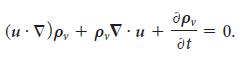
Let ρv be the volume charge density of charges in motion. If u is their velocity, show that (u. V)p, + p,V. u + дру ät = = 0.
The current density is given by J = 0.5 sin πaxx A/m2. Determine the time rate of increase of the charge density (i.e., δρv/δt) at point (2, 4, –3).
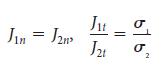
Show that the normal and tangential components of the current density J at the interface between two media with conductivities s1 and s2 satisfy Jin = J2n, J₁t ото N
Region 1 is x < 0 with, ε1 = 4εo, while region 2 is x > 0 with ε = 2εo. If E2 = 6ax – 10ay + 8az V/m, (a) Find P1, and P2, (b) Calculate the energy densities in both regions.
Let z < 0 be region 1 with dielectric constant εr1 = 4, while z > 0 is region 2 with εr2 = 7.5. Given that E1= 60ax – 100ay + 40az V/m, (a) Find P1, (b) Calculate D2.
A dielectric interface is defined by 4x + 3y = 10m. The region including the origin is free space, where D1 = 2ax – 4ay + 6.5az nC/m2. In the other region, εr2 = 2.5. Find D2 and the angle θ2 that D2 makes with the normal.
Regions 1 and 2 have permittivities ε1 = 2εo and ε2 = 5εo. The regions are separated by a plane whose equation is x + 2y + z = 1 such that x + 2y + z > 1 is region 1. If E1 = 20ax – 10ay + 40az V/m, find: (a) The normal and tangential components
Two homogeneous dielectric regions 1 (ρ ≤ 4 cm) and 2 (ρ ≥ 4 cm2 have dielectric constants 3.5 and 1.5, respectively. If D2 = 12aρ – 6aΦ + 9az nC/m2, calculate (a) E1 and D1, (b) P2 and ρρv2, (c) The energy density for each region.
A dielectric sphere ε1 = 2ε0 is buried in a medium with ε2 = 6ε0. Given that E2 = 10 sin θ ar + 5cos θ aθ in the medium, calculate E1 and D1 in the dielectric sphere.
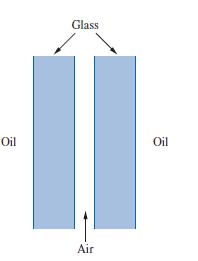
Two parallel sheets of glass (εr = 8.5) mounted vertically are separated by a uniform air gap between their inner surface. The sheets, properly sealed, are immersed in oil (εr = 3.0) as shown in Figure 5.24. A uniform electric field of strength 2 kV/m in the horizontal direction exists
At a point on a conducting surface, E = 30ax – 40ay + 20az mV/m. Calculate the surface charge density at that point.
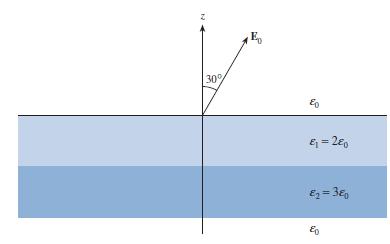
Two planar slabs of equal thickness but with different dielectric constants are shown in Figure 5.25. Eo in air makes an angle of 30° with the z-axis. Calculate the angle that E makes with the z-axis in each of the two dielectric layers. z 30% &0 &₁ = 2€ €₂=3& €0
In a dielectric material (ε = 5εo), the potential field V = 10x2yz – 5z2V, determine(a) E, (b) D, (c) P, (d) ρv.
Tell which of the following quantities is not a vector: (a) Force, (b) Momentum, (c) Acceleration, (d) Work, (e) Weight.
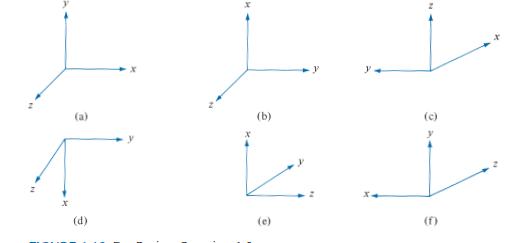
Of the rectangular coordinate systems shown in Figure 1.13, which are not right handed? (d) (e) y (c) (f)
Which of the following is not a scalar field?(a) Displacement of a mosquito in space(b) Light intensity in a drawing room(c) Temperature distribution in your classroom(d) Atmospheric pressure in a given region(e) Humidity of a city
Let vectors A = 10ax – 6ay + 8az and B = ax + 2az. Find: (a) A ∙ B, (b) A × B, (c) 2A – 3B.
Which of these is correct?(a) A × A = ΙAΙ2 (b) A × B + B × A = 0(c) A ∙ B ∙ C = B ∙ C ∙ A(d) ax ∙ ay = az(e) ak = ax – ay , where ak is a unit vector
Let A = –2ax + 5ay + az, B = ax + 3az, and C = 4ax – 6ay + 10az.(a) Determine A – B + C(b) Find A ∙ (B × C)(c) Calculate the angle between A and B
Which of the following identities is not valid?(a) a(b + c) = ab + bc (b) a × (b + c) = a × b + a × c (c) a ∙ b = b ∙ a(d) c ∙ (a × b) = –b ∙ (a × c)(e) aA ∙ aB = cos θAB
Let A = ax – az, B = ax + ay + az, C = ay + 2az, find:(a) A ∙ (B × C)(b) (A × B) ∙ C(c) A × (B X C)(d) (A × B) × C
Which of the following statements are meaningless?(a) A ∙ B + 2A = 0(b) A ∙ B + 5 = 2A (c) A(A + B) + 2 = 0(d) A ∙ A + B ∙ B = 0
Given that the position vectors of points T and S are 4ax + 6ay – az and 10ax + 12ay + 8az, respectively, find: (a) The coordinates of T and S, (b) The distance vector from T to S, (c) The distance between T and S.
Let F = 2ax – 6ay + 10az and G = ax + Gyay + 5az. If F and G have the same unit vector, Gy is(a) 6(b) –3 (c) 0(d) 6
Showing 400 - 500
of 669
1
2
3
4
5
6
7
Step by Step Answers

 Get 50% OFF
Claim Now
Get 50% OFF
Claim Now