New Semester
Started
Get
50% OFF
Study Help!
--h --m --s
Claim Now
Question Answers
Textbooks
Find textbooks, questions and answers
Oops, something went wrong!
Change your search query and then try again
S
Books
FREE
Study Help
Expert Questions
Accounting
General Management
Mathematics
Finance
Organizational Behaviour
Law
Physics
Operating System
Management Leadership
Sociology
Programming
Marketing
Database
Computer Network
Economics
Textbooks Solutions
Accounting
Managerial Accounting
Management Leadership
Cost Accounting
Statistics
Business Law
Corporate Finance
Finance
Economics
Auditing
Tutors
Online Tutors
Find a Tutor
Hire a Tutor
Become a Tutor
AI Tutor
AI Study Planner
NEW
Sell Books
Search
Search
Sign In
Register
study help
engineering
fundamentals of gas
Fundamentals Of Gas Dynamics 3rd Edition Robert D Zucker, Oscar Biblarz - Solutions
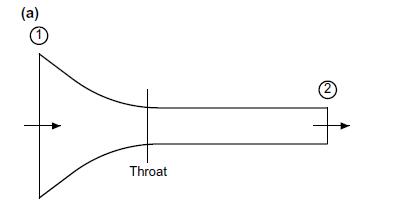
Air enters a device with a Mach number of \(M_{1}=2.0\) and leaves with \(M_{2}=0.25\). The ratio of exit to inlet area is \(A_{2} / A_{1}=3.0\).(a) Find the static pressure ratio \(p_{2} / p_{1}\).(b) Determine the stagnation pressure ratio \(p_{t 2} / p_{t 1}\).
Oxygen, with \(p_{t}=95.5 \mathrm{psia}\), enters a diverging section of area \(3.0 \mathrm{ft}^{2}\). At the outlet the area is \(4.5 \mathrm{ft}^{2}\), the Mach number is 0.43 , and the static pressure is 75.3 psia. Determine the possible values of Mach number that could exist at the inlet.
Nitrogen flows through a converging-diverging nozzle designed to operate at a Mach number of 3.0. If it is subjected to an operating pressure ratio of 0.5 :(a) Determine the Mach number at the exit.(b) What is the entropy change in the nozzle?(c) Compute the area ratio at the shock location.(d)
Consider a converging-diverging nozzle feeding air from a reservoir at \(p_{1}\) and \(T_{1}\). The exit area is \(A_{e}=4 A_{2}\), where \(A_{2}\) is the area at the throat. The back pressure \(p_{\text {rec }}\) is steadily reduced from an initial \(p_{\text {rec }}=p_{1}\).(a) Determine the
A normal shock is traveling into still air ( \(14.7 \mathrm{psia}\) and \(520^{\circ} \mathrm{R}\) ) at a velocity of 1800 \(\mathrm{ft} / \mathrm{sec}\).(a) Determine the temperature, pressure, and velocity that exist after passage of the shock wave.(b) What is the entropy change experienced by
The velocity of a certain atomic explosion blast wave has been determined to be approximately \(46,000 \mathrm{~m} / \mathrm{s}\) relative to the ground. Assume that it is moving into still air at \(300 \mathrm{~K}\) and \(1 \mathrm{bar}\). Estimate the static and stagnation temperatures and
Air flows in a duct, and a valve is quickly closed. A normal shock is observed to propagate back through the duct at a speed of \(1010 \mathrm{ft} / \mathrm{sec}\). The gas that has been brought to rest has a temperature and pressure of \(600^{\circ} \mathrm{R}\) and \(30 \mathrm{psia}\),
Oxygen at \(100^{\circ} \mathrm{F}\) and \(20 \mathrm{psia}\) is flowing at \(450 \mathrm{ft} / \mathrm{sec}\) in a duct. A valve is quickly shut, causing a normal shock to travel back through the duct.(a) Determine the speed of the traveling shock wave.(b) What are the temperature and pressure of
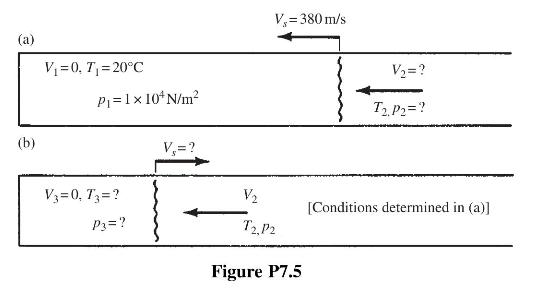
A closed tube contains nitrogen at \(20^{\circ} \mathrm{C}\) and a pressure of \(1 \times 10^{4} \mathrm{~N} / \mathrm{m}^{2}\) (Figure P7.5). A shock wave progresses through the tube at a speed of \(380 \mathrm{~m} / \mathrm{s}\).(a) Calculate the conditions that exist immediately after the shock
An oblique shock forms in air at an angle of \(\theta=30^{\circ}\). Before passing through the shock, the air has a temperature of \(60^{\circ} \mathrm{F}\), a pressure of \(10 \mathrm{psia}\), and is traveling at \(M=2.6\).(a) Compute the normal and tangential velocity components before and after
Conditions before a shock are \(T_{1}=40^{\circ} \mathrm{C}, p_{1}=1.2 \mathrm{bar}\), and \(M_{1}=3.0\). An oblique shock is observed at \(45^{\circ}\) to the approaching air flow.(a) Determine the Mach number and flow direction after the shock.(b) What are the temperature and pressure after the
Air at \(800^{\circ} \mathrm{R}\) and 15 psia is flowing at a Mach number of \(M=1.8\) and is deflected through a \(15^{\circ}\) angle. The directional change is accompanied by an oblique shock.(a) What are the possible shock angles?(b) For each shock angle, compute the temperature and pressure
The supersonic flow of a gas \((\gamma=1.4)\) approaches a wedge with a half-angle of \(24^{\circ}\) \(\left(\delta=24^{\circ}\right)\).(a) What Mach number will put the shock on the verge of detaching?(b) Is this value a minimum or a maximum?
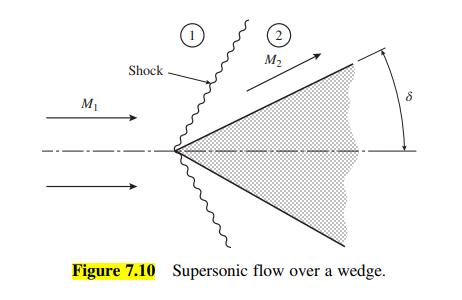
A simple wedge with a total included angle of \(28^{\circ}\) is used to measure the Mach number of supersonic flows. When inserted into a wind tunnel and aligned with the flow, oblique shocks are observed at \(50^{\circ}\) angles to the free stream (similar to Figure 7.10).(a) What is the Mach
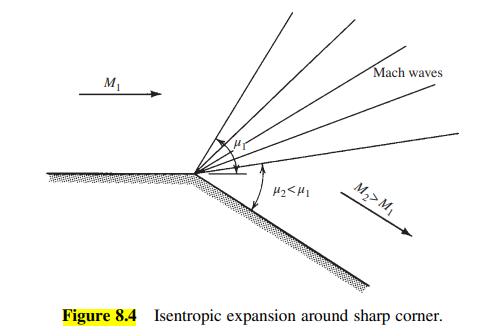
Air approaches a sharp \(15^{\circ}\) convex corner (see Figure 8.4) with a Mach number of 2.0 , temperature of \(520^{\circ} \mathrm{R}\), and pressure of \(14.7 \mathrm{psia}\). Determine the Mach number, static and stagnation temperature, and static and stagnation pressure of the air after it
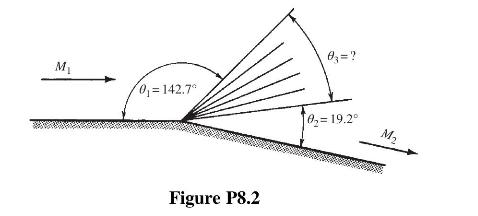
A Schleiren photo of the flow around a corner reveals the edges of the expansion fan to be indicated by the angles shown in Figure P8.2. Assume that \(\gamma=1.4\).(a) Determine the Mach number before and after the corner.(b) Through what angle was the flow turned, and what is the angle of the
Nitrogen at \(25 \mathrm{psia}\) and \(850^{\circ} \mathrm{R}\) is flowing at a Mach number of 2.54. After expanding around a smooth convex corner, the velocity of the nitrogen is found to be \(4000 \mathrm{ft} /\) sec. Through how many degrees did the flow turn?
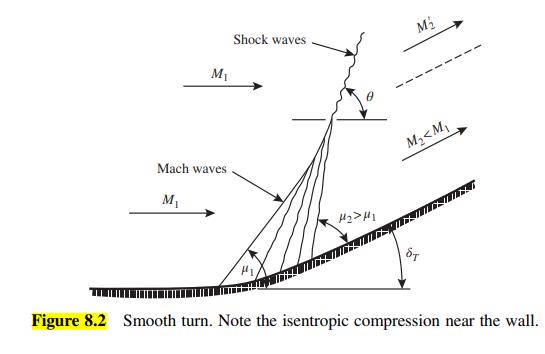
A smooth concave turn similar to that shown in Figure 8.2 turns the flow through a \(30^{\circ}\) angle. The fluid is oxygen, and it approaches the turn at \(M_{1}=4.0\).(a) Compute \(M_{2}, T_{2} / T_{1}\), and \(p_{2} / p_{1}\) via the Prandtl-Meyer compression, which occurs close to the wall.(b)
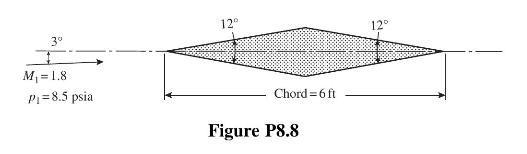
The symmetrical diamond-shaped airfoil shown in Figure P8.8 is operating at a \(3^{\circ}\) angle of attack. The flight speed is \(M=1.8\), and the air pressure equals 8.5 psia.(a) Compute the pressure on each surface.(b) Calculate the lift and drag forces.(c) Repeat the problem with a
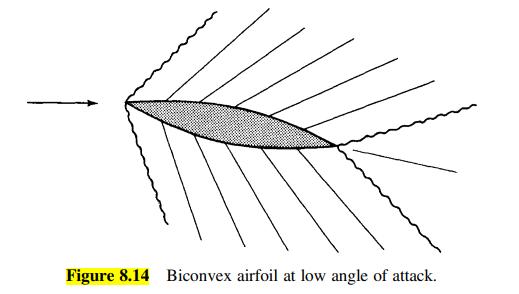
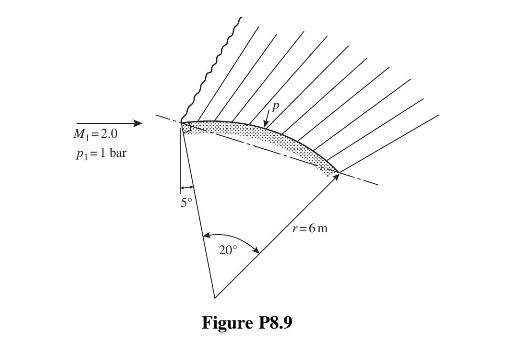
A biconvex airfoil (see Figure 8.14) is constructed of circular arcs. We shall approximate the curve on the upper surface by 10 straight-line segments, as shown in Figure P8.9.(a) Determine the pressure immediately after the oblique shock at the leading edge.(b) Determine the Mach number and
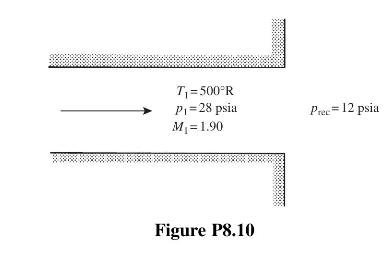
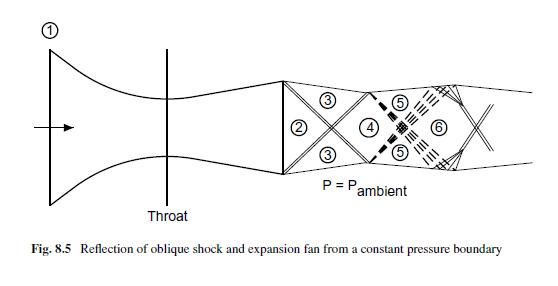
Properties of the flow are given at the exit plane of the two-dimensional duct shown in Figure P8.10. The receiver pressure is 12 psia.(a) Determine the Mach number and temperature just past the exit (after the flow has passed through the first wave formation). Assume that \(\gamma=1.4\).(b) Make a
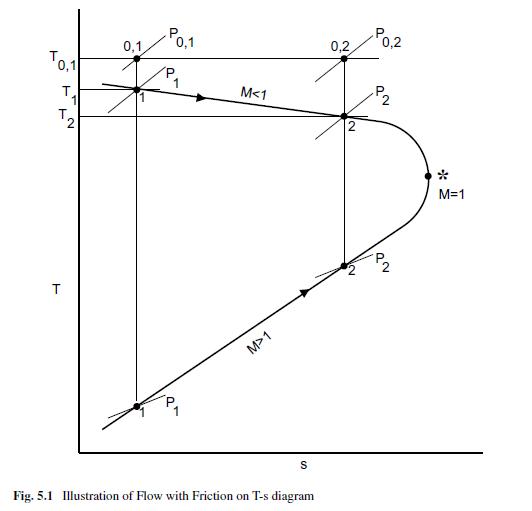
Redraw Fig. 5.1 in P-v coordinates. 0.1 T T 2 0,1 0,1 1 M 1 0,2 S Fig. 5.1 Illustration of Flow with Friction on T-s diagram P0,2 22 22 * M=1
Air enters a $5 \mathrm{~cm} \times 5 \mathrm{~cm}$ smooth, insulated square duct with a velocity of $900 \mathrm{~m} / \mathrm{s}$, and a static temperature of $300 \mathrm{~K}$. If the duct length is $2 \mathrm{~m}$, determine the flow conditions at the exit. Use Colebrook's formula to calculate
Air enters a smooth, insulated circular duct at $M=3$. Determine the stagnation pressure loss in the duct for $\mathrm{L} / \mathrm{D}=20$ and 40 . Take $f=0.02$.
Air enters a smooth, insulated $3 \mathrm{~cm}$ diameter duct with stagnation pressure and temperature of $200 \mathrm{kPa}, 500 \mathrm{~K}$, and a velocity of $100 \mathrm{~m} / \mathrm{s}$. Compute (a) the maximum duct length for these conditions, (b) the mass flow rate for a duct length of $15
Air enters a $3 \mathrm{~m}$ long pipe $(f=0.02)$ of diameter $0.025 \mathrm{~m}$ at a stagnation temperature of $300 \mathrm{~K}$. If the static pressure of the air at the exit of the pipe is $100 \mathrm{kPa}$ and the Mach number is 0.7 , determine the stagnation pressure at entry and the mass
Air enters a pipe $(f=0.02)$ of diameter $0.05 \mathrm{~m}$ with stagnation pressure and temperature equal to $1 \mathrm{MPa}$ and $300 \mathrm{~K}$, respectively. The pipe exhausts into the ambient at $100 \mathrm{kPa}$. Determine the length of the pipe required to achieve a mass flow rate of $2
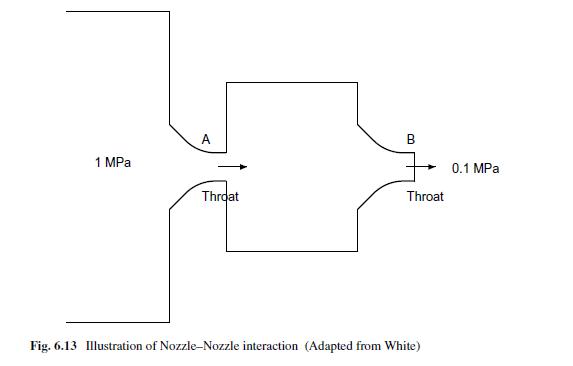
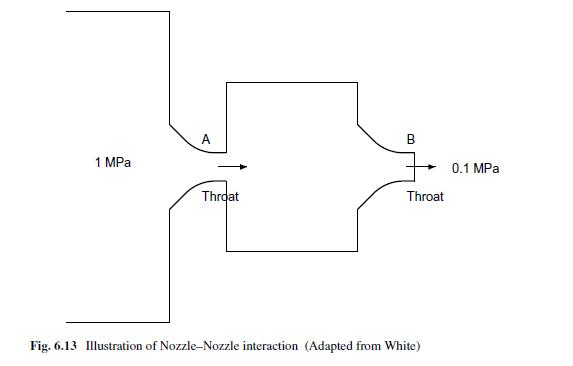
Consider the two-tank system in Fig. 6.13. Assume, in addition, the stagnation temperature to be 300Kand the throat diameter of the nozzles to be 2.54 cm. Initially, the pressure in the small tank is equal to the ambient pressure. Sketch the variation of the exit pressure, mass flow rate, and the
Consider again the two-tank system in Fig. 6.13. Assume that only nozzle A is present and that it is a convergent divergent nozzle of exit-to-throat area ratio 2 with the same throat diameter as before. Sketch the variation of the exit pressure,mass flow rate, exitMach number, and the ambient
Air enters a convergent divergent nozzle of a rocket engine at a stagnation temperature of 3200 K. The nozzle exhausts into an ambient pressure of 100 kPa and the exit-to-throat area ratio is 10. The thrust produced is 1300 kN. Assume the expansion process to be complete and isentropic. Determine
A reservoir of volume V initially contains air at pressure Pi and temperature Ti . A hole of cross-sectional area A develops in the reservoir and the air begins to leak out. Develop an expression for the time taken for half of the initial mass of air in the reservoir to escape. Assume that, during
Consider a CD nozzle with exit and throat areas of 0.5 m2 and 0.25 m2, respectively.The inlet reservoir pressure is 100 kPa and the exit static pressure is 60 kPa.Determine the exit Mach number.
Air at a pressure and temperature of 400 kPa and 300Kcontained in a large vessel is discharged through an isentropic nozzle into a space at a pressure of 100 kPa. Find the mass flow rate if the nozzle is (a) convergent and (b) convergent divergent with optimum expansion ratio. In both cases, the
Air flows in a frictionless, adiabatic duct at M = 0.6 and P0 = 500 kPa. The cross-sectional area of the duct is 6 cm2 and the mass flow rate is 0.5 kg/s. If the area of the duct near the exit is reduced so as to form a convergent nozzle, what is the minimum area possible without altering the flow
A student is trying to design an experimental setup to produce a correctly expanded supersonic stream at a Mach number of 2 issuing into ambient at 100 kPa. For this purpose, the student wishes to use a CD nozzle with the largest possible exit area. There is a 10 m3 reservoir containing air at 1
A rocket nozzle produces 1 MN of thrust at sea level (ambient pressure and temperature 100 kPa and 300 K). The stagnation pressure and temperature are 5 MPa and 2800 K. Determine (a) the exit to throat area ratio, (b) exit Mach number, (c) exit velocity, (d) mass flow rate, and (e) exit area.
Assume that the rocket nozzle of the previous problem is designed to develop a thrust of 1MN at an altitude of 10 km. Determine the thrust developed by the nozzle at 20 km, for the same stagnation conditions in the thrust chamber. Take the ambient pressure and temperature at 10 km to be 26.15 kPa
An aircraft engine is operating at an ambient pressure and temperature of P∞ and T∞. The mass flow rate through the engine is m˙ and the air enters with a velocity of u∞. Consider the following two choices for the nozzle:• Convergent with the flow choked at the exit, and• Convergent
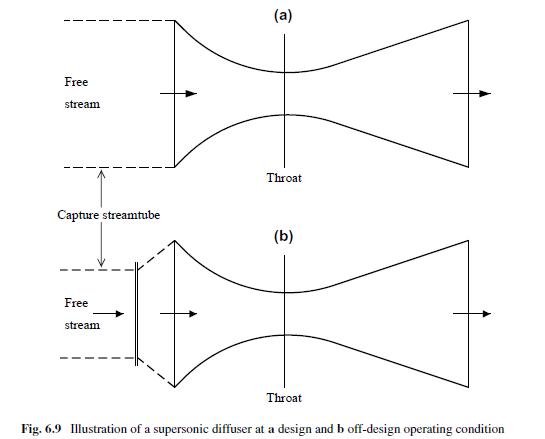
A supersonic diffuser is designed to operate at a freestream Mach number of 1.7. Determine the ratio of mass flow rate through the diffuser when it operates at a freestream Mach number of 2 with a normal shock in front (see Fig. 6.9) to that at the design condition. Assume M=1 at the throat for
Air enters the combustion chamber of a ramjet engine (Fig. ??) at T0 = 1700K and M = 0.3. How much can the stagnation temperature be increased in the combustion chamber without affecting the inlet conditions? Assume that the combustion chamber has a constant area of cross section.
Air enters a constant area combustor followed by a convergent nozzle. Heat addition takes place in the combustor and the flow is isentropic in the nozzle. The inlet Mach number is 0.3, and the throat-to-inlet area ratio is 0.9.(a) If the stagnation temperature is doubled in the combustor, determine
Consider an arrangement consisting of a converging nozzle followed by a smooth, 1m long pipe. The diameter of the pipe is 0.04 m. The stagnation conditions upstream of the nozzle are 2.5 MPa and 500 K. Determine the mass flow rate if the Mach number at the exit is 1. Assume the flow in the nozzle
A converging diverging frictionless nozzle is connected to a large air reservoir by means of a 20mlong pipe of diameter 0.025 m. The inlet, throat, and exit diameters of the nozzle are, respectively, 0.025 m, 0.0125 m, and 0.025 m. If the air is expanded to the ambient pressure of 100 kPa and f =
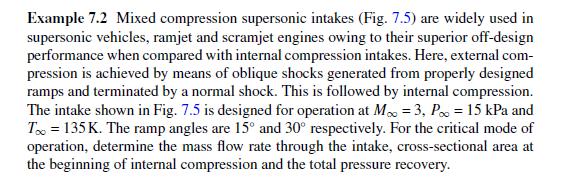
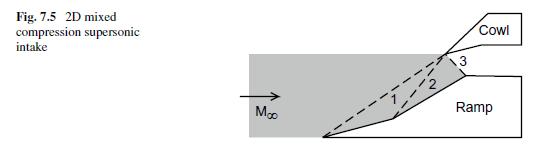
For the geometry shown in Worked Example 7.2, determine the mass flow rate through the intake and the total pressure recovery for the sub-critical mode of operation when M∞ = 2.5. Compare these values with those of the critical mode.Sketc.h the stream tube that enters the intake in the
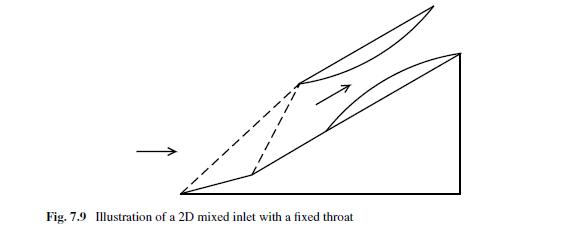
A 2D supersonic inlet (Fig. 7.9) is constructed with two ramps each of which deflects the flow through 15◦. Following the second oblique shock, a fixed throat inlet is used for internal compression. The inlet is designed to start for a flight Mach number of 2.5. Determine the stagnation pressure
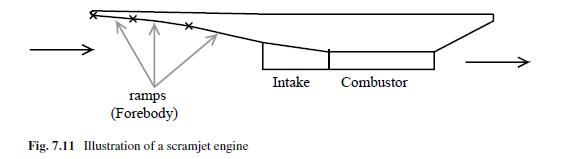
Consider the forebody, intake and the combustor for a conceptual scramjet engine shown in Fig. 7.11. The freestream conditions are M = 5, P∞ = 830N/m2 and T∞ = 230 K. The ramp angles are 5◦, 10◦ and 15◦ from the horizontal. The engine uses kerosene fuel (calorific value = 45 MJ/kg). The
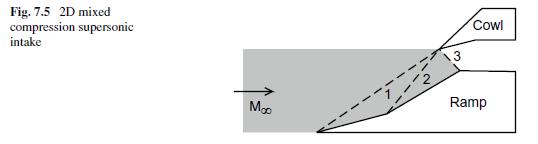
Sketc.h the flow field for the flow through the intake shown in Fig. 7.5 indicating oblique shocks and expansion fans clearly. Also show the external flow field around the cowl. Assume critical mode of operation. Fig. 7.5 2D mixed compression supersonic intake Cowl Ramp Moo
Air at a stagnation pressure of 1 MPa flows isentropically through a CD nozzle and exhausts into ambient at 40.4 kPa. The edge of the jet, as it comes out of the nozzle is deflected by 18° (counter clockwise) from the horizontal. Determine the Mach number and static pressure at the nozzle exit.
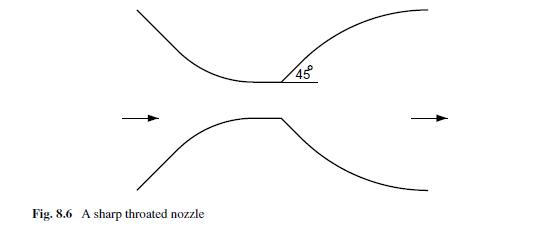
A sharp throated nozzle is shown in Fig. 8.6. The flow entering the throat is sonic. The exit to throat area ratio is 3 and the throat makes an angle of 45° with the horizontal. Determine the Mach number at the exit. Wave reflection may be ignored.The flow may be assumed to be quasi 1D, except
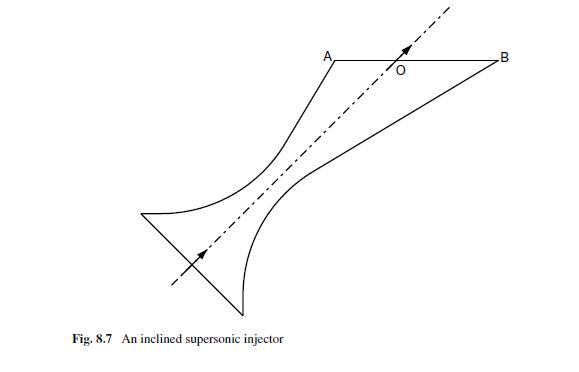
A supersonic injector fabricated from a CD nozzle (comprising of a circular arc throat and a conical divergent portion) is shown in Fig. 8.7.3 The throat diameter is 0.55cm and the divergence angle is 10°. The axis of the nozzle is inclined at an angle of 45° to the horizontal. The inlet
Dry, saturated steam enters a convergent nozzle at a static pressure of 800 kPa and is expanded to the sonic state. If the inlet and throat diameters are 0.05m and 0.025m respectively, determine the velocity at the inlet and exit and the stagnation pressure.
Dry saturated steam at 1.1 MPa is expanded in a nozzle to a pressure of 15 kPa. Assuming the expansion process to be isentropic and in equilibrium throughout, determine (a) if the nozzle is convergent or convergent-divergent, (b) the exit velocity, (c) the dryness fraction at the exit and (c) the
Superheated steam at 700 kPa, 220 °C in a steam chest is expanded through a nozzle to a final pressure of 20 kPa. The throat diameter is 10mm. Assuming the expansion process to be isentropic and in equilibrium throughout, determine (a) the mass flow rate, (b) the exit velocity, (c) the dryness
Dry saturated steam at 1.2 MPa is expanded in a nozzle to 20 kPa. The throat diameter of the nozzle is 6mm. If the total mass flow rate is 0.5 kg/s, determine how many nozzles are required and the exit diameter of the nozzle. Assume the expansion process to be isentropic and in equilibrium
Superheated steam at 850 kPa, 200 °C expands in a convergent nozzle until it becomes a saturated vapor. Determine the exit velocity, assuming the expansion process to be isentropic and in equilibrium throughout.
Steam which is initially saturated and dry expands from 1400 kPa to 700 kPa.Assuming the expansion to be in equilibrium (n = 1.135), determine the final velocity and specific volume. If the expansion is out of equilibrium (n = 1.3), determine the final velocity, specific volume, supersaturation
Superheated steam at 500 kPa, 180°C is expanded in a nozzle to pressure of 170 kPa. Assuming the expansion process to be isentropic and in equilibrium determine the exit velocity. Assuming the flow to be isentropic and supersaturated, determine the the exit velocity, supersaturation ratio and the
For each of the stagnation condition given below, determine the pressure, velocity and degree of supercooling just before the onset of condensation shock for a limiting value of supersaturation ratio of 5. Assume the expansion process to be isentropic. (a) 87000Pa, 96°C, (b) 70727Pa, 104°C and
What is the relation between degrees Fahrenheit and degrees Rankine? And the relation between degrees Celsius and Kelvin?
State Newton's second law as you would apply it to a control mass.
Define a 1-pound force in terms of the acceleration it will give to a 1-pound mass. Give a similar definition for a newton in the SI system.
Explain the significance of \(g_{c}\) in Newton's second law. What are the magnitude and units of \(g_{c}\) in the English Engineering system? In the SI system?
Nitrogen gas is reversibly compressed from \(70^{\circ} \mathrm{F}\) and 14.7 psia to one-fourth of its original volume by (1) a \(T=\) const process or (2) a \(p=\) const process followed by a \(v=\) const process to the same end point as (1).(a) Which compression involves the least amount of
What is the relationship between density and specific volume?
Explain the difference between absolute and gage pressures.
What is the distinguishing characteristic of a fluid (as compared to a solid)? How is this related to viscosity?
In any given physical situation, why can there be a difference between the number of units and the number of dimensions? [Number of units being less or equal to number of dimensions.]
Why is the ratio of the velocity at any point downstream of the throat of a supersonic nozzle to the velocity at the throat (where it equals the speed of sound), though dimensionless, not a Mach number?
Describe the difference between the microscopic and macroscopic approach in the analysis of fluid behavior.
Describe the control volume approach to problem analysis and contrast it to the control mass approach. What kinds of systems are these also called?
Describe a property and give at least three examples.
Properties may be categorized as either intensive or extensive. Define what is meant by each, and list examples of each type of property.
When dealing with a unit mass of a single component substance, how many independent properties are required to fix the state?
Why do we need an equation of state? Write down one with which you are familiar.
Define point functions and path functions. Give examples of each.
What is a thermodynamic process? What is a thermodynamic cycle?
How does the zeroth law of thermodynamics relate to temperature?
State the first law of thermodynamics for a closed system that is executing a single process.
What are the sign conventions used in this book for heat and work?
State any form of the second law of thermodynamics you are familiar with.
Define a reversible process for a thermodynamic system. Is any real process ever completely reversible?
What are some phenomena that cause processes to be irreversible?
Under what conditions is an isentropic process not a reversible adiabatic process?
Give the equations that define enthalpy and entropy.
Give differential expressions that relate entropy to(a) internal energy(b) enthalpy.
Define (in the form of partial derivatives) the specific heats \(c_{v}\) and \(c_{p}\). Are these expressions valid for materials in any state?
State the perfect gas equation of state. Give a consistent set of units for each term in the equation.
For a perfect gas, the specific internal energy is a function of which state variables? How about the specific enthalpy?
Give expressions for \(\Delta u\) and \(\Delta h\) that are valid for perfect gases. Do these hold for any process?
For perfect gases, at what temperature do we arbitrarily assign \(u=0\) and \(h=0\) ?
State any one expression for the entropy change between two arbitrary points which is valid for a perfect gas.
If a perfect gas undergoes an isentropic process, what equation relates the pressure to the volume? Temperature to the volume? Temperature to the pressure?
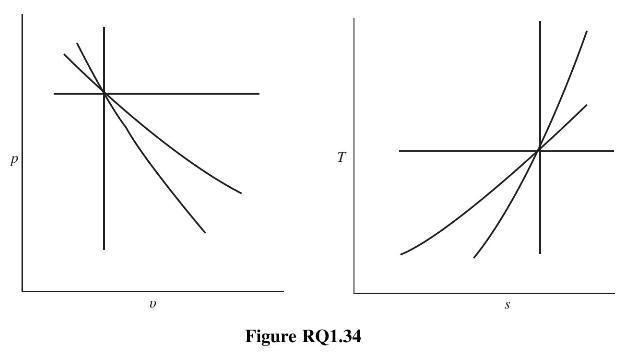
Consider the general polytropic process \(\left(p v^{n}=\right.\) const) for a perfect gas. In the \(p-v\) and \(T-s\) diagrams shown in Figure RQ1.34, label each process line with the correct value of \(n\) and identify which fluid property is being held constant. P T Figure RQ1.34 S
There is three-dimensional flow of an incompressible fluid in a duct of radius \(R\). The velocity distribution at any section is hemispherical, with the maximum velocity \(U_{m}\) at the center and zero velocity at the wall. Show that the mass average velocity is \(\frac{2}{3} U_{m}\).
Name the basic concepts (or equations) from which the study of gas dynamics proceeds.
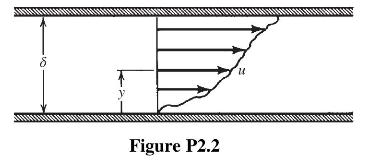
A constant-density fluid flows between two flat parallel plates that are separated by a distance \(\delta\) (Figure P2.2). Sketch the velocity distribution and compute the mass average velocity based on the velocity \(u\) given by:(a) \(u=k_{1} y\).(b) \(u=k_{2} y^{2}\).(c) \(u=k_{3}\left(\delta
Define steady flow. Explain what is meant by one-dimensional flow.
An incompressible fluid is flowing in a rectangular duct whose dimensions are 2 units in the \(Y\)-direction and 1 unit in the \(Z\)-direction. The velocity in the \(X\)-direction is given by \(u=3 y^{2}+5 z\). Compute the mass average velocity.
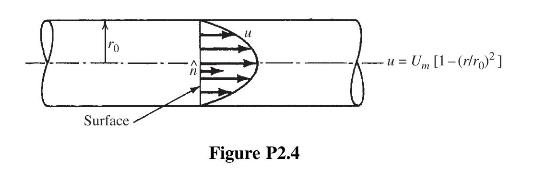
An incompressible fluid flows in a duct of radius \(r_{0}\). At a particular location, the velocity distribution is \(u=U_{m}\left[1-\left(r / r_{0}\right)^{2}\right]\) and the distribution of an extensive property is \(\beta=B_{m}\left[1-\left(r / r_{0}\right)\right]\). Evaluate the integral
Laminar flow in circular ducts is not one-dimensional, but we may still use the equivalent mass-average velocity \(V=U_{m} / 2\) from equations (2.10) and (2.11) in our onedimensional formulations. This velocity came from solving \(\int u d A \equiv\left(\pi r_{0}^{2}\right) V\). Now, in the energy
Showing 100 - 200
of 234
1
2
3
Step by Step Answers

 Get 50% OFF
Claim Now
Get 50% OFF
Claim Now