New Semester
Started
Get
50% OFF
Study Help!
--h --m --s
Claim Now
Question Answers
Textbooks
Find textbooks, questions and answers
Oops, something went wrong!
Change your search query and then try again
S
Books
FREE
Study Help
Expert Questions
Accounting
General Management
Mathematics
Finance
Organizational Behaviour
Law
Physics
Operating System
Management Leadership
Sociology
Programming
Marketing
Database
Computer Network
Economics
Textbooks Solutions
Accounting
Managerial Accounting
Management Leadership
Cost Accounting
Statistics
Business Law
Corporate Finance
Finance
Economics
Auditing
Tutors
Online Tutors
Find a Tutor
Hire a Tutor
Become a Tutor
AI Tutor
AI Study Planner
NEW
Sell Books
Search
Search
Sign In
Register
study help
engineering
principles of composite
Principles Of Composite Material Mechanics 4th Edition Ronald F. Gibson - Solutions
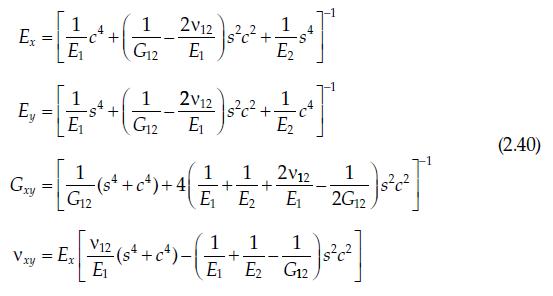
Derive the third of Equation 2.40 for the off-axis shear modulus, \(G_{x y}\). 2V12 E-[1 + (1-2)+1] Ex = Ey E E 1 2V12 + 1 1 G12 E2 1 E2 2V12 - E 2G12 1 1 sc E E1 E2 E2 G12 Gxy = 1 G12 Vxy = Ex ($4 V12 +c c). +4 1 1 1 + -c)- + 1 2 + 1 (2.40)
Using the result from Problem 2.10a. Find the value of the angle \(\theta\) (other than \(0^{\circ}\) or \(90^{\circ}\) ), where the curve of \(G_{x y}\) versus \(\theta\) has a possible maximum, minimum, or inflection point.b. For the value of \(\theta\) found in part (a), find the bounds on
Describe a series of tensile tests that could be used to measure the four independent engineering constants for an orthotropic lamina without using a pure shear test. Give the necessary equations for the data reduction.
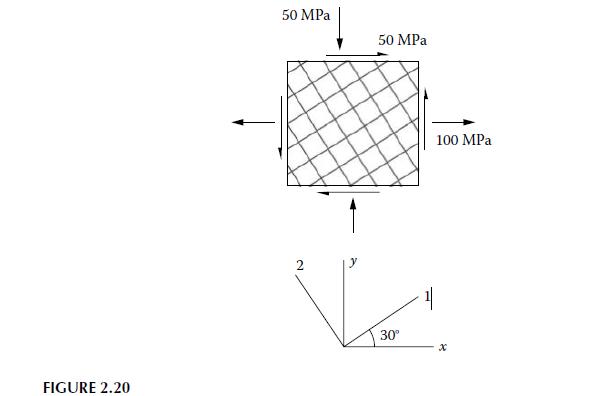
An element of a balanced orthotropic carbon/epoxy lamina is under the state of stress shown in Figure 2.20. If the properties of the woven carbon fabric/ epoxy material are \(E_{1}=70 \mathrm{GPa}, v_{12}=0.25\), and \(G_{12}=5 \mathrm{GPa}\), determine all the strains along the fiber directions.
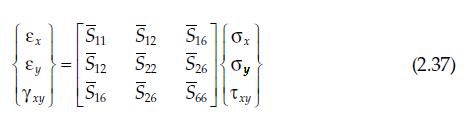
Express the stress-strain relationships in Equation 2.37 in terms of offaxis engineering constants such as the moduli of elasticity, shear modulus, Poisson's ratios, and shear-coupling ratios. 3 Ex S11 S12 S16 Ox Ey 512 522 526 Oy (2.37) Yxy 516 526 526 566xy
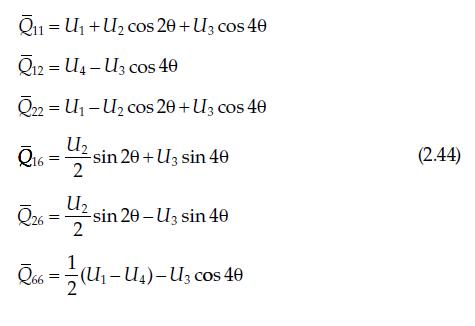
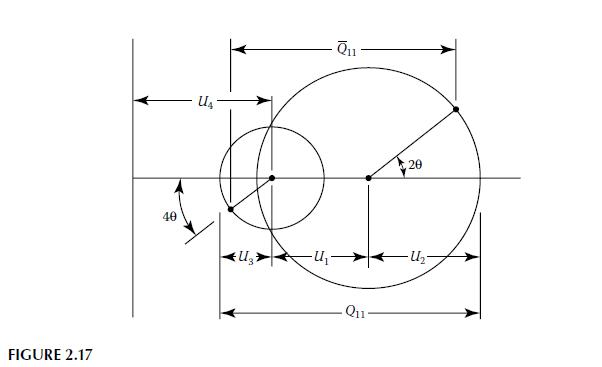
Derive the first two equations of Equation 2.44. Q11=U+U cos 20+ U3 cos 40 Q12 U4-U3 cos 40 Q22 2=U-U cos 20+ U3 cos 40 U2 Q16 sin 20+ U3 sin 40 2 us Q26 sin 20-U3 sin 40 2 Q66 = (U-U4)-U3 cos 40 (2.44)
Using the results of Problem 2.6, determine the invariants \(U_{i}\) and \(V_{i}\) for the AS/3501 lamina, where \(i=1,2,3,4\).Problem 2.6Find all components of the stiffness and compliance matrices for a specially orthotropic lamina made of AS/3501 carbon/epoxy.
Using the results of Problem 2.6 or Problem 2.16, compare the transformed lamina stiffnesses for AS/3501 carbon/epoxy plies oriented at \(+45^{\circ}\) and \(-45^{\circ}\).Problem 2.6Using the results of Problem 2.6, determine the invariants \(U_{i}\) and \(V_{i}\) for the AS/3501 lamina, where
Show how the Mohr's circles in Figure 2.17 can be used to interpret the transformed lamina stiffness \(\bar{Q}_{12}\). FIGURE 2.17 40 'n Q11 In- n> Q11 20 -U-
Using the approach described in Example 2.6, derive the expressions for all the averaged stiffnesses for the planar isotropic lamina in terms of invariants. Use these results to find the corresponding averaged engineering constants (modulus of elasticity, shear modulus, and Poisson's ratio) in
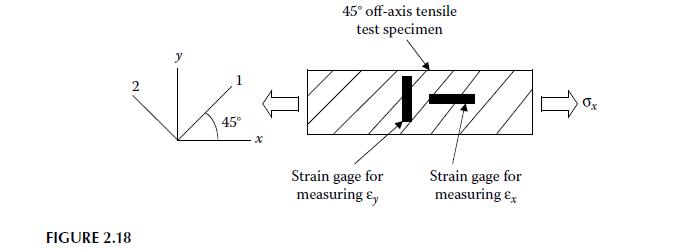
A \(45^{\circ}\) off-axis tensile test specimen has three strain gages attached. Two of the gages are mounted as shown in Figure 2.18 so as to measure the normal strains \(\varepsilon_{x}\) and \(\varepsilon_{y}\), and a third gage is mounted at \(\theta=45^{\circ}\) so as to measure the normal
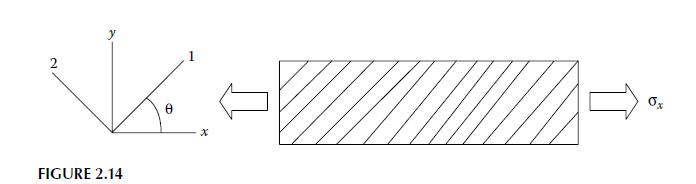
A off-axis tensile test (Figure 2.14) of a unidirectional AS/3501 carbon/epoxy specimen is conducted with \(\theta=45^{\circ}\) and the applied stress is found to be \(\sigma_{x}=15.44 \mathrm{MPa}\). Determine the resulting strain \(\varepsilon_{x}\). 2 A FIGURE 2.14 x 0x
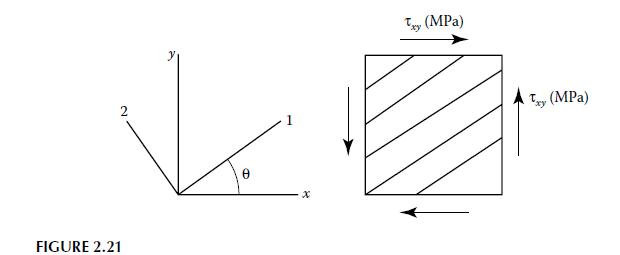
An element of an orthotropic lamina is subjected to an off-axis shear stress \(\tau_{x y}\) at an angle \(\theta\) as shown in Figure 2.21.(a) For an angle \(\theta=45^{\circ}\), determine the value of the applied shear stress \(\tau_{x y}\) that would generate the following stresses along the 1,2
Use invariants to find the optimum lamina orientation for maximizing the shear stiffness \(\bar{Q}_{66}\), then find the corresponding maximum shear stiffness in terms of invariants.
Showing 200 - 300
of 214
1
2
3
Step by Step Answers

 Get 50% OFF
Claim Now
Get 50% OFF
Claim Now