







Question: Using the method of concept mapping presented in Appendix E, construct a concept map showing the relationships among the various concentration units. Appendix E 1.
Using the method of concept mapping presented in Appendix E, construct a concept map showing the relationships among the various concentration units.
Appendix E
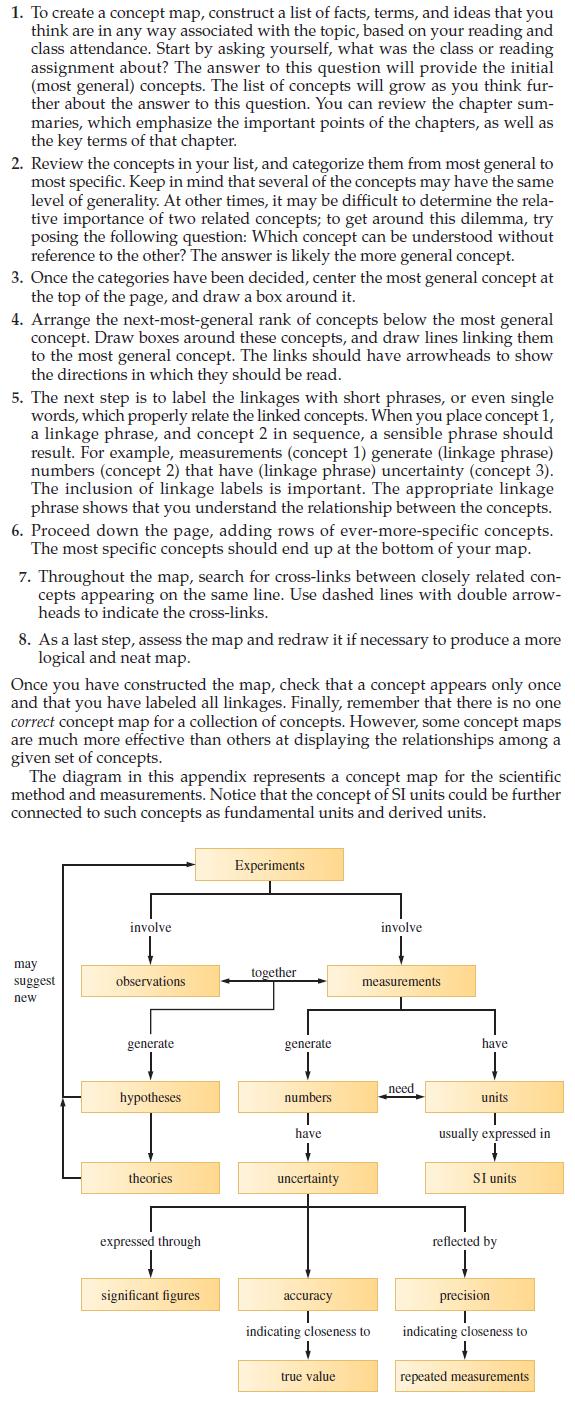
1. To create a concept map, construct a list of facts, terms, and ideas that you think are in any way associated with the topic, based on your reading and class attendance. Start by asking yourself, what was the class or reading assignment about? The answer to this question will provide the initial (most general) concepts. The list of concepts will grow as you think fur- ther about the answer to this question. You can review the chapter sum- maries, which emphasize the important points of the chapters, as well as the key terms of that chapter. 2. Review the concepts in your list, and categorize them from most general to most specific. Keep in mind that several of the concepts may have the same level of generality. At other times, it may be difficult to determine the rela- tive importance of two related concepts; to get around this dilemma, try posing the following question: Which concept can be understood without reference to the other? The answer is likely the more general concept. 3. Once the categories have been decided, center the most general concept at the top of the page, and draw a box around it. 4. Arrange the next-most-general rank of concepts below the most general concept. Draw boxes around these concepts, and draw lines linking them to the most general concept. The links should have arrowheads to show the directions in which they should be read. 5. The next step is to label the linkages with short phrases, or even single words, which properly relate the linked concepts. When you place concept 1, a linkage phrase, and concept 2 in sequence, a sensible phrase should result. For example, measurements (concept 1) generate (linkage phrase) numbers (concept 2) that have (linkage phrase) uncertainty (concept 3). The inclusion of linkage labels is important. The appropriate linkage phrase shows that you understand the relationship between the concepts. 6. Proceed down the page, adding rows of ever-more-specific concepts. The most specific concepts should end up at the bottom of your map. 7. Throughout the map, search for cross-links between closely related con- cepts appearing on the same line. Use dashed lines with double arrow- heads to indicate the cross-links. 8. As a last step, assess the map and redraw it if necessary to produce a more logical and neat map. Once you have constructed the map, check that a concept appears only once and that you have labeled all linkages. Finally, remember that there is no one correct concept map for a collection of concepts. However, some concept maps are much more effective than others at displaying the relationships among a given set of concepts. The diagram in this appendix represents a concept map for the scientific method and measurements. Notice that the concept of SI units could be further connected to such concepts as fundamental units and derived units. may suggest new involve observations generate hypotheses theories expressed through significant figures Experiments together generate numbers T have uncertainty accuracy T indicating closeness to true value involve measurements need have units usually expressed in SI units reflected by precision indicating closeness to repeated measurements
Step by Step Solution
3.39 Rating (155 Votes )
There are 3 Steps involved in it

Get step-by-step solutions from verified subject matter experts
 Study Help