New Semester
Started
Get
50% OFF
Study Help!
--h --m --s
Claim Now
Question Answers
Textbooks
Find textbooks, questions and answers
Oops, something went wrong!
Change your search query and then try again
S
Books
FREE
Study Help
Expert Questions
Accounting
General Management
Mathematics
Finance
Organizational Behaviour
Law
Physics
Operating System
Management Leadership
Sociology
Programming
Marketing
Database
Computer Network
Economics
Textbooks Solutions
Accounting
Managerial Accounting
Management Leadership
Cost Accounting
Statistics
Business Law
Corporate Finance
Finance
Economics
Auditing
Tutors
Online Tutors
Find a Tutor
Hire a Tutor
Become a Tutor
AI Tutor
AI Study Planner
NEW
Sell Books
Search
Search
Sign In
Register
study help
Sciences
geology
structural geology
Structural Geology 2nd Edition Haakon Fossen - Solutions
What set of material lines do not rotate or change length during simple shear?
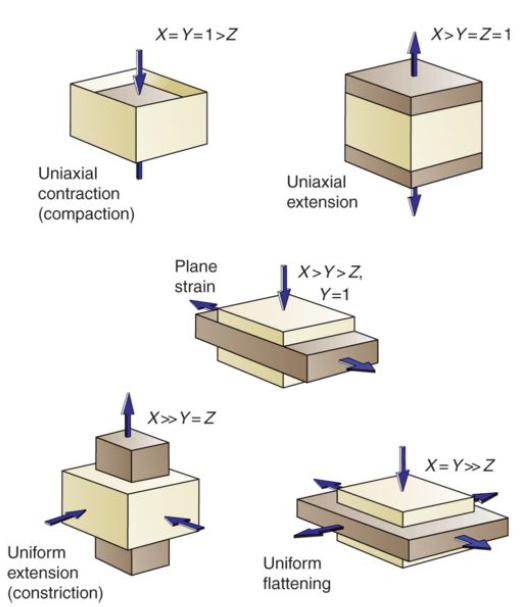
Where in the Flinn diagram would the different states of strain shown in Figure 2.12 plot? Uniaxial contraction (compaction) Uniform extension (constriction) X=Y=1>Z Plane strain X>>>Y=Z Uniaxial extension X>Y>Z, Y=1 Uniform flattening X>Y=Z=1 X=YZ
What is meant by the term “strain marker”? Give examples.
What information can we obtain from linear or planar strain markers?
What is the effect of a viscosity (competence) difference between strain markers and the matrix?
How can we deal with pre-deformational fabrics, for example in conglomerate pebbles?
What is needed to find shear strain in a rock?
Give some serious concerns (pitfalls) regarding strain analysis.
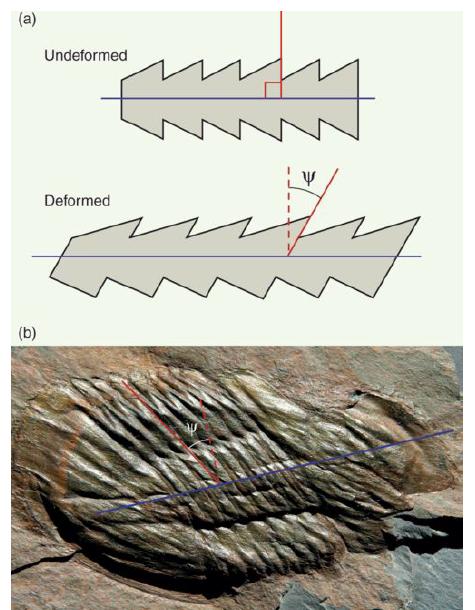
How much shear strain has the trilobite in Figure 3.3 experienced parallel to its axial line?Figure 3.3: (a) Undeformed (b) Deformed
How can we find three-dimensional strain from a deformed conglomerate?
Shear zones are expressions of heterogeneous strain. How can we perform strain analyses in shear zones?
What is meant by strain partitioning in this context?
When is it appropriate to use the term pressure in geology?
How can we graphically visualize the state of stress in two and three dimensions?
Where could we expect to find tensile stress in the crust?
How will the shape and orientation of the stress ellipsoid change if we define a different coordinate system?
Will the stress tensor (matrix) look different if we choose a different coordinate system?
A diagonal tensor has numbers on the diagonal running from the upper left to the lower right corner, with all other entries being zero. What does a diagonal stress tensor imply?
If the diagonal entries in a diagonal stress matrix are equal, what does the stress ellipsoid look like, and what do we call this state of stress?
If we apply a stress vector at various angles to a given surface, at what angle is the shear stress at its maximum? How does that compare to applying a force (also a vector) to the same surface, i.e. at what orientation would the shear component of the force be maximized?
How can we get information about the stress field near the surface? Some kilometers down? Even deeper down?
Which of the three reference states of stress are, by nature, isotropic?
Is the uniaxial-strain reference state a stress or strain state?How are stress and strain related in this model?
What physical factors control the state of stress in a rock that is being uplifted through the upper crust?
Why does sandstone fracture more easily than shale when uplifted?
How can we define tectonic stress?
What conditions must apply for Anderson’s classification of tectonic stress to be strictly valid?
What is the differential stress at 5 km depth for continental crust if we have a perfect lithostatic state of stress?
What forces related to plate tectonics can cause tectonic stress?
Why do we find evidence of strike-slip and normal-fault stress regimes in addition to the thrust-fault regime in active(contractional) orogens such as the Himalaya and Andes?
What stress regime(s) would we expect along strike-slip faults such as the San Andreas Fault?
Why does the differential stress increase downwards in the brittle crust?
If we increase the fluid pressure in a sandstone unit, will the effective stress increase or decrease?
What is the difference between rheology and rock mechanics?
What is a constitutive law or equation?
What does isotropic mean?
What is an elastic material?
What is an incompressible medium, and what is its Poisson’s ratio?
Some media are easier to elastically bend, stretch or shorten than others – we could say that there is a difference in stiffness.What constants describe the stiffness of an elastic material or its resistance to elastic deformation?
What is the yield stress and what happens if it is exceeded?
What is the difference between linear elastic and linear viscous?
What types of materials are truly viscous? What parts of the Earth can be modeled as being viscous?
What does it mean that a rock layer is more competent than its neighboring layers?
What could cause strain softening and strain hardening in a deforming rock?
What is the difference between plastic deformation and creep?
What controls the locations of brittle–plastic transitions in the lithosphere?
What is the difference between cataclastic and granular flow?
What is frictional sliding?
What is the process zone that is located at the tip of shear fractures?
What is the difference between fractures and deformation bands?
Why do shear fractures not form at 45° to σ1, where the resolved shear stress is at its maximum?
What is a wing crack and how do they form?
What structures can be found on joints that can reveal their growth history?
What does it mean that a rock is critically stressed?
What is a failure envelope and how is it established for a rock?
What is meant by the term Griffith cracks, and how do they affect rock strength and fracture propagation?
Why are large rock samples weaker than small samples of the same rock?
What is the coefficient of sliding friction and what is a representative value for this coefficient for the brittle crust?
What is the difference between joints, fissures and veins?
In a layered sequence, would we expect the stiffest layer to contain more or fewer joints?
Will a thicker layer normally contain more or fewer joints than a thinner layer, given that their properties are similar?
Why do joints tend to be evenly spaced rather than clustered?
What is the relationship between joint orientation and stress?
Geometrically, how do joints propagate?
Why do joints typically first form in the stiffest layers?
What is the difference between syntaxial and antitaxial veins?
Joints typically form during exhumation of rock units. Why?
During extension, why do we sometimes get joints (and veins) and other times shear fractures and faults?
What structures can be found on joints that can reveal their growth history?
Are joints good or bad structures in the field of petroleum geology, and why?
What is the difference between shear fractures and faults?
Why do normal faults tend to be steeper than reverse faults?
What are the main differences between a mylonite and a cataclasite?
A vertical well is drilled through a stratigraphic section twice (repeated section). What type of fault can we infer, and why can we not explain this by folding?
Why would the damage zone grow during faulting?
Would the damage zone be visible on good 3-D seismic data?
How can dipmeter data help identifying faults?
Is fault sealing good or bad in terms of petroleum exploration and production?
Why must we be careful when interpreting lineations as displacement indicators?
What are the premises for successful paleostress analysis?
What is meant by the expression “slip inversion”?
What are conjugate faults, and what stress information do they give?
What does the Wallace–Bott hypothesis postulate?
What is the reduced stress tensor?
What is the difference between a slip plane in a plastically deforming crystal and a slip plane associated with brittle faulting?
What are the principal differences between brittle and plastic deformation?
Why is intracrystalline fracturing so common in brittle deformation of highly porous rocks?
Name two plastic deformation mechanisms that can operate at shallow crustal depths.
What is meant by the term dislocation creep and how does it differ from diffusion?
What deformation mechanism is particularly active in finegrained rocks at high temperatures (in the lower crust and the mantle)?
What information can we get from dynamically deformed quartz that disappears during static recrystallization?
What is the difference between recrystallization by subgrain rotation and grain boundary migration?
Make a sketch map of a dome, a basin, an upright synform and a plunging upright synformal anticline.
How could dome-and-basin patterns form?
How can we distinguish between flexural flow and orthogonal flexure?
How would we identify a buckle fold?
A shear fold?
What is the difference between a parallel and a similar fold?
What fold types are parallel?
Where can we expect to find similar folds?
Showing 100 - 200
of 293
1
2
3
Step by Step Answers

 Get 50% OFF
Claim Now
Get 50% OFF
Claim Now