



Question: Air Force Col. John P. Stapp was a pioneer in the study of the effects of large, rapid accelerations and decelerations on humans, as well
(a) Calculate the average (negative) acceleration that Col. Stapp experienced as the sled came to a stop. How many g €™s is this?
(b) Find the distance Stapp traveled during the time it took to brake the sled from its maximum speed to rest.
Because the acceleration of the sled as it was brought to a stop was not constant, the average acceleration computed in part (a) is smaller than the maximum (negative) acceleration that Col. Stapp suffered. On-board measurements showed that Stapp survived up to 46.2 g€™s of acceleration during the final moments of his run (see Table 1.3).
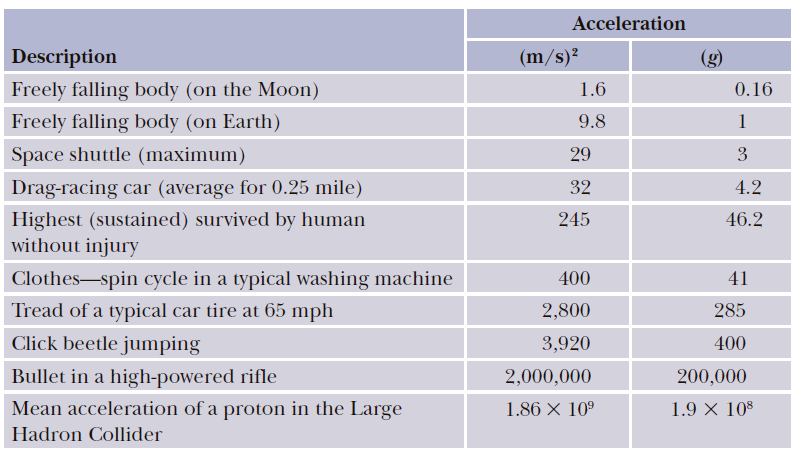
Acceleration Description (g) (m/s) Freely falling body (on the Moon) 1.6 0.16 Freely falling body (on Earth) 9.8 Space shuttle (maximum) 29 Drag-racing car (average for 0.25 mile) 32 4.2 Highest (sustained) survived by human without injury 245 46.2 Clothes-spin cycle in a typical washing machine 400 41 Tread of a typical car tire at 65 mph 2,800 285 Click beetle jumping 3,920 400 Bullet in a high-powered rifle 2,000,000 200,000 Mean acceleration of a proton in the Large 1.86 X 10⁹ 1.9 108 Hadron Collider
Step by Step Solution
3.55 Rating (169 Votes )
There are 3 Steps involved in it
Col Stapp reached a velocity of 2824 ms after which the ... View full answer

Get step-by-step solutions from verified subject matter experts