







Question: Reconsider Example 3.11 using a work-energy analysis. That is, assume the amplitude of the swing is (theta) at the end of an arbitrary cycle. Use
Reconsider Example 3.11 using a work-energy analysis. That is, assume the amplitude of the swing is \(\theta\) at the end of an arbitrary cycle. Use the principle of work-energy to determine the amplitude at the end of the next half-cycle.
Data From Example 3.11:
A father builds a swing for his children. The swing consists of a board attached to two ropes, as shown in Figure 3.17. The swing is mounted on a tree branch, with the board 3.5 m below the branch. The diameter of the branch is 8.2 cm and the kinetic coefficient of friction between the ropes and the branch is 0.1. After the swing is installed and his child is seated, the father pulls the swing back 10 and releases. What is the decrease in angle of each swing and how many swings will the child receive before Dad needs to give another push?
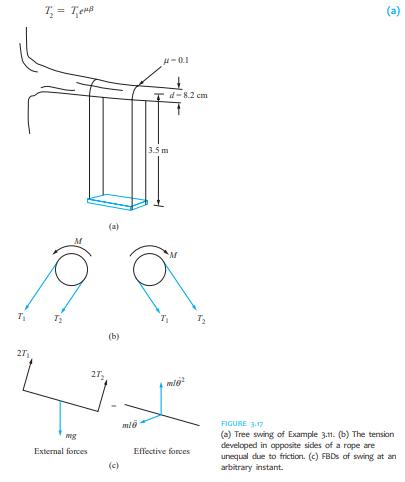
27 T: = -0.1 Td-8.2 cm 3.5 m 'M 2T mig mg External forces (c) 12 Effective forces FIGURE 3.17 (a) Tree swing of Example 3.11. (b) The tension developed in opposite sides of a rope are unequal due to friction. (c) FBDs of swing at an arbitrary instant.
Step by Step Solution
3.41 Rating (157 Votes )
There are 3 Steps involved in it

Get step-by-step solutions from verified subject matter experts
 Study Help