







Question: 5.19 Let X be a binomial random variable with n = 20 and p=0.1. a. Calculate P(X4) using the binomial formula. b. Calculate P(X 4)
5.19 Let X be a binomial random variable with n = 20 and p=0.1.
a. Calculate P(X4) using the binomial formula.
b. Calculate P(X 4) using Table 1 in Appendix I.
c. Use the Excel output below to calculate P(X 4). Compare the results of parts
a, b, and
c. d. Calculate the mean and standard deviation of the random variable X.
e. Use the results of part d to calculate the intervals , 20, and 30. Find the probability that an observation will fall into each of these intervals.
f. Are the results of part e consistent with Tchebysheff's Theorem? With the Empirical Rule? Why or why not? Excel Output for Exercise 5.19: Binomial with n = 20 and p = 0.1
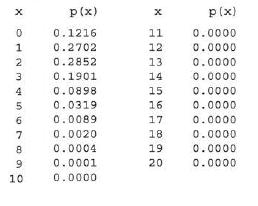
x p(x) x p(x) 0 0.1216 11 0.0000 1 0.2702 12 0.0000 2 0.2852 13 0.0000 3 0.1901 14 0.0000 4 0.0898 15 0.0000 5 0.0319 16 0.0000 6 0.0089 17 0.0000 7 0.0020 18 0.0000 8 0.0004 19 0.0000 9 0.0001 20 0.0000 10 0.0000
Step by Step Solution
There are 3 Steps involved in it

Get step-by-step solutions from verified subject matter experts
 Study Help