







Question: To construct a stem-and-leaf display with more stems than there would be otherwise, we might repeat each stem. The leaves $0,1,2,3$, and 4 would be
To construct a stem-and-leaf display with more stems than there would be otherwise, we might repeat each stem. The leaves $0,1,2,3$, and 4 would be attached to the first stem and leaves $5,6,7,8$, and 9 to the second. For the humidity readings on page 31 , we would thus get the double-stem display:
| 1 | 2 |
|---|---|
| 1 | 57 |
| 2 | 1134 |
| 2 | 5789 |
| 3 | 244 |
| 3 | 79 |
| 4 | 24 |
| 4 | 8 |
| 5 | 3 |
where we doubled the number of stems by cutting the interval covered by each stem in half. Construct a double-stem display with one-digit leaves for the data in Exercise 2.14.
Data From Exercise 2.14
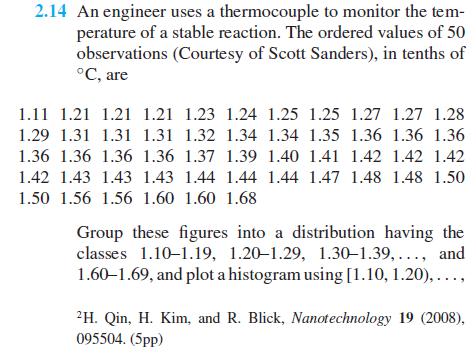

2.14 An engineer uses a thermocouple to monitor the tem- perature of a stable reaction. The ordered values of 50 observations (Courtesy of Scott Sanders), in tenths of C, are 1.11 1.21 1.21 1.21 1.23 1.24 1.25 1.25 1.27 1.27 1.28 1.29 1.31 1.31 1.31 1.32 1.34 1.34 1.35 1.36 1.36 1.36 1.36 1.36 1.36 1.36 1.37 1.39 1.40 1.41 1.42 1.42 1.42 1.42 1.43 1.43 1.43 1.44 1.44 1.44 1.47 1.48 1.48 1.50 1.50 1.56 1.56 1.60 1.60 1.68 Group these figures into a distribution having the classes 1.10-1.19, 1.20-1.29, 1.30-1.39,..., and 1.60-1.69, and plot a histogram using [1.10, 1.20),..., 2H. Qin, H. Kim, and R. Blick, Nanotechnology 19 (2008), 095504. (5pp)
Step by Step Solution
3.39 Rating (155 Votes )
There are 3 Steps involved in it

Get step-by-step solutions from verified subject matter experts
 Study Help