







Question: (a) Generalize Problem 8.2, using the trial wave function for arbitrary n. (b) Find the least upper bound on the first excited state of the
(a) Generalize Problem 8.2, using the trial wave function for arbitrary n.
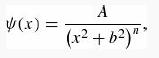
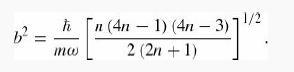
(b) Find the least upper bound on the first excited state of the harmonic oscillator using a trial function of the form
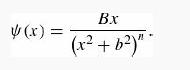
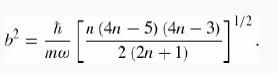
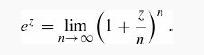
(c) Notice that the bounds approach the exact energies as n → ∞ . Why is that? Plot the trial wave functions for n = 2, n = 3, and n = 4, and compare them with the true wave functions (Equations 2.60 and 2.63). To do it analytically, start with the identity
V(x) = A (x + b)"
Step by Step Solution
3.40 Rating (162 Votes )
There are 3 Steps involved in it
We will need the following integral repeatedly a b c ... View full answer

Get step-by-step solutions from verified subject matter experts
 Study Help