







Question: Consider operators A and B that do not commute with each other but do commute with their commutator: (for instance, x and p). (a) Show
Consider operators  and B̂ that do not commute with each other ![(C = [A, B])](https://dsd5zvtm8ll6.cloudfront.net/si.question.images/images/question_images/1673/5/1/1/81463bfc3862a8f21673511814026.jpg) but do commute with their commutator:
but do commute with their commutator:
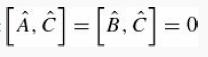
(for instance, x̂ and p̂).
(a) Show that
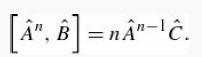
You can prove this by induction on n, using Equation 3.65.
(b) Show that
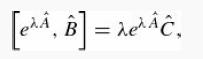
where λ is any complex number. Express eλ as a power series.
(c) Derive the Baker–Campbell–Hausdorff formula:
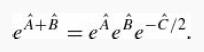

these functions are equal at λ = 0, and show that they satisfy the same differential equation:
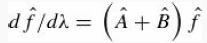
and
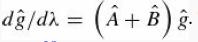
Therefore, the functions are themselves equal for all λ.
Equation 3.65

(C = [A, B])
Step by Step Solution
3.44 Rating (151 Votes )
There are 3 Steps involved in it
a Its trivial for n 1 Assume it is true for and prove ... View full answer

Get step-by-step solutions from verified subject matter experts
 Study Help