New Semester
Started
Get
50% OFF
Study Help!
--h --m --s
Claim Now
Question Answers
Textbooks
Find textbooks, questions and answers
Oops, something went wrong!
Change your search query and then try again
S
Books
FREE
Study Help
Expert Questions
Accounting
General Management
Mathematics
Finance
Organizational Behaviour
Law
Physics
Operating System
Management Leadership
Sociology
Programming
Marketing
Database
Computer Network
Economics
Textbooks Solutions
Accounting
Managerial Accounting
Management Leadership
Cost Accounting
Statistics
Business Law
Corporate Finance
Finance
Economics
Auditing
Tutors
Online Tutors
Find a Tutor
Hire a Tutor
Become a Tutor
AI Tutor
AI Study Planner
NEW
Sell Books
Search
Search
Sign In
Register
study help
mathematics
applied linear algebra
Applied Linear Algebra 2nd Edition Peter J. Olver, Chehrzad Shakiban - Solutions
Graph the following planes and determine whether they have a common intersection:x + y + z = 1, x + y = 1, x + z = 1.
Which is faster: Back Substitution or multiplying a matrix by a vector? How much faster?
Find a formula for the transposed product (ABC)T in terms of AT ,BT and CT.
True or false: A singular matrix cannot be regular.
True or false: Every square matrix A commutes with its transpose AT.
(a) Write down the 5 × 5 identity and zero matrices. (b) Write down their sum and their product. Does the order of multiplication matter?
(a) Let U be a m × n matrix and V an n × m matrix, such that the m × m matrix Im + U V is invertible. Prove that In +V U is also invertible, and is given by(b) The Sherman–Morrison–Woodbury formula generalizes this identity toExplain what assumptions must be made on the matrices A,B, U, V
True or false: A square matrix that has a column with all 0 entries is singular. What can you say about a linear system that has such a coefficient matrix?
An alternative solution strategy, also called Gauss–Jordan in some texts, is, once a pivot is in position, to use elementary row operations of type #1 to eliminate all entries both above and below it, thereby reducing the augmented matrix to diagonal form D | c where D = diag(d1, . . . ,dn) is a
(a) Show that if A has size n × n, then det(−A) = (−1)n detA. (b) Prove that, for n odd, any n × n skew-symmetric matrix A = −AT is singular. (c) Find a nonsingular skew-symmetric matrix.
Prove that if A is an invertible matrix, then AAT and ATA are also invertible.
Write out the following diagonal matrices: (a) Diag(1, 0,−1), (b) Diag(2,−2, 3,−3).
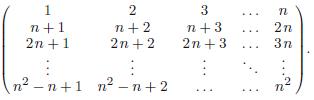
Find the rank of the n × n matrix 1 n+1 2n +1 2 n+2 2n+2 n²n+1 n²n+2 3 n +3 2n + 3 n 2n 3n n 2
True or false: (a) The product of two tridiagonal matrices is tridiagonal.(b) The inverse of a tridiagonal matrix is tridiagonal.
What does it mean if a linear system has a coefficient matrix with a column of all 0’s?
Show that if a square matrix A satisfies A2 − 3A + I = O, then A − 1 = 3I − A.
True or false: One can find an m × n matrix of rank r for every 0 ≤ r ≤ min {m, n}.
True or false: Every m × n matrix has (a) Exactly m pivots; (b) At least one pivot.
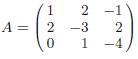
Given the factorization explain, without computing, which elementary row operations are used to reduce A to upper triangular form. Be careful to state the order in which they should be applied. Then check the correctness of your answer by performing the elimination. 1 0 +- ( 1 9 - ( 4 1 9 6 1 A
A square matrix P is called idempotent if P2 = P. (a) Find all 2 × 2 idempotent upper triangular matrices. (b) Find all 2 × 2 idempotent matrices.
(a) Let P and Q be n × n permutation matrices and v ∈ Rn a vector. Under what conditions does the equation P v = Qv imply that P = Q? (b) Answer the same question when PA = QA, where A is an n × k matrix.
Show that if A is a nonsingular matrix, so is everyy power An.
(a) Let A be an m × n matrix and let M = A | b be the augmented matrix for the linear system Ax = b. Show that either (i) Rank A = rank M, or (ii) Rank A = rank M − 1.(b) Prove that the system is compatible if and only if case (i) holds.
Prove that one cannot produce an elementary row operation of type #2 by a combination of elementary row operations of type #1.
Let A be an m × n matrix. What are the permissible sizes for the zero matrices appearing in the identitie AO = O and OA = O?
True or false: If A,B are square matrices of the same size, thenA2 − B2 = (A + B)(A − B).
What is the effect of permuting the columns of its coefficient matrix on a linear system?
Find a nonzero matrix A ≠ O such that A2 = O.
True or false: The pivots of a nonsingular matrix are uniquely defined.
True or false: If A has a zero entry on its main diagonal, it is not regular.
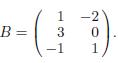
(a) Suppose A̅ is obtained from A by applying an elementary row operation. Let C = AB, where B is any matrix of the appropriate size. Explain why C̅ = A̅B can be obtained by applying the same elementary row operation to C. (b) Illustrate by adding −2 times the first row to the third row of
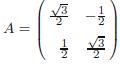
Express as a product of elementary matrices. A Но как
Let A be a matrix and c a scalar. Find all solutions to the matrix equation c A = I.
Showing 300 - 400
of 333
1
2
3
4
Step by Step Answers

 Get 50% OFF
Claim Now
Get 50% OFF
Claim Now