New Semester
Started
Get
50% OFF
Study Help!
--h --m --s
Claim Now
Question Answers
Textbooks
Find textbooks, questions and answers
Oops, something went wrong!
Change your search query and then try again
S
Books
FREE
Study Help
Expert Questions
Accounting
General Management
Mathematics
Finance
Organizational Behaviour
Law
Physics
Operating System
Management Leadership
Sociology
Programming
Marketing
Database
Computer Network
Economics
Textbooks Solutions
Accounting
Managerial Accounting
Management Leadership
Cost Accounting
Statistics
Business Law
Corporate Finance
Finance
Economics
Auditing
Tutors
Online Tutors
Find a Tutor
Hire a Tutor
Become a Tutor
AI Tutor
AI Study Planner
NEW
Sell Books
Search
Search
Sign In
Register
study help
mathematics
calculus 10th edition
Calculus 10th Edition Ron Larson, Bruce H. Edwards - Solutions
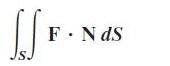
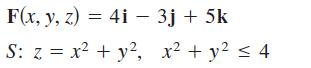
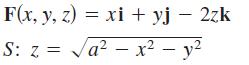
Find the flux of F through S,where N is the upward unit normal vector to S. JsJ F. NdS
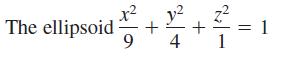
Find a vector-valued function whose graph is the indicated surface. The ellipsoid + 9 4 1 || 1
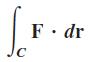
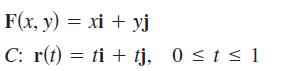
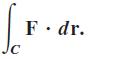
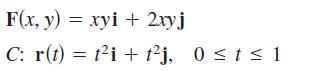
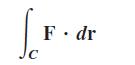
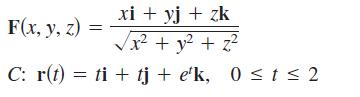
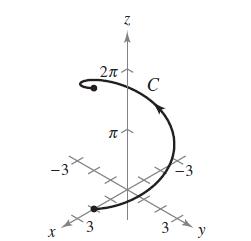
Evaluatewhere C is represented by r(t). So с F. dr
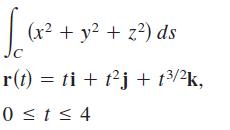
Use a computer algebra system to evaluate the line integral over the given path. So r(t) = ti + t²j + 1³/2k, 0 ≤ t ≤ 4 (x² + y² + z²) ds
Find a vector-valued function whose graph is the indicated surface.The cylinder z = x²
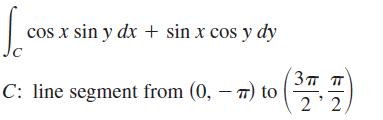
Evaluate the line integral using the Fundamental Theorem of Line Integrals. Use a computer algebra system to verify your results. So cos x sin y dx + sin x cos y dy C: line segment from (0, -п) to Зп п 2 2
Determine whether the vector field is conservative.F(x, y) = sin yi + x cos yj
Prove the identity, assuming that Q, S, and N meet the conditions of the Divergence Theorem and that the required partial derivatives of the scalar functions ƒ and g are continuous. The expressions DNƒ and DNg are the derivatives in the direction of the vector N and are defined by DNf=VfN, Dng =
Find the flux of F through S,where N is the upward unit normal vector to S. JsJ F. NdS
Use a line integral to find the area of the region R. R: region inside the loop of the folium of Descartes bounded by the graph of X = 3t 1³ + 1' y 31² t³ + 1
Use a line integral to find the area of the region R.R: region bounded by the graphs of y = 5x - 3 and y = x² + 1
Prove the identity, assuming that Q, S, and N meet the conditions of the Divergence Theorem and that the required partial derivatives of the scalar functions ƒ and g are continuous. The expressions DNƒ and DNg are the derivatives in the direction of the vector N and are defined by DNf=VfN, Dng =
Evaluatewhere C is represented by r(t). So с F. dr
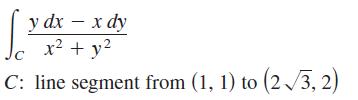
Evaluate the line integral using the Fundamental Theorem of Line Integrals. Use a computer algebra system to verify your results. S x² + y² C: line segment from (1, 1) to (2√3, 2) y dx - x dy
Determine whether the vector field is conservative.F(x, y) = 5y²(yi + 3xj)
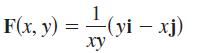
Determine whether the vector field is conservative. F(x, y) = -—-(yi - xj) xy
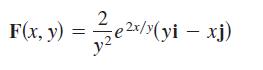
Determine whether the vector field is conservative. F(x, y) = 2e²x/y(yi - xj)
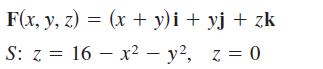
Find the flux of F over the closed surface. (Let N be the outward unit normal vector of the surface.) F(x, y, z) = (x + y)i + yj + zk S: z = 16x² - y², z = 0
Evaluatewhere C is represented by r(t). So с F. dr
Evaluate the line integral using the Fundamental Theorem of Line Integrals. Use a computer algebra system to verify your results. So e sin y dx + e* cos y dy C: cycloid x = - sin 0, y = 1- cos 0 from (0, 0) to (27, 0)
Find a vector-valued function whose graph is the indicated surface. The part of the plane z = 4 that lies inside the cylinder x² + y² = 9
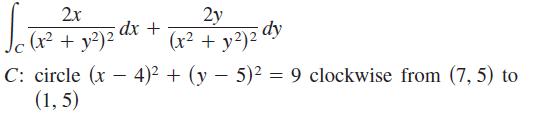
Evaluate the line integral using the Fundamental Theorem of Line Integrals. Use a computer algebra system to verify your results. le taz 2x (x² + y²)² dx + 2y (x² + y²)2 dy C: circle (x-4)² + (y - 5)² = 9 clockwise from (7,5) to (1,5)
Find the lateral surface area over the curve C in the xy-plane and under the surface z = ƒ(x, y).ƒ(x, y) = 3 + sin(x + y); C: y = 2x from (0, 0) to (2, 4)
Find the flux of F over the closed surface. (Let N be the outward unit normal vector of the surface.) F(x, y, z) = 4xyi + z²j + yzk S: unit cube bounded by x = 0, x = 1, y = 0, y = 1, z = 0, z = 1
Evaluatewhere C is represented by r(t). So с F. dr
Evaluate the following C F. dr.
Find a vector-valued function whose graph is the indicated surface.The part of the paraboloid z = x² + y² that lies inside the cylinder x² + y² = 9
Write a set of parametric equations for the surface of revolution obtained by revolving the graph of the function about the given axis. Function X 2² 0≤x≤6 Axis of Revolution x-axis
Find the lateral surface area over the curve C in the xy-plane and under the surface z = ƒ(x, y).ƒ(x, y) = 12 - x - y; C: y = x² from (0, 0) to (2, 4)
Use Green’s Theorem to verify the line integral formulas. The centroid of the region having area A bounded by the simple closed path C is X 24 xdy, y = 24 y'dx.
Evaluatewhere C is represented by r(t). So с F. dr
Evaluate the line integral using the Fundamental Theorem of Line Integrals. Use a computer algebra system to verify your results.(a) C: line segment from (0, 0, 0) to (1, 1, 1)(b) C: line segments from (0, 0, 0) to (0, 0, 1) to (1, 1, 1)(c) C: line segments from (0, 0, 0) to (1, 0, 0) to (1, 1, 0)
Evaluate the following C F. dr.
Give the line integral for the area of a region R bounded by a piecewise smooth simple curve C.
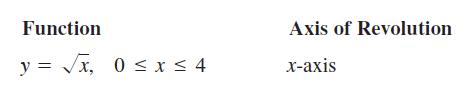
Write a set of parametric equations for the surface of revolution obtained by revolving the graph of the function about the given axis. Function y = √√√x, 0 ≤ x ≤ 4 Axis of Revolution x-axis
Evaluatewhere C is represented by r(t). So с F. dr
Evaluate the line integral using the Fundamental Theorem of Line Integrals. Use a computer algebra system to verify your results.Repeat Exercise 31 using the integralData from in Exercise 31Evaluate the line integral using the Fundamental Theorem of Line Integrals. Use a computer algebra system to
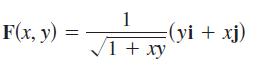
Determine whether the vector field is conservative. F(x, y) 1 1+ :(yi + xj) y
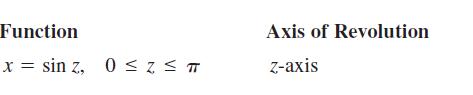
Write a set of parametric equations for the surface of revolution obtained by revolving the graph of the function about the given axis. Function x = sin Z, 0 ≤ Z ≤ T Axis of Revolution Z-axis
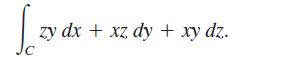
Let E = yzi + xzj + xyk be an electrostatic field. Use Gauss's Law to find the total charge enclosed by the closed surface consisting of the hemisphere z = √1- x² - y2 and its circular base in the xy-plane.
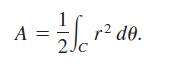
Use Green’s Theorem to verify the line integral formulas. The area of a plane region bounded by the simple closed path C given in polar coordinates is A || ½r²do. 2.
Use a computer algebra system to evaluate the integralwhere C is represented by r(t). So C F. dr
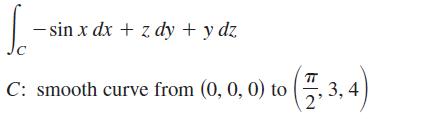
Evaluate the line integral using the Fundamental Theorem of Line Integrals. Use a computer algebra system to verify your results. So C: smooth curve from (0, 0, 0) to (7, 3, 4) -sin x dx + z dy + y dz
Evaluate the following C F. dr.
Let E = xi + yj + 2zk be electrostatic field. Use Gauss's Law to find the total charge enclosed by the closed surface consisting of the hemisphere z = √1- x² - y2 and its circular base in the xy-plane.
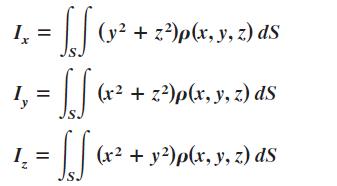
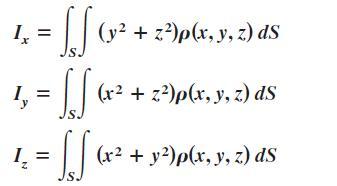
Use the following formulas for the moments of inertia about the coordinate axes of a surface lamina of density ρ.Verify that the moment of inertia of a conical shell of uniform density about its axis is 1/2ma², where m is the mass and a is the radius and height. Ix = 1₂ I₁ = N ff (y²
Evaluate the following C F. dr.
Determine whether the vector field is conservative. If it is, find a potential function for the vector field.F(x, y) = yi + xj
Use the following formulas for the moments of inertia about the coordinate axes of a surface lamina of density ρ.Verify that the moment of inertia of a spherical shell of uniform density about its diameter is 2/3ma², where m is the mass and a is the radius. I₂ = I, 1₁ = Į₂ N ff (y² +
Use a computer algebra system to evaluate the integralwhere C is represented by r(t). So C F. dr
Write a set of parametric equations for the surface of revolution obtained by revolving the graph of the function about the given axis. Function z = y² + 1, 0 ≤ y ≤ 2 Axis of Revolution y-axis
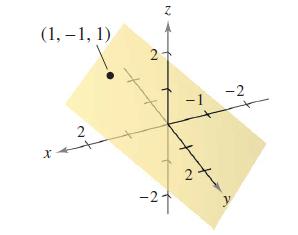
Find an equation of the tangent plane to the surface represented by the vector-valued function at the given point.r(u, v) = (u + v)i + (u − v)j + vk, (1,-1, 1) (1,-1, 1) X 2 N -24 -2
Evaluate the following C F. dr.
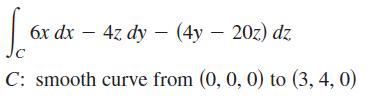
Evaluate the line integral using the Fundamental Theorem of Line Integrals. Use a computer algebra system to verify your results. So 6x dx - 4zdy (4y - 20z) dz C: smooth curve from (0, 0, 0) to (3, 4, 0)
To find the centroid of the region.R: region bounded by the graphs of y = 0 and y = 4 - x²
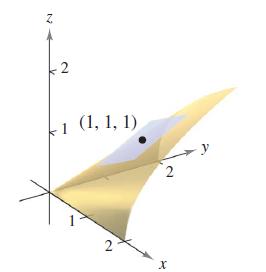
Find an equation of the tangent plane to the surface represented by the vector-valued function at the given point.r(u, v) = ui + vj + √uvk, (1, 1, 1) 2 1 (1, 1, 1) 2 2 X
Evaluate the following C F. dr.
Determine whether the vector field is conservative. If it is, find a potential function for the vector field.F(x, y) = 3x²y²i + 2x³yj
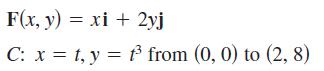
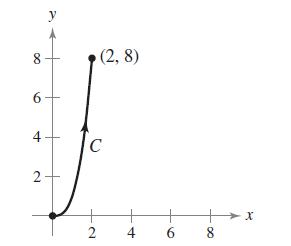
Find the work done by the force field F on a particle moving along the given path. F(x, y) = xi + 2yj C: x = 1, y = f from (0, 0) to (2,8)
To find the centroid of the region.R: region bounded by the graphs of y = √a² - x² and y = 0
Determine whether the vector field is conservative. If it is, find a potential function for the vector field.F(x, y) = 2xyi + x²j
Find Iz, for thegiven lamina with uniform density of 1. Use a computer algebrasystem to verify your results.x² + y² = a², 0 ≤ z ≤ h
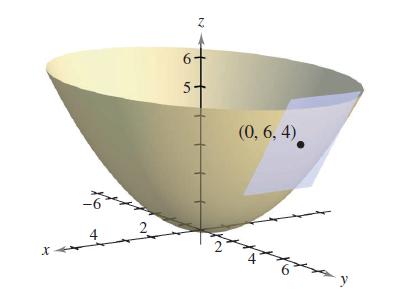
Find an equation of the tangent plane to the surface represented by the vector-valued function at the given point.r(u, v) = 2u cos vi + 3u sin vj + u²k, (0, 6, 4) -6 4 2 6 5+ 2 (0, 6, 4) 4 6
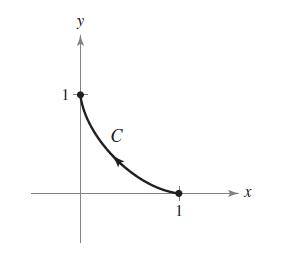
Find the work done by the force field F on a particle moving along the given path. F(x, y) = x²ixyj C: x = cos³ t, y = sin³ t from (1, 0) to (0, 1)
Find the centroid of the region.R: region bounded by the graphs of y = x³ and y = x, 0 ≤ x ≤ 1
Find the work done by the forcefield F in moving an object from P to Q.F(x, y) = 9x²y²i + (6x³y - 1)j; P(0, 0), Q(5,9)
Determine whether the vector field is conservative. If it is, find a potential function for the vector field.F(x, y) = xex2y(2yi + xj)
Find the work done by the force field F in moving an object from P to Q. F(x, y) = 2xi x² y v2j; P(-1, 1), Q(3, 2)
Use a computer algebra system to evaluate the line integral. So xy dx + (x² + y²) dy C: y = x² from (0, 0) to (2, 4) and y = 2x from (2, 4) to (0, 0)
Find Iz, for the given lamina with uniform density of 1. Use a computer algebra system to verify your results.z = x² + y², 0 ≤ z ≤ h
To find the centroid of the region.R: triangle with vertices (-a, 0), (a, 0), and (b, c), where - a ≤ b ≤ a
Determine whether the vector field is conservative. If it is, find a potential function for the vector field.F(x, y) = 15y³i - 5xy²j
Use a computer algebra system to find the rate of mass flow of a fluid of density ρ through the surface S oriented upward when the velocity field is given by F(x, y, z) = 0.5zk.S: z = 16 - x² - y², z ≥ 0
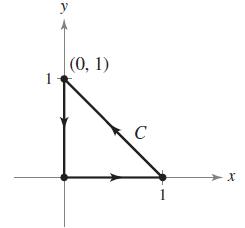
Find the work done by the force field F on a particle moving along the given path. F(x, y) = xi + yj C: counterclockwise around the triangle with vertices (0, 0), (1, 0), and (0, 1)
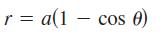
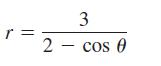
Use the results of Exercise 32 to find the area of the region bounded by the graph of the polar equation.Data from in Exercise 32Use Green’s Theorem to verify the line integral formulas.The area of a plane region bounded by the simple closed path C given in polar coordinates is A || ½r²do. 2.
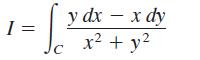
Letwhere C is a circle oriented counterclockwise. Show that I = 0 when C does not contain the origin. What is I when C do contain the origin? = S² C I = y dx - x dy x² + y²
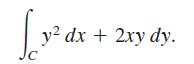
Evaluate the line integral(a) C: r(t) = (1 + 3t)i + (1 + t)j, 0≤ t ≤ 1(b) C: r(t) = ti + √tj, 1 ≤ t ≤ 4(c) Use the Fundamental Theorem of Line Integrals, where Cis a smooth curve from (1, 1) to (4,2). Love y² dx + 2xy dy.
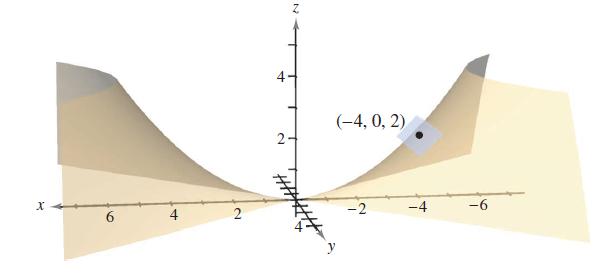
Find an equation of the tangent plane to the surface represented by the vector-valued function at the given point.r(u, v) = 2u cosh vi + 2u sinh vj + 1/2u2k, (−4, 0, 2) X 6 4 2 N + T T 2- (-4, 0, 2) -2 T -6
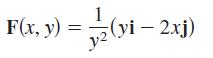
Determine whether the vector field is conservative. If it is, find a potential function for the vector field. 1 F(x, y) = (yi — 2xj) - y²
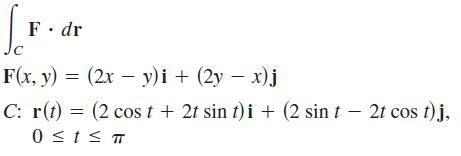
Use a computer algebra system to evaluate the line integral. So F. dr F(x, y) = (2x - y)i + (2y − x)j - C: r(t) = (2 cost + 2t sin t)i + (2 sin t - 2t cost)j, 0 ≤ t ≤ T
Use a computer algebra system to find the rate of mass flow of a fluid of density ρ through the surface S oriented upward when the velocity field is given by F(x, y, z) = 0.5zk.S: z = 16 - x² - y²
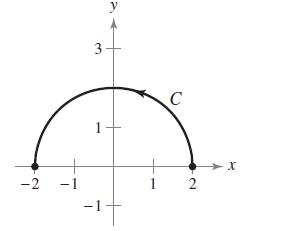
Find the work done by the force field F on a particle moving along the given path. F(x, y) = yi xj C: counterclockwise along the semicircle y (2, 0) to (-2, 0) = √4x² from
Can you find a path for the zip line in Exercise 39 such that the work done by the gravitational force field would differ from the amounts of work done for the two paths given? Explain why or why not.Data from in Exercise 39A zip line is installed 50 meters above ground level. It runs to a point on
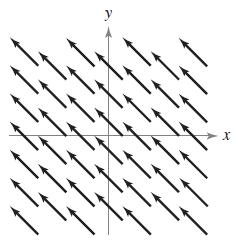
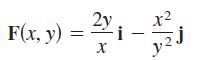
Consider the force field shown in the figure. Is the force field conservative? Explain why or why not. //// /// // /// 1712
Show that the cone can be represented parametrically by r(u, v) = u cos vi + u sin vj + uk, where 0 ≤ u and 0 ≤ y ≤ 2π.
Use the results of Exercise 32 to find the area of the region bounded by the graph of the polar equation.Data from in Exercise 32Use Green’s Theorem to verify the line integral formulas.The area of a plane region bounded by the simple closed path C given in polar coordinates is A || ½r²do. 2.
Determine whether the vector field is conservative. If it is, find a potential function for the vector field. F(x, y) = 2y X x² y²
Find the work done by the force field F on a particle moving along the given path. F(x, y) = -yi-xj C: counterclockwise along the semicircle y = √√√4 - x² from (2, 0) to (-2, 0)
Let F(x, y, z) = a₁i + a₂j + a3k be a constant force vector field. Show that the work done in moving a particle along any path from P to Q is W = F · PQ̅.
Find the area of the surface over the given region. Use a computer algebra system to verify your results. The part of the plane r(u, v) = 4ui - vj + vk, where 0 ≤ u ≤ 2 and 0 ≤ y ≤ 1
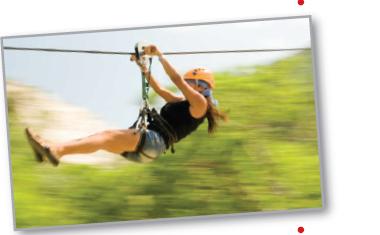
A zip line is installed 50 meters above ground level. It runs to a point on the ground 50 meters away from the base of the installation. Show that the work done by the gravitational force field for a 175-pound person moving the length of the zip line is the same for each path.(a) r(t) = ti + (50 -
Use the results of Exercise 32 to find the area of the region bounded by the graph of the polar equation.Data from in Exercise 32Use Green’s Theorem to verify the line integral formulas.The area of a plane region bounded by the simple closed path C given in polar coordinates is r = 1 + 2 cos
Find the area of the surface over the given region. Use a computer algebra system to verify your results. The part of the paraboloid u²k, where 0 ≤ u ≤ 2 and 0 ≤ y ≤ 2π r(u, v) = 2u cos vi + 2u sin vj +
Find the work done by the force field F = xi - √yj along the path y = x3/2 from (0, 0) to (4,8).
Define a surface integral of thescalar function f over a surface z = g(x, y). Explain how toevaluate the surface integral.
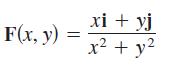
Determine whether the vector field is conservative. If it is, find a potential function for the vector field. F(x, y) = xi + yj x² + y²
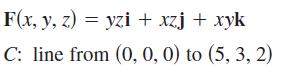
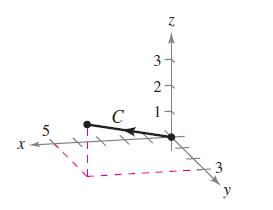
Find the work done by the force field F on a particle moving along the given path. F(x, y, z) = yzi + xzj + xyk C: line from (0, 0, 0) to (5, 3, 2)
Use the results of Exercise 32 to find the area of the region bounded by the graph of the polar equation.Data from in Exercise 32Use Green’s Theorem to verify the line integral formulas.The area of a plane region bounded by the simple closed path C given in polar coordinates is A || ½r²do. 2.
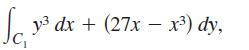
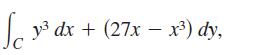
(a) Evaluatewhere C₁ is the unit circle given by r(t) = cos ti + sin tj, for 0 ≤ t ≤ 2 π.(b) Find the maximum value ofwhere C is any closed curve in the xy-plane, oriented counterclockwise. Sc, y³ dx y³ dx + (27x- x³) dy,
A 20-ton aircraft climbs 2000 feet while making a 90° turn in a circular arc of radius 10 miles. Find the work done by the engines.
Showing 600 - 700
of 9867
1
2
3
4
5
6
7
8
9
10
11
12
13
14
15
Last
Step by Step Answers

 Get 50% OFF
Claim Now
Get 50% OFF
Claim Now