New Semester
Started
Get
50% OFF
Study Help!
--h --m --s
Claim Now
Question Answers
Textbooks
Find textbooks, questions and answers
Oops, something went wrong!
Change your search query and then try again
S
Books
FREE
Study Help
Expert Questions
Accounting
General Management
Mathematics
Finance
Organizational Behaviour
Law
Physics
Operating System
Management Leadership
Sociology
Programming
Marketing
Database
Computer Network
Economics
Textbooks Solutions
Accounting
Managerial Accounting
Management Leadership
Cost Accounting
Statistics
Business Law
Corporate Finance
Finance
Economics
Auditing
Tutors
Online Tutors
Find a Tutor
Hire a Tutor
Become a Tutor
AI Tutor
AI Study Planner
NEW
Sell Books
Search
Search
Sign In
Register
study help
mathematics
calculus 10th edition
Calculus 10th Edition Ron Larson, Bruce H. Edwards - Solutions
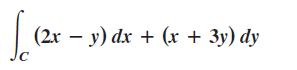
Evaluate the integralalong the path C.C: elliptic path x = 4 sin t, y = 3 cos t from (0, 3) to (4, 0) (((2x - y) (2x - y) dx + (x + 3y) dy C
Evaluate the integralalong the path C.C: parabolic path x = 1, y = 2t² from (0, 0) to (2, 8) (((2x - y) (2x - y) dx + (x + 3y) dy C
Find the divergence of the vector field F.F(x, y, z) = ln(x² + y²)i + xyj + ln(y² + z²)k
Find the divergence of the vector field F at the given point.F(x, y, z) = xyzi + xyj + zk; (2, 1, 1)
Prove that it is not possible for a vector field with twice- differentiable components to have a curl of xi + yj + zk.
Find the divergence of the vector field F at the given point.F(x, y, z) = x²zi - 2xzj + yzk; (2,−1, 3)
Find the divergence of the vector field F at the given point.F(x, y, z) = ex sin yi - ex cos yj + z²k; (3, 0, 0)
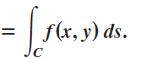
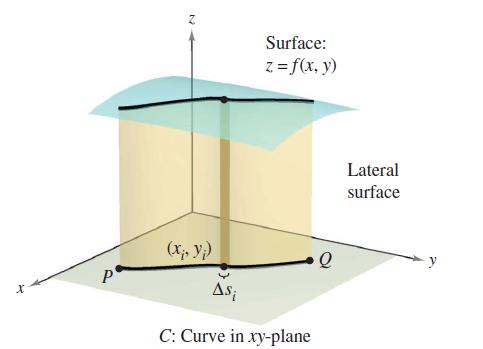
Find the area of the lateral surface (see figure) over the curve C in the xy-plane and under the surface z = ƒ(x, y), whereLateral surface area ƒ(x, y) = y, C: line from (0, 0) to (4,4) = [50 C f(x, y) ds.
Find the area of the lateral surface (see figure) over the curve C in the xy-plane and under the surface z = ƒ(x, y), whereLateral surface area ƒ(x, y) = xy, C: x² + y² = 1 from (1, 0) to (0, 1) = [50 C f(x, y) ds.
Find the area of the lateral surface (see figure) over the curve C in the xy-plane and under the surface z = ƒ(x, y), whereLateral surface area ƒ(x, y) = h, C: line from (0, 0) to (3, 4) = [50 C f(x, y) ds.
Find the area of the lateral surface (see figure) over the curve C in the xy-plane and under the surface z = ƒ(x, y), whereLateral surface area ƒ(x, y) = h, C: y = 1 - x² from (1, 0) to (0, 1) = [50 C f(x, y) ds.
Find the area of the lateral surface (see figure) over the curve C in the xy-plane and under the surface z = ƒ(x, y), whereLateral surface area ƒ(x, y) = y + 1, C: y = 1 - x² from (1, 0) to (0, 1) = [50 C f(x, y) ds.
Find the area of the lateral surface (see figure) over the curve C in the xy-plane and under the surface z = ƒ(x, y), whereLateral surface area ƒ(x, y) = x + y, C: x² + y² = 1 from (1, 0) to (0, 1) = [50 C f(x, y) ds.
Find the divergence of the vector field F at the given point.F(x, y, z)= ln(xyz)(i + j + k); (3, 2, 1)
Define a vector field in the plane and in space. Give some physical examples of vector fields.
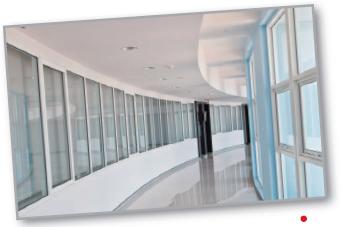
The ceiling of a building has a height above the floor given by z = 20 + 1/4x. One of the walls follows a path modeled by y = x³/2. Find thesurface area of the wallfor 0 ≤ x ≤ 40. (Allmeasurements are in feet.)
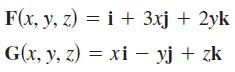
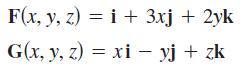
Find curl (F x G) = ∇ x (F x G). F(x, y, z)= i + 3xj + 2yk G(x, y, z) = xi - yj + zk
What is a conservative vector field?How do you test for it in the plane and in space?
Moments of Inertia Consider a wire of density ρ(x, y)given by the space curveThe moments of inertia about the x- and y-axes are given byFind the moments of inertia for the wire of density ρ.A wire lies along r(t) = a cos ti + a sin tj, where 0 ≤ t ≤ 2T and a > 0, with density ρ(x, y) = 1.
Find the area of the lateral surface (see figure) over the curve C in the xy-plane and under the surface z = ƒ(x, y), whereLateral surface area ƒ(x, y) = xy, C: y = 1- x² from (1, 0) to (0, 1) = [50 C f(x, y) ds.
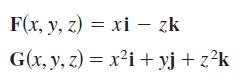
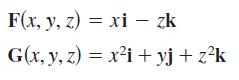
Find curl (F x G) = ∇ x (F x G). F(x, y, z) = xi - zk G(x, y, z) = x²i+yj + z²k
Define the curl of a vector field.
Find the area of the lateral surface (see figure) over the curve C in the xy-plane and under the surface z = ƒ(x, y), whereLateral surface area ƒ(x, y) = x² - y² + 4, C: x² + y² = 4 = [50 C f(x, y) ds.
Define the divergence of a vector field in the plane and in space.
Find div(F x G) = ∇ . (F x G). F(x, y, z)=xi - zk G(x, y, z) = x²i+yj + z²k
Moments of Inertia Consider a wire of density ρ(x, y) given by the space curveThe moments of inertia about the x- and y-axes are given byFind the moments of inertia for the wire of density ρ.A wire lies along r(t) = a cos ti + a sin tj, where 0 ≤ t ≤ 2π and a > 0, with density ρ(x, y) =
Find curl(curl F) = ∇ x (∇ x F).F(x, y, z) = xyzi + yj + zk
Find curl(curl F) = ∇ x (∇ x F).F(x, y, z) = x²zi - 2xzj + yzk
Work A particle moves along the path y = x² from the point (0, 0) to the point (1, 1). The force field F is measured at five points along the path, and the results are shown in the table. Use Simpson's Rule or a graphing utility to approximate the work done by the force field. (x, y) F(x, y) (0,
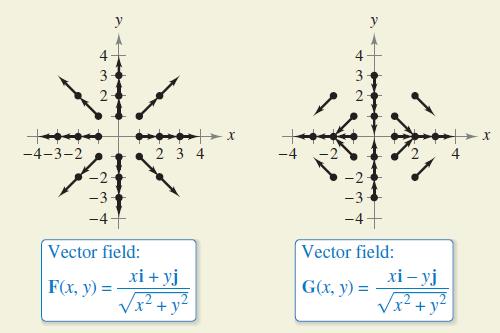
Several representative vectors in the vector fieldsare shown below. Explain any similarities or differences in the vector fields. F(x, y) = xi + yj √x² + y² and G(x, y) = xi - yj √x² + y²
Find div(curl F) = ∇ . (∇ x F). F(x, y, z) = xyzi + yj + zk
Find div(curl F) = ∇ . (∇ x F). F(x, y, z) = x²zi - 2xzj + yzk
Find the work done by a person weighing 175 pounds walking exactly one revolution up a circular helical staircase of radius 3 feet when the person rises 10 feet.
Determine the value of c such that the work done by the force field F(x, y) = 15[(4 - x²y)i — xyj] on an object moving along the parabolic path y = c(1 - x²) between the points (-1,0) and (1, 0) is a minimum. Compare the result with the work required to move the object along the straight-line
Define a line integral of a function ƒ along a smooth curve C in the plane and in space. How do you evaluate the line integral as a definite integral?
Determine whether the statement is true or false. If it is false, explain why or give an example that shows it is false.If F(x, y) = 4xi - y²j, then ||F(x, y)||→0 as (x, y)→(0, 0).
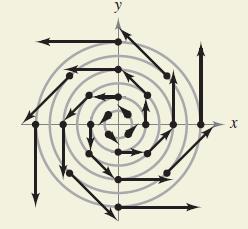
For each of the following, determine whether the work done in moving an object from the first to the second point through the force field shown in the figure is positive, negative, or zero. Explain your answer.(a) From (-3, -3) to (3, 3)(b) From (-3, 0) to (0, 3)(c) From (5, 0) to (0, 3) y x
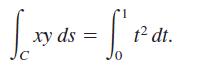
Determine whether the statement is true or false. If it is false, explain why or give an example that shows it is false.If C is given by x(t) = t, y(t) = t, where 0 ≤ t ≤ 1, then So = S₁ 0 xy ds = t² dt.
Determine whether the statement is true or false. If it is false, explain why or give an example that shows it is false.If F(x, y) = 4xi — y²j and (x, y) is on the positive y-axis, then the vector points in the negative y-direction.
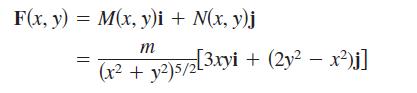
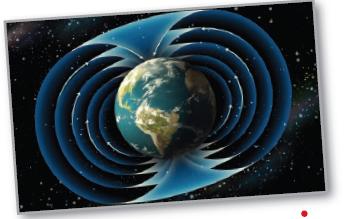
A cross section of Earth's magnetic field can be represented as a vector field in which the center of Earth is located at the origin and the positive y-axis points in the direction of the magnetic north pole. The equation for this field iswhere m is the magnetic moment of Earth. Show that this
Define a line integral vector field F on a smooth curve C. How do you evaluate the line integral as a definite integral?
Determine whether the statement is true or false. If it is false, explain why or give an example that shows it is false.If ƒ is a scalar field, then curl ƒ is a meaningful expression.
Determine whether the statement is true or false. If it is false, explain why or give an example that shows it is false.If F is a vector field and curl F = 0, then F is irrotational but not conservative.
Determine whether the statement is true or false. If it is false, explain why or give an example that shows it is false. If C₂ = - C₁, then [ f(x, y) ds + JC₂ f(x, y) ds = 0.
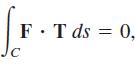
Determine whether the statement is true or false. If it is false, explain why or give an example that shows it is false. If then F and T are orthogonal. FT ds = 0, Jc
Determine whether the statement is true or false. If it is false, explain why or give an example that shows it is false.The vector functions r₁ = ti + t²j, where 0 ≤ t ≤ 1, and r₂ = (1 - t)i + (1 – t)²j, where 0 ≤ t ≤ 1, define the same curve.
Find div(F x G) = ∇ . (F x G). F(x, y, z)= i + 3xj + 2yk G(x, y, z) = xi - yj + zk
Consider a particle that moves through the force field F(x, y) = (y - x)i + xyj from the point (0, 0) to the point (0, 1) along the curve x = kt(1 - t), y = t. Find the value of k such that the work done by the force field is 1.
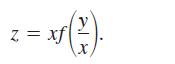
Tangent Planes Let ƒ be a differentiable function and consider the surfaceShow that the tangent plane at any point P(x0, Y0, Z0) on thesurface passes through the origin. z = xf X
Examine the function for relative extrema and saddle points.ƒ(x, y) = x² + 3xy + y² - 5x
Find dw/dt (a) By using the appropriate Chain Rule(b) By converting w to a function of t before differentiating.w = y² - x, x = cos t, y = sin t
Finddw/dt (a) By using the appropriate Chain Rule(b) By converting w to a function of t before differentiating.w = In(x² + y), x = 2t, y = 4 - t
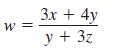
Find the total differential. w= 3x + 4y y у + 32 3z
The possible error involved in measuring each dimension of a right circular cone is ±1/8 inch. The radius is2 inches and the height is 5 inches. Approximate the propagatederror and the relative error in the calculated volume ofthe cone.
(a) Evaluate ƒ(2, 1) and ƒ(2.1, 1.05) and calculate Δz(b) Use the total differential dz to approximate Δz.ƒ(x, y) = 36 - x² - y²
(a) Evaluate ƒ(2, 1) and ƒ(2.1, 1.05) and calculate Δz(b) Use the total differential dz to approximate Δz.ƒ(x, y) = 4x + 2y
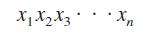
A company has two plants that produce the same lawn mower. If x1 and x₂ are the numbers of units produced at plant 1 and plant 2, respectively, then the total revenue for the product is given byWhen x₁ = = 5 and x₂ 8, find (a) The marginal revenue forplant 1, ∂R/∂x₁(b) The marginal
Find the total differential.w = 3xу² - 2х³yz²
Differentiate implicitly to find the first partial derivatives of z.exz + xy = 0
(a) Find a set of symmetric equations for the tangent line to the curve of intersection of the surfaces at the given point(b) Find the cosine of the angle between thegradient vectors at this point. State whether the surfaces areorthogonal at the point of intersection.x² + y² = 2, z = x, (1, 1, 1)
Find the total differential.z = 5x4y³
Explain the Method of Lagrange Multipliers for solving constrained optimization problems.
Find the total differential.z = x sin xy
Explain what is meant by constrained optimization problems.
Use Lagrange multipliers to find the minimum distance from the curve or surface to the indicated point. Surface 2 Cone: z = √√√x² + y² Point (4, 0, 0)
Find the highest point on the curve of intersection of the surfaces.Sphere: x² + y² + z² = 36Plane: 2x + y - z = 2
Find the slopes of the surface z = x² In(y + 1) in the x- and y-directions at the point (2, 0, 0).
Find the highest point on the curve of intersection of the surfaces.Cone: x² + y² - z² = 0Plane: x + 2z = 4
Find the four second partial derivatives. Observe that the second mixed partials are equal.g(x, y) = cos(x - 2y)
Find the four second partial derivatives. Observe that the second mixed partials are equal.h(x, y) = x sin y + y cos x
Find∂w/∂r and ∂w/∂t (a) By using the appropriate Chain Rule and(b) By converting w to a function of r and t before differentiating.W = xy/z x = 2r + t, y = rt, z = 2r - 1
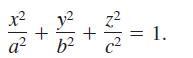
Use Lagrange multipliers to find the dimensions of a rectangular box of maximum volume that can be inscribed (with edges parallel to the coordinate axes) in the ellipsoid = 1. นน + 2 +
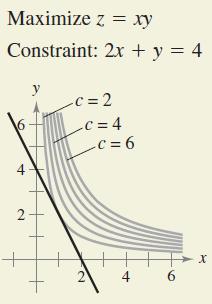
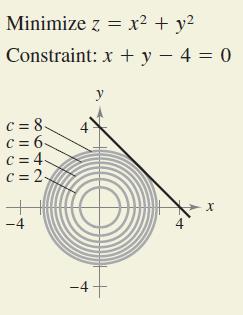
The graphs show the constraint and several level curves of the objective function. Use the graph to approximate the indicated extrema.(a)(b) Maximize z = xy Constraint: 2x + y = 4 4 2 y + -c = 2 _c=4 -C=6 4 6 X
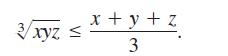
(a) Use Lagrange multipliers to prove that the product of threepositive numbers x, y, and z, whose sum has the constantvalue S, is a maximum when the three numbers are equal.Use this result to prove that(b) Generalize the result of part (a) to prove that the productis a maximum whenThen prove
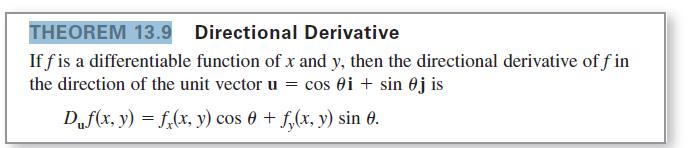
Use Theorem 13.9 to find the directional derivative of the function at P in the direction of v.ƒ(x, y) = 1/4y² - x², P(1, 4), v = 2i + jData from in Theorem 13.9 THEOREM 13.9 Directional Derivative If f is a differentiable function of x and y, then the directional derivative of fin the direction
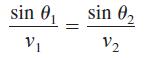
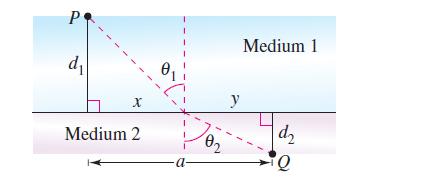
When light waves traveling in a transparent medium strike the surface of a second transparent medium, they tend to “bend” in order to follow the path of minimum time. This tendency is called refraction and is described by Snell’s Law of Refraction,where θ1, and θ2 are the magnitudes of the
Find ∂w/∂r and ∂w/∂t (a) By using the appropriate Chain Rule and(b) By converting w to a function of r and t before differentiating.w = x² + y² + z², x = r cost, y = r sint, z = t
Use Theorem 13.9 to find the directional derivative of the function at P in the direction of v.ƒ(x, y) = x²y, P(-5 5), v = 3i - 4jData from in Theorem 13.9 THEOREM 13.9 Directional Derivative If f is a differentiable function of x and y, then the directional derivative of fin the direction of the
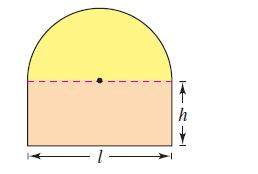
A semicircle is on top of a rectangle (see figure). When the area is fixed and the perimeter is a minimum, or when the perimeter is fixed and the area is a maximum, use Lagrange multipliers to verify that the length of the rectangle is twice its height. 1- h
Differentiate implicitly to find the first partialderivatives of z.x² + xy + y² + yz + z² = 0
A cargo container (in the shape of a rectangular solid) must have a volume of 480 cubic feet. The bottom will cost $5 per square foot to construct and the sides and the top will cost $3 per square foot to construct. Use Lagrange multipliers to find the dimensions of the container of this size that
Differentiate implicitly to find the first partial derivatives of z.xz² - y sin z = 0
Evaluate ƒx and ƒy at the given point.ƒ(x, y) = ey sinx, (π, 0)
Find the gradient of the function and the maximum value of the directional derivative at the given point.z = x²y, (2, 1)
Use the gradient to find the directional derivative of thefunction at P in the direction of v.w = y² + xz, P(1, 2, 2), v = 2i - j + 2k
Use Lagrange multipliers to find the dimensions of a right circular cylinder with volume V0 cubic units and minimum surface area.
Use the gradient to find the directional derivative of the function at P in the direction of v.w = 5x² + 2xy - 3y²z, P(1, 0, 1), v = i + j - k
The temperature at each point on the sphereLet T(x, y, z) = 100 + x² + y² representx² + y² + z² = 50.Find the maximum temperature on the curve formed by the intersection of the sphere and the plane x - z = 0.
Use Lagrange multipliers to find the minimum distance from the curve or surface to the indicated point. Curve Line: x - y = 4 Point (0, 2)
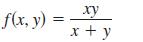
Find all first partial derivatives. xy x + y f(x, y) = -
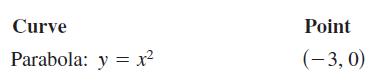
Use Lagrange multipliers to find the minimum distance from the curve or surface to the indicated point. Curve Parabola: y = x² Point (-3,0)
Use Lagrange multipliers to find the minimum distance from the curve or surface to the indicated point. Curve Line: x + 4y = 3 Point (1,0)
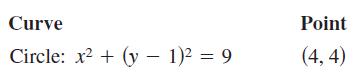
Use Lagrange multipliers to find the minimum distance from the curve or surface to the indicated point. Curve Circle: x² + (y - 1)² = 9 Point (4,4)
Use Lagrange multipliers to find the minimum distance from the curve or surface to the indicated point. Curve Parabola: y = x² Point (0, 3)
Find all first partial derivatives.ƒ(x, y) = y³e4x
Find all first partial derivatives.z = In(x² + y² + 1)
Use Lagrange multipliers to find the minimum distance from the curve or surface to the indicated point. Curve Circle: (x-4)2² + y² = 4 Point (0, 10)
Find all first partial derivatives.ƒ(x, y, z) = 2xz² + 6xyz - 5xy³
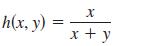
Find the four second partial derivatives. Observe that the second mixed partials are equal. h(x, y) = X x + y
Find all first partial derivatives.W = √x² - y² - z²
Showing 800 - 900
of 9867
First
2
3
4
5
6
7
8
9
10
11
12
13
14
15
16
Last
Step by Step Answers

 Get 50% OFF
Claim Now
Get 50% OFF
Claim Now