New Semester
Started
Get
50% OFF
Study Help!
--h --m --s
Claim Now
Question Answers
Textbooks
Find textbooks, questions and answers
Oops, something went wrong!
Change your search query and then try again
S
Books
FREE
Study Help
Expert Questions
Accounting
General Management
Mathematics
Finance
Organizational Behaviour
Law
Physics
Operating System
Management Leadership
Sociology
Programming
Marketing
Database
Computer Network
Economics
Textbooks Solutions
Accounting
Managerial Accounting
Management Leadership
Cost Accounting
Statistics
Business Law
Corporate Finance
Finance
Economics
Auditing
Tutors
Online Tutors
Find a Tutor
Hire a Tutor
Become a Tutor
AI Tutor
AI Study Planner
NEW
Sell Books
Search
Search
Sign In
Register
study help
mathematics
calculus 6th edition
Calculus 6th Edition James Stewart - Solutions
Evaluate the integral.∫x sin x cos x dx
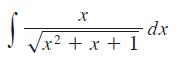
Evaluate the integral. S X x² + x + 1 x2 dx
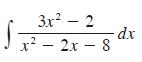
Evaluate the integral. 3x² - 2 √x²² - 2x - 8 dx
Evaluate the integral. y So y dy 2y e
Evaluate the integral.∫sec6t dt
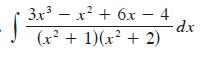
Evaluate the integral. 3x³x² + 6x - 4 (x² + 1)(x² + 2) - dx
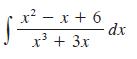
Evaluate the integral. x² = x + 6 x³ + 3x dx
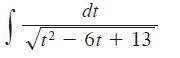
Evaluate the integral. S dt t² - 6t + 13
Evaluate the integral.∫(tan2x + tan4x) dx
Evaluate the integral.∫ In(x2 - 1) dx
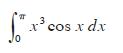
Evaluate the integral. Ső x³ cos x dx
Evaluate the integral.∫ex cos x dx
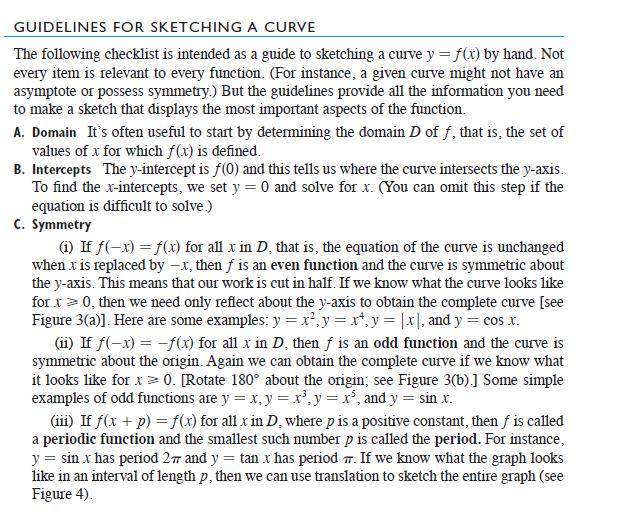
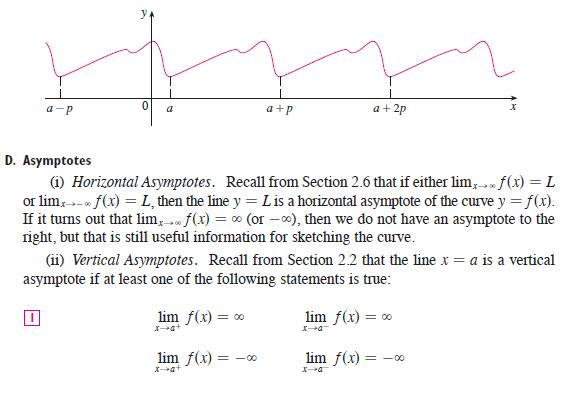
Use the guidelines of this section to sketch the curve.y = x√5 – xData from section 4.5 GUIDELINES FOR SKETCHING A CURVE The following checklist is intended as a guide to sketching a curve y = f(x) by hand. Not every item is relevant to every function. (For instance, a given curve might not
Use the guidelines of Section 4.5 to sketch the curve.y = x3 – 6x2 – 15x + 4 Data from section 4.5 GUIDELINES FOR SKETCHING A CURVE The following checklist is intended as a guide to sketching a curve y = f(x) by hand. Not every item is relevant to every function. (For instance, a given curve
Use Newton’s method to find all roots of the equation correct to six decimal places.1/x = 1 + x3
Find the most general antiderivative of the function. (Check your answer by differentiation.)f(x) = 2 + x2/1 + x2
Use the guidelines of Section 4.5 to sketch the curve.y = x4 – 3x3 + 3x2 – xData from section 4.5 GUIDELINES FOR SKETCHING A CURVE The following checklist is intended as a guide to sketching a curve y = f(x) by hand. Not every item is relevant to every function. (For instance, a given curve
Use the guidelines of this section to sketch the curve.y = √x2 + x – xData from section 4.5 GUIDELINES FOR SKETCHING A CURVE The following checklist is intended as a guide to sketching a curve y = f(x) by hand. Not every item is relevant to every function. (For instance, a given curve might not
Use the guidelines of Section 4.5 to sketch the curve.y = 1/1 – x2Data from section 4.5 GUIDELINES FOR SKETCHING A CURVE The following checklist is intended as a guide to sketching a curve y = f(x) by hand. Not every item is relevant to every function. (For instance, a given curve might not have
Use the guidelines of this section to sketch the curve.y = e2x – exData from section 4.5 GUIDELINES FOR SKETCHING A CURVE The following checklist is intended as a guide to sketching a curve y = f(x) by hand. Not every item is relevant to every function. (For instance, a given curve might not have
Use a computer algebra system to graph f and to find f' and f". Use graphs of these derivatives to estimate the intervals of increase and decrease, extreme values, intervals of concavity, and inflection points of f.f(x) = (x2 – 1)earctan x
Use Newton’s method to find all roots of the equation correct to six decimal places.cos x = √x
Use the guidelines of this section to sketch the curve.y = ex/xData from section 4.5 GUIDELINES FOR SKETCHING A CURVE The following checklist is intended as a guide to sketching a curve y = f(x) by hand. Not every item is relevant to every function. (For instance, a given curve might not have
Use the guidelines of this section to sketch the curve.y = 1/(1+ e–x)Data from section 4.5 GUIDELINES FOR SKETCHING A CURVE The following checklist is intended as a guide to sketching a curve y = f(x) by hand. Not every item is relevant to every function. (For instance, a given curve might not
Use Newton’s method to find all roots of the equation correct to six decimal places.tan x = √1 – x2
Use the guidelines of this section to sketch the curve.y = ln(x2 – 3x + 2)Data from section 4.5 GUIDELINES FOR SKETCHING A CURVE The following checklist is intended as a guide to sketching a curve y = f(x) by hand. Not every item is relevant to every function. (For instance, a given curve might
Use the guidelines of this section to sketch the curve.y = x – ln xData from section 4.5 GUIDELINES FOR SKETCHING A CURVE The following checklist is intended as a guide to sketching a curve y = f(x) by hand. Not every item is relevant to every function. (For instance, a given curve might not have
Use the guidelines of this section to sketch the curve.y = xe–x2Data from section 4.5 GUIDELINES FOR SKETCHING A CURVE The following checklist is intended as a guide to sketching a curve y = f(x) by hand. Not every item is relevant to every function. (For instance, a given curve might not have
Use the guidelines of this section to sketch the curve.y = (x2 – 3) e–xData from section 4.5 GUIDELINES FOR SKETCHING A CURVE The following checklist is intended as a guide to sketching a curve y = f(x) by hand. Not every item is relevant to every function. (For instance, a given curve might
Use the guidelines of this section to sketch the curve.y = e3x + e–2xData from section 4.5 GUIDELINES FOR SKETCHING A CURVE The following checklist is intended as a guide to sketching a curve y = f(x) by hand. Not every item is relevant to every function. (For instance, a given curve might not
Find f.f"(x) = 2 + cos x, f(0) = –1, f(π/2) = 0
Use the guidelines of this section to sketch the curve. In guideline D find an equation of the slant asymptote.y = –2x2 + 5x – 1/2x – 1Data from section 4.5 GUIDELINES FOR SKETCHING A CURVE The following checklist is intended as a guide to sketching a curve y = f(x) by hand. Not every item is
Use the guidelines of this section to sketch the curve.y = tan–1(x – 1/x + 1)Data from section 4.5 GUIDELINES FOR SKETCHING A CURVE The following checklist is intended as a guide to sketching a curve y = f(x) by hand. Not every item is relevant to every function. (For instance, a given curve
Find f.f"(t) = 2et + 3 sin t. f(0) = 0, f(π) = 0
Find f.f"(x) = x–2, x > 0, f(1) = 0, f(2) = 0
Find f.f"'(x) = cos x, f(0) = 1, f'(0) = 2, f"(0) = 3
Evaluate the integral. Jo 10* dx
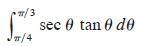
Evaluate the integral. 7/3 π/4 sec Ꮎ tan Ꮎ dᎾ
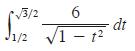
Evaluate the integral. √√3/2 6 √1/²² √1-1² = dt J1/2
Evaluate the integral. ᎾᏢ - dᎾ Jo 0-S00 0-500 + [ v/=
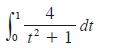
Evaluate the integral. 4 Jo t² + 1 dt
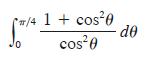
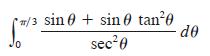
Evaluate the integral. #/3 sin + sin 0 tan²0 10 sec²0 de
Evaluate the integral. e²+1 du
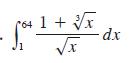
Evaluate the integral. 64 J1 1 + √√x √x - dx
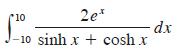
Evaluate the integral. *10 2e* |−10 sinh x + cosh x dx
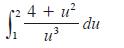
Evaluate the integral. 2 4 + u² 3 J1 n np.
Evaluate the integral. f(x) dx where f(x). R sin x cosx if 0
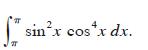
Evaluate 2 sin x cos*x dx.
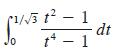
Evaluate the integral. 1/√3 1² - 1 t-1 - dt
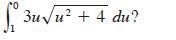
Given thatwhat is (²3x√√x² + 4 dx = 5√5 - 8,
Evaluate the integral. f(x) dx where f(x) = if -2 ≤ x ≤0 4- x² if 0
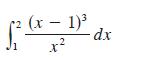
Evaluate the integral. J1 (x - 1)³ -dx 2 x²
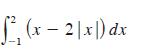
Evaluate the integral. S²₁ (x - 2)x) dx -1
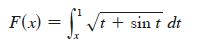
Find the derivative of the function. F(x) = f'₁² ₁ = [₁ √t + sint dt x
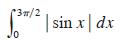
Evaluate the integral. *3π/2 Jo | sin x | dx
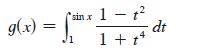
Find the derivative of the function. g(x)= sin x 1-² 1+,4 ܟ dt
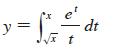
Find the derivative of the function. ===²=² - dt t y=
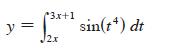
Find the derivative of the function. (3x+1 y= = J2x sin(t¹) dt
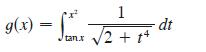
Find the derivative of the function. g(x) 1 - Stoms √2 + 1² tan..x dt
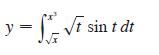
Find the derivative of the function. y-f √t sin t dt
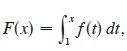
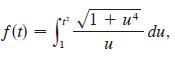
If wherefind f"(2). F(x) = f(t) dt. 1
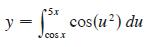
Find the derivative of the function. y = - 5x cos.x cos(u²) du
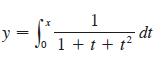
Find the interval on which the curveis concave upward. 1 Jo 1 + 1 + 1² y=√₁₁ = y dt
Evaluate 9 9 9 n - [☺) - () + ()* - - - (;)] lim + + 71 n n n
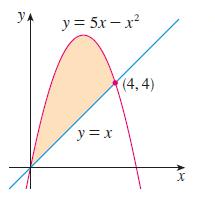
Find the area of the shaded region. у У y=5r-r y=x ((4,4) X
How much work is done in lifting a 40-kg sandbag to a height of 1.5 m?
Find the average value of the function on the given interval.f(x) = 4x – x2, [0, 4]
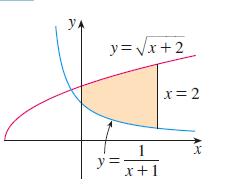
Find the area of the shaded region. y y= √√√x+2 y = x= x = 2 1 x+1 X
Find the volume of the solid obtained by rotating the region bounded by the given curves about the specified line. Sketch the region, the solid, and a typical disk or washer.y = 2 – 1/2x, y = 0, x = 1, x = 2; about the x-axis
Find the work done if a constant force of 100 lb is used to pull a cart a distance of 200 ft.
Find the average value of the function on the given interval.f(x) = sin 4x, [–π, π]
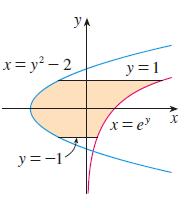
Find the area of the shaded region. x=y²-2 у=-1 У y=1 x=ey ➜ X
Find the area of the region bounded by the given curves.y = 1/x, y = x2, y = 0, x = e
Find the volume of the solid obtained by rotating the region bounded by the given curves about the specified line. Sketch the region, the solid, and a typical disk or washer.y = 1 – x2, y = 0; about the x-axis
Find the average value of the function on the given interval.g(x) = 3√x. [1,8]
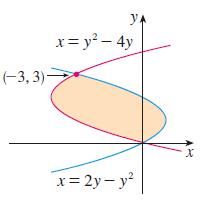
Find the area of the shaded region. (-3,3)- У x = y² - 4y x=2y-y² X
Find the volume of the solid obtained by rotating the region bounded by the given curves about the specified line. Sketch the region, the solid, and a typical disk or washer.y = 1/x, x = 1, x = 2, y = 0; about the x-axis
Find the average value of the function on the given interval.g(x) = x2√1 + x3, [0.2]
Find the volume of the solid obtained by rotating the region bounded by the given curves about the specified line. Sketch the region, the solid, and a typical disk or washer.y = √25 - x2, y = 0, x = 2, x = 4; about the x-axis
Find the average value of the function on the given interval.f(t) = te–t2 , [0, 5]
Find the volume of the solid obtained by rotating the region bounded by the given curves about the specified line. Sketch the region, the solid, and a typical disk or washer.x = 2√y, x = 0, y = 9; about the y-axis
Sketch the region enclosed by the given curves. Decide whether to integrate with respect to x or y. Draw a typical approximating rectangle and label its height and width. Then find the area of the region.y = sin x, y = ex, x = 0, x = π/2
Find the average value of the function on the given interval.f(θ) = sec2(θ/2), [0, π/2]
Find the area of the region bounded by the given curves.y = √x, y = x2, x = 2
Find the volume of the solid obtained by rotating the region bounded by the given curves about the specified line. Sketch the region, the solid, and a typical disk or washer.y = ln x, y = 1, y = 2, x = 0; about the y-axis
Sketch the region enclosed by the given curves. Decide whether to integrate with respect to x or y. Draw a typical approximating rectangle and label its height and width. Then find the area of the region.y = x , y = x2
Find the average value of the function on the given interval.h(x) = cos4x sinx, [0, π]
Find the volume of the solid obtained by rotating the region bounded by the given curves about the specified line. Sketch the region, the solid, and a typical disk or washer.y = x3, y = x, x ≥ 0; about the x-axis
Sketch the region enclosed by the given curves. Decide whether to integrate with respect to x or y. Draw a typical approximating rectangle and label its height and width. Then find the area of the region.y = x2 – 2x, y = x + 4
Find the average value of the function on the given interval.h(u) = (3 – 2u)–1, [–1,1]
Find the volume of the solid obtained by rotating the region bounded by the given curves about the specified line. Sketch the region, the solid, and a typical disk or washer.y = 1/4x2, y = 5 – x2; about the x-axis
Sketch the region enclosed by the given curves. Decide whether to integrate with respect to x or y. Draw a typical approximating rectangle and label its height and width. Then find the area of the region.y = 1/x, y = 1/x2, x = 2
Sketch the region enclosed by the given curves. Decide whether to integrate with respect to x or y. Draw a typical approximating rectangle and label its height and width. Then find the area of the region.y = 1 + √x, y = (3 + x)/3
Find the volume of the solid obtained by rotating the region bounded by the given curves about the specified line. Sketch the region, the solid, and a typical disk or washer.y = 1/4x2, x = 2, y = 0; about the y-axis
Find the volume of the solid obtained by rotating the region bounded by the given curves about the specified line. Sketch the region, the solid, and a typical disk or washer.y = x, y = √x; about y = 1
Sketch the region enclosed by the given curves. Decide whether to integrate with respect to x or y. Draw a typical approximating rectangle and label its height and width. Then find the area of the region.y = x2, y2 = x
Find the volume of the solid obtained by rotating the region bounded by the given curves about the specified line. Sketch the region, the solid, and a typical disk or washer.y = e–x, y = 1, x = 2; about y = 2
Sketch the region enclosed by the given curves. Decide whether to integrate with respect to x or y. Draw a typical approximating rectangle and label its height and width. Then find the area of the region.y = x2, y = 4x – x2
Find the volume of the solid obtained by rotating the region bounded by the given curves about the specified line. Sketch the region, the solid, and a typical disk or washer.ky = 1/x, y = 0, x = 1, x = 3; about y = –1
Sketch the region enclosed by the given curves. Decide whether to integrate with respect to x or y. Draw a typical approximating rectangle and label its height and width. Then find the area of the region.y = cos x, y = 2 – cos x, 0 ≤ x ≤ 2π
Showing 2100 - 2200
of 2680
First
13
14
15
16
17
18
19
20
21
22
23
24
25
26
27
Step by Step Answers

 Get 50% OFF
Claim Now
Get 50% OFF
Claim Now








![9 9 9 n - [) - () + ()* - - ()] lim + + 71 n n](https://dsd5zvtm8ll6.cloudfront.net/si.question.images/images/question_images/1697/4/3/3/131652cc62bb83061697433135832.jpg)