New Semester
Started
Get
50% OFF
Study Help!
--h --m --s
Claim Now
Question Answers
Textbooks
Find textbooks, questions and answers
Oops, something went wrong!
Change your search query and then try again
S
Books
FREE
Study Help
Expert Questions
Accounting
General Management
Mathematics
Finance
Organizational Behaviour
Law
Physics
Operating System
Management Leadership
Sociology
Programming
Marketing
Database
Computer Network
Economics
Textbooks Solutions
Accounting
Managerial Accounting
Management Leadership
Cost Accounting
Statistics
Business Law
Corporate Finance
Finance
Economics
Auditing
Tutors
Online Tutors
Find a Tutor
Hire a Tutor
Become a Tutor
AI Tutor
AI Study Planner
NEW
Sell Books
Search
Search
Sign In
Register
study help
mathematics
college algebra
College Algebra 11th Edition Michael Sullivan, Michael Sullivan III - Solutions
Use the zero-factor property to solve each equation.8x2 + 14x + 3 = 0
Use the zero-factor property to solve each equation.12x2 + 19x + 5 = 0
Use the square root property to solve each equation.x2 = 81
Use the square root property to solve each equation.x2 = 225
Use the square root property to solve each equation.x2 = 17
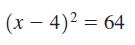
Use the square root property to solve each equation. (x-4)² = 64
Use the square root property to solve each equation.x2 = 19
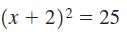
Use the square root property to solve each equation. (x + 2)² = 25
Use the square root property to solve each equation.x2 = 32
Use the square root property to solve each equation.x2 = 54
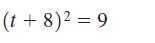
Use the square root property to solve each equation. (t + 8)² = 9
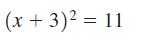
Use the square root property to solve each equation. (x + 3)² = 11
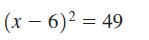
Use the square root property to solve each equation. (x-6)² = 49
Use the square root property to solve each equation.x2 - 20 = 0
Use the square root property to solve each equation.p2 - 50 = 0
Use the square root property to solve each equation.3x2 - 72 = 0
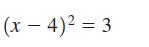
Use the square root property to solve each equation. (x-4)² = 3
Use the square root property to solve each equation.5z2 - 200 = 0
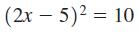
Use the square root property to solve each equation. (2x - 5)² = 10
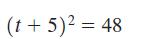
Use the square root property to solve each equation. (t + 5)² = 48
Use the square root property to solve each equation.2x2 + 7 = 61
Use the square root property to solve each equation.3x2 + 8 = 80
Use the square root property to solve each equation.3x2 - 10 = 86
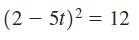
Use the square root property to solve each equation. (2 - 5t)² = 12
Use the square root property to solve each equation.4x2 - 7 = 65
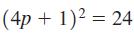
Use the square root property to solve each equation. (4p + 1)² = 24
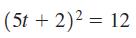
Use the square root property to solve each equation. (5t + 2)² = 12
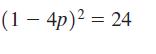
Use the square root property to solve each equation. (1-4p)² = 24
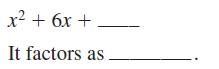
Find the constant that must be added to make each expression a perfect square trinomial. Then factor the trinomial. x² + 6x + It factors as
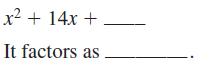
Find the constant that must be added to make each expression a perfect square trinomial. Then factor the trinomial. x² + 14x + It factors as
Which one of the two equationsis more suitable for solving by the square root property? By completing the square? (2x + 1)2 = 5 and x² + 4x = 12
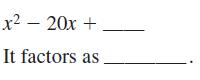
Find the constant that must be added to make each expression a perfect square trinomial. Then factor the trinomial. x² - 20x + It factors as
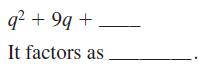
Find the constant that must be added to make each expression a perfect square trinomial. Then factor the trinomial. q² +9q + It factors as
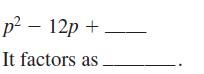
Find the constant that must be added to make each expression a perfect square trinomial. Then factor the trinomial. p² - 12p + It factors as
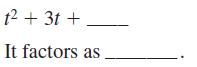
Find the constant that must be added to make each expression a perfect square trinomial. Then factor the trinomial. 1² + 3t+ It factors as
According to the procedure described in this section, what would be the first step in solving 2x2 + 8x = 9 by completing the square?
Solve each equation by completing the square.x2 - 2x - 24 = 0
Solve each equation by completing the square.m2 - 4m - 32 = 0
Solve each equation by completing the square.x2 + 4x - 2 = 0
Solve each equation by completing the square.t2 + 2t - 1 = 0
Solve each equation by completing the square.x2 + 10x + 18 = 0
Solve each equation by completing the square.x2 + 8x + 11 = 0
Solve each equation by completing the square.3w2 - w = 24
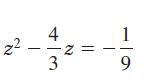
Solve each equation by completing the square. - +| 3 N || I - 9
Solve each equation by completing the square.4z2 - z = 39
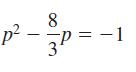
Solve each equation by completing the square. 8 p²-²p=-1 3P
Solve each equation by completing the square.x2 + 7x - 1 = 0
Solve each equation by completing the square.x2 + 13x - 3 = 0
Solve each equation by completing the square.2k2 + 5k - 2 = 0
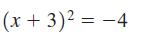
Solve each equation. (x+3)² = -4
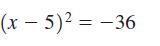
Solve each equation. (x - 5)² = -36
Solve each equation by completing the square.5x2 - 10x + 2 = 0
Solve each equation by completing the square.2x2 - 16x + 25 = 0
Solve each equation by completing the square.9x2 - 24x = -13
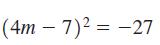
Solve each equation. (4m - 7)² = -27
Solve each equation by completing the square.25n2 - 20n = 1
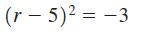
Solve each equation. (r 5)² = -3
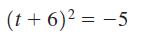
Solve each equation. (t + 6)² = -5
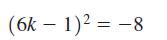
Solve each equation. (6k 1)² = -8 -
Solve each equation by completing the square.0.1x2 - 0.2x - 0.1 = 0
Solve each equation by completing the square.0.1p2 - 0.4p + 0.1 = 0
Solve each equation. x2 = -100
Solve each equation. x2 = -64
Solve each equation. x2 = -12
Solve each equation. x2 = -18
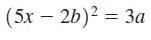
Solve for x. Assume that a and b represent positive real numbers. (5x-2b)2 = 3а
Solve each equation. m2 + 4m + 13 = 0
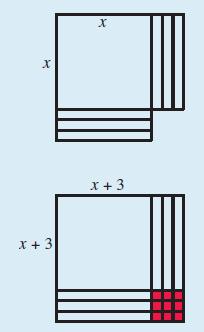
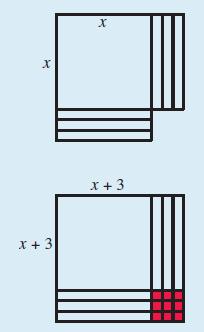
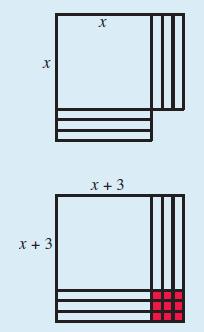
The Greeks had a method of completing the square geometrically in which they literally changed a figure into a square. For example, to complete the square for x2 + 6x, we begin with a square of side x, as in the figure on the top. We add three rectangles of width 1 to the right side and the bottom
Solve each equation. t2 + 6t + 10 = 0
Solve each equation.m2 + 6m + 12 = 0
Solve each equation. x2 + 10x + 27 = 0
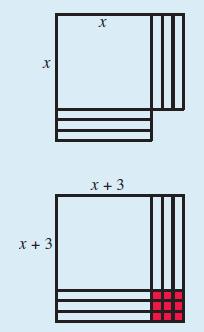
The Greeks had a method of completing the square geometrically in which they literally changed a figure into a square. For example, to complete the square for x2 + 6x, we begin with a square of side x, as in the figure on the top. We add three rectangles of width 1 to the right side and the bottom
Solve each equation. 3r2 + 4r + 4 = 0
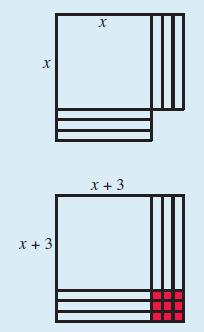
The Greeks had a method of completing the square geometrically in which they literally changed a figure into a square. For example, to complete the square for x2 + 6x, we begin with a square of side x, as in the figure on the top. We add three rectangles of width 1 to the right side and the bottom
Solve each equation. 4x2 + 5x + 5 = 0
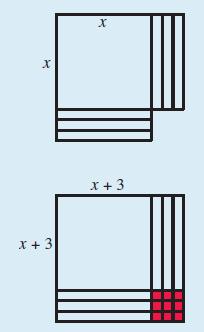
The Greeks had a method of completing the square geometrically in which they literally changed a figure into a square. For example, to complete the square for x2 + 6x, we begin with a square of side x, as in the figure on the top. We add three rectangles of width 1 to the right side and the bottom
Solve each equation. -k2 - 5k - 10 = 0
Solve each equation.-x - 3x - 8 = 0
The Greeks had a method of completing the square geometrically in which they literally changed a figure into a square. For example, to complete the square for x2 + 6x, we begin with a square of side x, as in the figure on the top. We add three rectangles of width 1 to the right side and the bottom
Solve for x. Assume that a and b represent positive real numbers.x2 - b = 0
Solve for x. Assume that a and b represent positive real numbers.x2 = 4b
Solve for x. Assume that a and b represent positive real numbers.4x2 = b2 + 16
Solve for x. Assume that a and b represent positive real numbers.9x2 - 25a = 0
Solve for x. Assume that a and b represent positive real numbers.x2 - a2 - 36 = 0
The Greeks had a method of completing the square geometrically in which they literally changed a figure into a square. For example, to complete the square for x2 + 6x, we begin with a square of side x, as in the figure on the top. We add three rectangles of width 1 to the right side and the bottom
In Problems 19–54, solve each inequality algebraically.x3 > 1
In Problems 33–44, list the potential rational zeros of each polynomial function. Do not attempt to find the zeros. f(x) = 3x43x³ + x² = x + 1
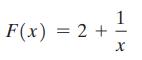
In Problems 33–44, (a) Graph the rational function using transformations, (b) Use the final graph to find the domain and range, and (c) Use the final graph to list any vertical, horizontal, or oblique asymptotes. F(x) = 2 + X
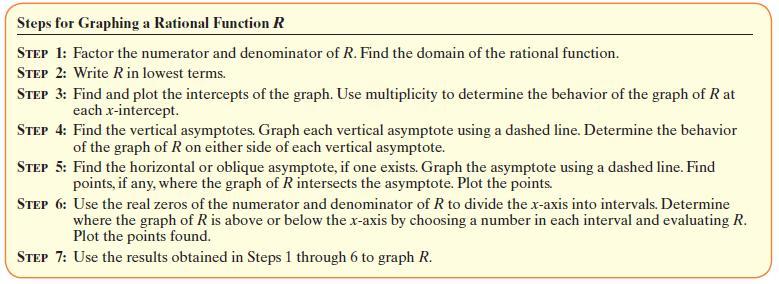
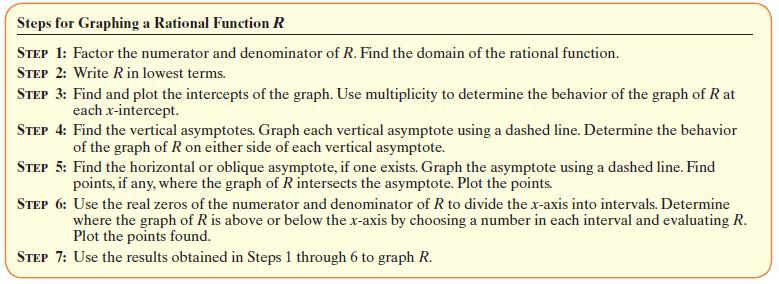
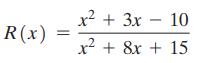
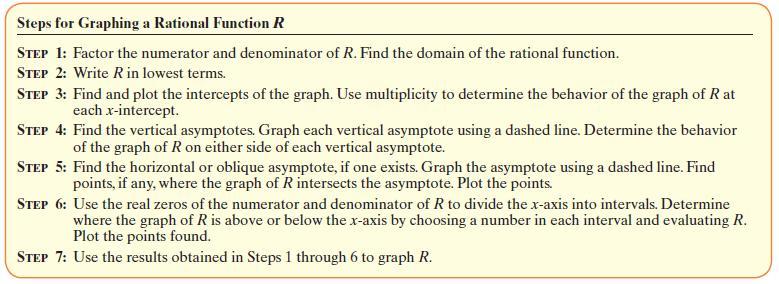
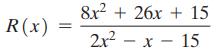
In Problems 7–50, follow Steps 1 through 7 on page 367 to graph each function. Steps for Graphing a Rational Function R STEP 1: Factor the numerator and denominator of R. Find the domain of the rational function. STEP 2: Write R in lowest terms. STEP 3: Find and plot the intercepts of the graph.
In Problems 19–54, solve each inequality algebraically. 3(x²-2)
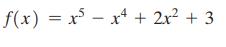
In Problems 33–44, list the potential rational zeros of each polynomial function. Do not attempt to find the zeros. f(x) = x5 - x4 + 2x2 + 3
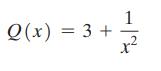
In Problems 33–44, (a) Graph the rational function using transformations, (b) Use the final graph to find the domain and range, and (c) Use the final graph to list any vertical, horizontal, or oblique asymptotes. Q(x) = 3 + 1 x²
In Problems 7–50, follow Steps 1 through 7 on page 367 to graph each function. Steps for Graphing a Rational Function R STEP 1: Factor the numerator and denominator of R. Find the domain of the rational function. STEP 2: Write R in lowest terms. STEP 3: Find and plot the intercepts of the graph.
In Problems 19–54, solve each inequality algebraically. (x-3) (x + 2) < x² + 3x + 5
In Problems 33–44, list the potential rational zeros of each polynomial function. Do not attempt to find the zeros. f(x) = x³ 2x² + 8x - 5
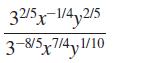
Simplify each expression. Leave answers in exponential form. Assume that all variables represent positive real numbers. 32/5x-1/4y2/5 3-8/5x7/4, 1/10
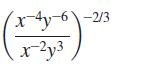
Simplify each expression. Leave answers in exponential form. Assume that all variables represent positive real numbers. -6-2/3 Az_x
In Problems 7–50, follow Steps 1 through 7 on page 367 to graph each function. Steps for Graphing a Rational Function R STEP 1: Factor the numerator and denominator of R. Find the domain of the rational function. STEP 2: Write R in lowest terms. STEP 3: Find and plot the intercepts of the graph.
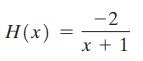
In Problems 33–44, (a) Graph the rational function using transformations, (b) Use the final graph to find the domain and range, (c) Use the final graph to list any vertical, horizontal, or oblique asymptotes. H(x) = -2 x + 1
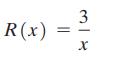
In Problems 33–44, (a) Graph the rational function using transformations, (b) Use the final graph to find the domain and range, and (c) Use the final graph to list any vertical, horizontal, or oblique asymptotes. R (x) 3 X
Showing 5100 - 5200
of 16373
First
45
46
47
48
49
50
51
52
53
54
55
56
57
58
59
Last
Step by Step Answers

 Get 50% OFF
Claim Now
Get 50% OFF
Claim Now