New Semester
Started
Get
50% OFF
Study Help!
--h --m --s
Claim Now
Question Answers
Textbooks
Find textbooks, questions and answers
Oops, something went wrong!
Change your search query and then try again
S
Books
FREE
Study Help
Expert Questions
Accounting
General Management
Mathematics
Finance
Organizational Behaviour
Law
Physics
Operating System
Management Leadership
Sociology
Programming
Marketing
Database
Computer Network
Economics
Textbooks Solutions
Accounting
Managerial Accounting
Management Leadership
Cost Accounting
Statistics
Business Law
Corporate Finance
Finance
Economics
Auditing
Tutors
Online Tutors
Find a Tutor
Hire a Tutor
Become a Tutor
AI Tutor
AI Study Planner
NEW
Sell Books
Search
Search
Sign In
Register
study help
mathematics
college algebra
Intermediate Algebra 13th Edition Margaret Lial, John Hornsby, Terry McGinnis - Solutions
Graph the following functions using transformations. (a) f(x) = int(-x) (b) g(x) = -int(x)
Problems 76–85 are based on material learned earlier in the course. The purpose of these problems is to keep the material fresh in your mind so that you are better prepared for the final exam. Identify the leading term: -5x4 + 8x² - 2x²
Problems 76–85 are based on material learned earlier in the course. The purpose of these problems is to keep the material fresh in your mind so that you are better prepared for the final exam. Simplify: (x-3 y5) -2
Graph the following functions using transformations (a) f(x) = int(x - 1) (b) g(x) = int(1 - x)
Problems 76–85 are based on material learned earlier in the course. The purpose of these problems is to keep the material fresh in your mind so that you are better prepared for the final exam.Find the center and radius of the circle x2 + y2 = 6y + 16.
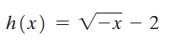
Problems 98–106 are based on material learned earlier in the course. The purpose of these problems is to keep the material fresh in your mind so that you are better prepared for the final exam. Find the domain of h (x) = x + 2 r? – 5x – 14 2
Problems 76–85 are based on material learned earlier in the course. The purpose of these problems is to keep the material fresh in your mind so that you are better prepared for the final exam.Ethan has $60,000 to invest. He puts part of the money in a CD that earns 3% simple interest per year and
Problems 76–85 are based on material learned earlier in the course. The purpose of these problems is to keep the material fresh in your mind so that you are better prepared for the final exam.Find the quotient and remainder when x3 + 3x2 - 6 is divided by x + 2.
Problems 98–106 are based on material learned earlier in the course. The purpose of these problems is to keep the material fresh in your mind so that you are better prepared for the final exam. The amount of water used when taking a shower varies directly with the number of minutes the
Problems 98–106 are based on material learned earlier in the course. The purpose of these problems is to keep the material fresh in your mind so that you are better prepared for the final exam. Find the intercepts and test for symmetry: y2 = x + 4.
Problems 127–135 are based on material learned earlier in the course. The purpose of these problems is to keep the material fresh in your mind so that you are better prepared for the final exam.How many pounds of lean hamburger that is 7% fat must be mixed with 12 pounds of ground chuck that is
Problems 127–135 are based on material learned earlier in the course. The purpose of these problems is to keep the material fresh in your mind so that you are better prepared for the final exam. Solve x3 - 9x = 2x2 - 18
Problems 127–135 are based on material learned earlier in the course. The purpose of these problems is to keep the material fresh in your mind so that you are better prepared for the final exam. Given a + bx = ac + d, solve for a.
In Problems 37–60, graph each function using the techniques of shifting, compressing, stretching, and/or reflecting. Start with the graph of the basic function (for example, y = x2) and show all the steps. Be sure to show at least three key points. Find the domain and the range of each function.
Apply the quotient rule for exponents, if possible, and write each result using only positive exponents. Assume that all variables represent nonzero real numbers. 7 7-1
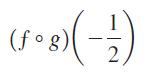
Let ƒ(x) = x2 + 4, g(x) = 2x + 3, and h(x) = x - 5. Find each of the following. (fog)(-1/2)
Find each product. [(2a + b) - 3]²
Perform the indicated operations. Subtract (-4x + 2z² + 3m) from [(22²- 3x + m) + (2² - 2m)]. -
Apply the quotient rule for exponents, if possible, and write each result using only positive exponents. Assume that all variables represent nonzero real numbers. 8 8-1
Let ƒ(x) = x2 + 4, g(x) = 2x + 3, and h(x) = x - 5. Find each of the following. (7-) (108)
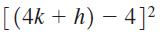
Find each product. [(4k + h) - 4]²
Apply the quotient rule for exponents, if possible, and write each result using only positive exponents. Assume that all variables represent nonzero real numbers. -3
Find each product. [ε + (q + p) ] [ε − (q + p)]
Perform the indicated operations. [ − (4m² − 8m + 4m³) − (3m² + 2m + 5m³)] + m² -
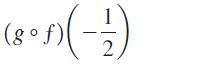
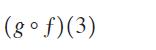
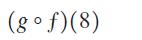
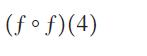
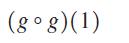
The tables give some selected ordered pairs for functions ƒ and g.Tables like these can be used to evaluate composite functions. For example, to evaluate (g ° ƒ) (6), use the first table to find ƒ(6) = 9. Then use the second table to findFind each of the following. 4. X 3 6 f(x) 1 3
The tables give some selected ordered pairs for functions ƒ and g.Tables like these can be used to evaluate composite functions. For example, to evaluate (g ° ƒ) (6), use the first table to find ƒ(6) = 9. Then use the second table to findFind each of the following. 4. X 3 6 f(x) 1 3
Perform the indicated operations. - - −4m² + 3n² − 5n) − [(3m² − 5n² + 2n) + (−3m²) + 4n²]
Find each product. [(m + p) - 5] [(m + p) + 5]
Perform the indicated operations. - [−(y4 − y² + 1) − (y4 + 2y² + 1)] + (3y4 − 3y² − 2)
Apply the quotient rule for exponents, if possible, and write each result using only positive exponents. Assume that all variables represent nonzero real numbers. x³ y²
Apply the quotient rule for exponents, if possible, and write each result using only positive exponents. Assume that all variables represent nonzero real numbers. S 5-8 S
Find each product. [(2h − k) +j][(2h - k) - j]
Perform the indicated operations. [2p (3p-6)] - [(5p - (8-9p)) + 4p]
The tables give some selected ordered pairs for functions ƒ and g.Tables like these can be used to evaluate composite functions. For example, to evaluate (g ° ƒ) (6), use the first table to find ƒ(6) = 9. Then use the second table to findFind each of the following. 4. X 3 6 f(x) 1 3
Apply the quotient rule for exponents, if possible, and write each result using only positive exponents. Assume that all variables represent nonzero real numbers. 13
The tables give some selected ordered pairs for functions ƒ and g.Tables like these can be used to evaluate composite functions. For example, to evaluate (g ° ƒ) (6), use the first table to find ƒ(6) = 9. Then use the second table to findFind each of the following. 4. X 3 6 f(x) 1 3
Find each product. [(3m - y) + z][(3m - y) — z]
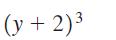
Find each product. (y + 2)³
Perform the indicated operations. - [3z² + 5z - (2z² − 6z)] + [(82² - [5z - z²]) + 2z²]
Perform the indicated operations. 5k − (5k — [2k − (4k − 8k)]) + 11k – (9k – 12k) -
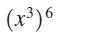
Simplify using the power rules. Assume that all variables represent nonzero real numbers. 9(cr)
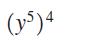
Simplify using the power rules. Assume that all variables represent nonzero real numbers. (y)4
Simplify using the power rules. Assume that all variables represent nonzero real numbers. 3 5 3
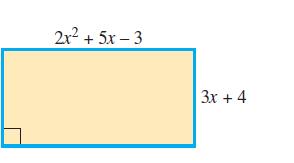
Find the perimeter of each figure. Express it as a polynomial in descending powers of the variable x. 2x² + 5x - 3 3x + 4
Find each product. (z − 3)³ -
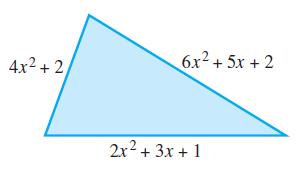
Find the perimeter of each figure. Express it as a polynomial in descending powers of the variable x. 4x²+2, 6x² + 5x + 2 2x² + 3x + 1
Simplify using the power rules. Assume that all variables represent nonzero real numbers. + 3 2
Simplify using the power rules. Assume that all variables represent nonzero real numbers. (41) 3
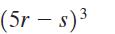
Find each product. (5r - s) ³ 3
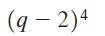
Find each product. (q − 2)4
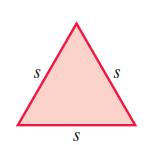
The perimeter x of an equilateral triangle with sides of length s is given by the formula x = 3s.(a) Solve for s in terms of x.(b) The area y of an equilateral triangle with sides of length s is given by the formulaWrite y as a function of the perimeter x.(c) Use the composite function of part (b)
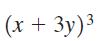
Find each product. (x + 3y)³
Simplify using the power rules. Assume that all variables represent nonzero real numbers. (6x²)3
Simplify using the power rules. Assume that all variables represent nonzero real numbers. (5t)4
Find each product. (2a + b) (3a² + 2ab + b²)
Simplify using the power rules. Assume that all variables represent nonzero real numbers. (2x-5) 5
Find each product. (r + 3) 4
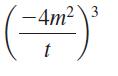
Simplify using the power rules. Assume that all variables represent nonzero real numbers. -4m²3 t
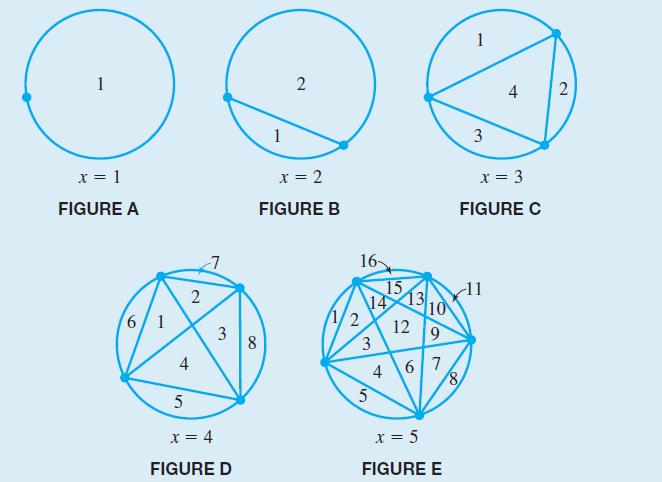
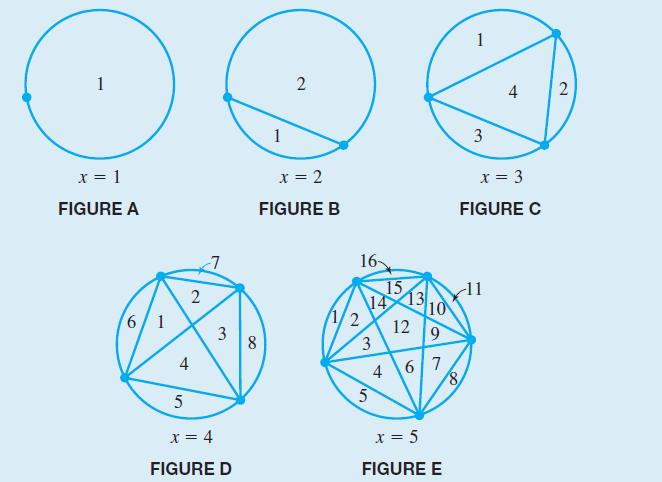
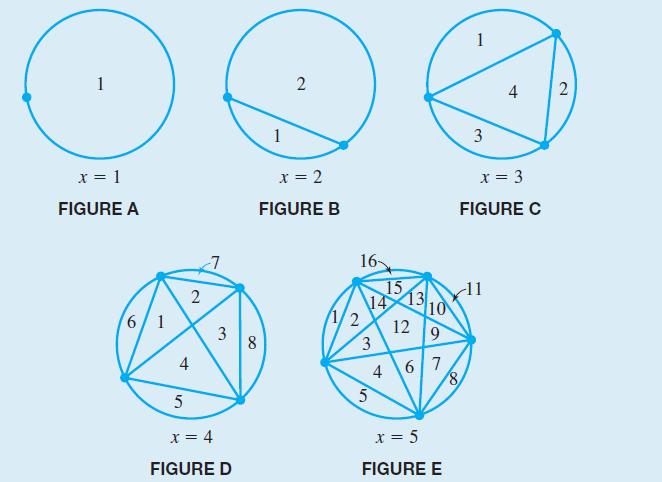
The polynomial functionwill give the maximum number of interior regions formed in a circle if x points on the circumference are joined by all possible chords. For x = 1, 2, 3, 4, and 5, see FIGURES A–E.For example, in FIGURE A we have 1 point, and because no chords can be drawn, we have only 1
Find each product. (4z - x) (2³ 4z²x + 2zx²x³) -
The polynomial functionwill give the maximum number of interior regions formed in a circle if x points on the circumference are joined by all possible chords. For x = 1, 2, 3, 4, and 5, see FIGURES A–E.For example, in FIGURE A we have 1 point, and because no chords can be drawn, we have only 1
Find each product. (m − 5p)(m² − 2mp + 3p²)
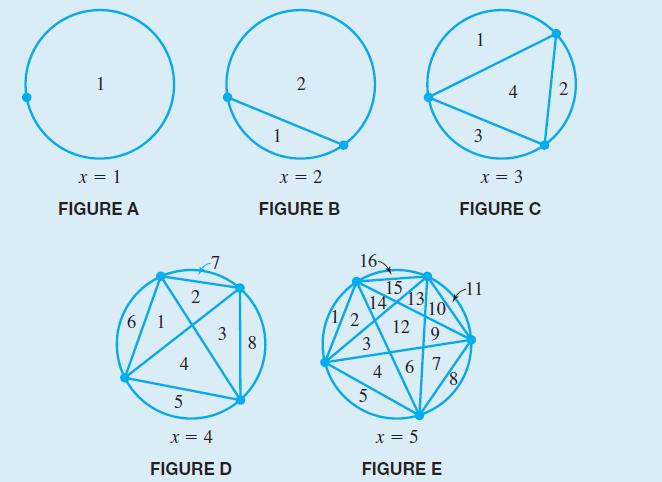
The polynomial functionwill give the maximum number of interior regions formed in a circle if x points on the circumference are joined by all possible chords. For x = 1, 2, 3, 4, and 5, see FIGURES A–E.For example, in FIGURE A we have 1 point, and because no chords can be drawn, we have only 1
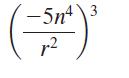
Simplify using the power rules. Assume that all variables represent nonzero real numbers. -5n4\3 p²
Find each product. (m² - 2mp + p²) (m² + 2mp − p²) -
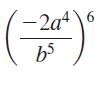
Simplify using the power rules. Assume that all variables represent nonzero real numbers. -2a4 65 6
Find each product. (3r + 2s) (r³+2r²s - rs² + 2s³)
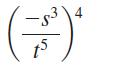
Simplify using the power rules. Assume that all variables represent nonzero real numbers. ts 4
The polynomial functionwill give the maximum number of interior regions formed in a circle if x points on the circumference are joined by all possible chords. For x = 1, 2, 3, 4, and 5, see FIGURES A–E.For example, in FIGURE A we have 1 point, and because no chords can be drawn, we have only 1
Find each product. (3 + x + y) (-3 + x - y)
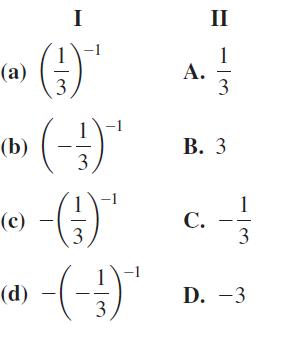
Match the expression in Column I with its equivalent expression in Column II. Choices may be used once, more than once, or not at all. (a) (b) (-3) -()* (d) -(-3) -¹ I () 3 (c) A. II C. 3 B. 3 -18 D. -3
Find each product. mp(m − p)(m – 2p) (2m + p)
Find each product. ab(a + b)(a + 2b)(a − 3b)
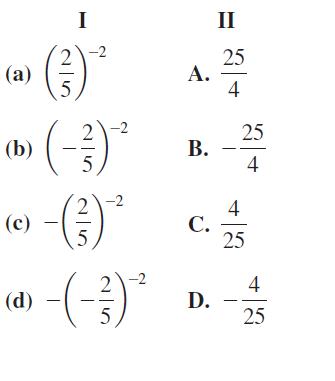
Match the expression in Column I with its equivalent expression in Column II. Choices may be used once, more than once, or not at all. (a) (b) (c) (d) 2 5 I -2 2 5 (3) ² -(-²-13) 2 5 7 A. B. C. D. II 25 4 25 4 25 4 25
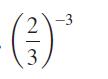
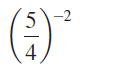
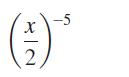
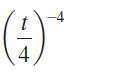
Write using only positive exponents and then evaluate. Assume that all variables represent nonzero real numbers. 5 -2
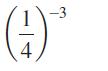
Write using only positive exponents and then evaluate. Assume that all variables represent nonzero real numbers. 4 -3
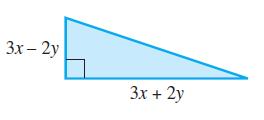
Find the area of each figure. Express it as a polynomial in descending powers of the variable x. Refer to the formulas at the back of this text if necessary. 3x-2y 3x+2y
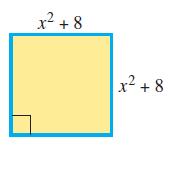
Find the area of each figure. Express it as a polynomial in descending powers of the variable x. Refer to the formulas at the back of this text if necessary. x² +8 x 2 + 8
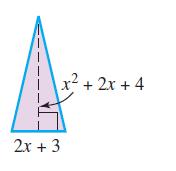
Find the area of each figure. Express it as a polynomial in descending powers of the variable x. Refer to the formulas at the back of this text if necessary. x² + 2x + 4 2x + 3
Write using only positive exponents and then evaluate. Assume that all variables represent nonzero real numbers. 3 -3
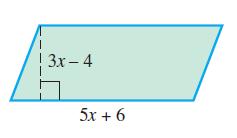
Find the area of each figure. Express it as a polynomial in descending powers of the variable x. Refer to the formulas at the back of this text if necessary. 3x-4 50+6
Write using only positive exponents and then evaluate. Assume that all variables represent nonzero real numbers. -3 ♡ la
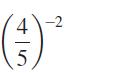
Write using only positive exponents and then evaluate. Assume that all variables represent nonzero real numbers. T 4 -2
For each pair of functions, find (ƒg)(x). f(x) = 3x, g(x) = 6x - 8
Write using only positive exponents and then evaluate. Assume that all variables represent nonzero real numbers. 5 -2
For each pair of functions, find (ƒg)(x). f(x) = 2x, g(x) = 5x - 1 :
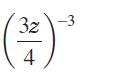
Write using only positive exponents and then evaluate. Assume that all variables represent nonzero real numbers. 3z 4 -3
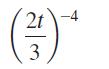
Write using only positive exponents and then evaluate. Assume that all variables represent nonzero real numbers. 2t 3 -4
For each pair of functions, find (ƒg)(x). f(x)=x+1, g(x) = 2x - 3
For each pair of functions, find (ƒg)(x). f(x) = 3x + 4, g(x) = 9x² 12x + 16
For each pair of functions, find (ƒg)(x). f(x)=x-7, g(x) = 4x + 5
Write using only positive exponents and then evaluate. Assume that all variables represent nonzero real numbers. 2 -5
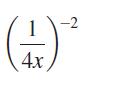
Write using only positive exponents and then evaluate. Assume that all variables represent nonzero real numbers. -2 (1) ² 4x
For each pair of functions, find (ƒg)(x). f(x)=2x-3, g(x) = 4x² + 6x + 9 :
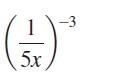
Write using only positive exponents and then evaluate. Assume that all variables represent nonzero real numbers. 5x -3
Let ƒ(x) = x2 - 9, g(x) = 2x, and h(x) = x - 3. Find each of the following. (fg)(x)
Write using only positive exponents and then evaluate. Assume that all variables represent nonzero real numbers. t- -14
Let ƒ(x) = x2 - 9, g(x) = 2x, and h(x) = x - 3. Find each of the following. (fh)(x)
Let ƒ(x) = x2 - 9, g(x) = 2x, and h(x) = x - 3. Find each of the following. (fg)(2)
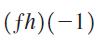
Let ƒ(x) = x2 - 9, g(x) = 2x, and h(x) = x - 3. Find each of the following. (fh) (-1)
Showing 7500 - 7600
of 16373
First
69
70
71
72
73
74
75
76
77
78
79
80
81
82
83
Last
Step by Step Answers

 Get 50% OFF
Claim Now
Get 50% OFF
Claim Now