New Semester
Started
Get
50% OFF
Study Help!
--h --m --s
Claim Now
Question Answers
Textbooks
Find textbooks, questions and answers
Oops, something went wrong!
Change your search query and then try again
S
Books
FREE
Study Help
Expert Questions
Accounting
General Management
Mathematics
Finance
Organizational Behaviour
Law
Physics
Operating System
Management Leadership
Sociology
Programming
Marketing
Database
Computer Network
Economics
Textbooks Solutions
Accounting
Managerial Accounting
Management Leadership
Cost Accounting
Statistics
Business Law
Corporate Finance
Finance
Economics
Auditing
Tutors
Online Tutors
Find a Tutor
Hire a Tutor
Become a Tutor
AI Tutor
AI Study Planner
NEW
Sell Books
Search
Search
Sign In
Register
study help
mathematics
contemporary mathematics
Contemporary Mathematics 1st Edition OpenStax - Solutions
Account from Exercise 5 .Find the return on investment based on the specified exercise. Round to two decimal places.Data from Exercises 5The amount of \(\$ 3,000\) deposited in a CD bearing \(2.6 \%\) compounded semi-annually for 3 years.
Account from Exercise 6.Find the return on investment based on the specified exercise. Round to two decimal places.Data from Exercises 6The amount of \(\$ 1,500\) deposited in a money market account bearing \(3.11 \%\) interest compounded monthly for 10 years.Find the future value of the account
Account from Exercise 7.Find the return on investment based on the specified exercise. Round to two decimal places.Data from Exercises 7The amount of \(\$ 8,450\) deposited in a savings account bearing \(1.75 \%\) interest compounded monthly for 2 years.Find the future value of the account based on
Account from Exercise 8.Find the return on investment based on the specified exercise. Round to two decimal places.Data from Exercises 8The amount of \(\$ 10,500\) deposited in a savings account bearing \(1.35 \%\) interest compounded quarterly for 20 years.Find the future value of the account
The amount of \(\$ 150\) deposited monthly in an account bearing \(4.22 \%\) interest compounded monthly for 20 years.Find the future value of the ordinary annuities based on the payment, interest rate, compounding periods and length of time given.
The amount of \(\$ 500\) deposited semi-annually in an account bearing \(3.62 \%\) interest compounded semi-annually for 30 years.Find the future value of the ordinary annuities based on the payment, interest rate, compounding periods and length of time given
The amount of \(\$ 250\) deposited quarterly in an account bearing \(3.61 \%\) interest compounded quarterly for 25 years.Find the future value of the ordinary annuities based on the payment, interest rate, compounding periods and length of time given
The amount of \(\$ 250\) deposited monthly in an account bearing \(3.09 \%\) interest compounded monthly for 40 years.Find the future value of the ordinary annuities based on the payment, interest rate, compounding periods and length of time given
The amount of \(\$ 1,500\) deposited annually in an account bearing \(3.34 \%\) interest compounded annually for 10 years.Find the future value of the ordinary annuities based on the payment, interest rate, compounding periods and length of time given
The amount of \(\$ 1400\) deposited semi-annually in an account bearing \(2.78 \%\) interest compounded semiannually for 30 years.Find the future value of the ordinary annuities based on the payment, interest rate, compounding periods and length of time given
Future value of \(\$ 1,000,000\) from an account bearing \(3.94 \%\) interest compounded monthly for 40 years.Find the payment per period necessary to reach a specified future value based on the given interest rate, compounding periods per year, and number of years. Recall, the number of payments
Future value of \(\$ 500,000\) from an account bearing \(2.11 \%\) interest compounded quarterly for 30 years.Find the payment per period necessary to reach a specified future value based on the given interest rate, compounding periods per year, and number of years. Recall, the number of payments
Future value of \(\$ 750,000\) from an account bearing \(3.27 \%\) interest compounded monthly for 25 years.Find the payment per period necessary to reach a specified future value based on the given interest rate, compounding periods per year, and number of years. Recall, the number of payments per
Future value of \(\$ 300,000\) from an account bearing \(3.59 \%\) interest compounded semiannually for 35 years.Find the payment per period necessary to reach a specified future value based on the given interest rate, compounding periods per year, and number of years. Recall, the number of
Future value of \(\$ 1,000,000\) from an account bearing \(3.62 \%\) interest compounded annually for 25 years.Find the payment per period necessary to reach a specified future value based on the given interest rate, compounding periods per year, and number of years. Recall, the number of payments
Future value of \(\$ 600,000\) from an account bearing \(4.02 \%\) interest compounded quarterly for 30 years.Find the payment per period necessary to reach a specified future value based on the given interest rate, compounding periods per year, and number of years. Recall, the number of payments
Dina deposits \(\$ 3,000\) in a 5 -year CD that bears \(3.25 \%\) interest compounded quarterly. What is the CD worth after those 5 years?
Timothy deposits \(\$ 1,200\) in a savings account that bears \(1.85 \%\) interest compounded monthly. If Timothy does not deposit or withdraw money from the account how much is in Timothy's account after 3 years?
Leslie deposits \(\$ 13,000\) in a money market account that bears \(2.55 \%\) interest compounded semi-annually. If Leslie does not withdraw or deposit money into the account, how much is in Leslie's account after 6 years?
Jennifer deposits \(\$ 8,500\) in a 3 -year CD bearing \(2.71 \%\) interest compounded annually. How much is Jennifer's CD worth after those 3 years?
Yasmin has analyzed her budget and decides to deposit \(\$ 425\) per month in an account bearing \(3.99 \%\) interest compounded monthly. How much will be in the account after 20 years? After 30 years? After 40 years?
Brad applied the 50-30-20 budget philosophy to his income and decides that he can afford \(\$ 380\) per month for savings. He finds an account bearing \(3.47 \%\) interest compounded monthly. How much will he have in the account after 25 years? 30 years? 35 years?
Ashliegh wants to save for an early retirement. She thinks she needs \(\$ 1,250,000\) to retire at the age of 55 , which is 30 years from now. How much must she deposit per month in an account bearing \(3.48 \%\) interest compounded monthly to reach her goal?
Colin plans out the next 38 years of his life. In order to retire in 38 years (age 65 ) with \(\$ 1,450,000\), how much should he deposit quarterly in an account bearing \(4.21 \%\) interest compounded quarterly to reach his goal?
Sam is 23 years old and has just landed her first post-college job. She creates a budget, and using the \(50-30-20\) budget philosophy, she sees she should save or pay down debt with \(\$ 650\). She decides to apply \(\$ 300\) per month to long-term savings. She finds an account bearing \(3.75 \%\)
Sam decides instead to delay investing in the account until her 35 th birthday. How much will be in the account at age 65 ( 30 years)?
Sam decides to deposit the \(\$ 300\) per month until she turns 35 years old ( 11 years). She will then stop investing the \(\$ 300\) monthly, and just allow the money to earn interest until her 65 th birthday ( 30 more years). How much will be in her account on her 65th birthday? First, compute
Compare the results of the three investment strategies.
Dahlia is 22 years old and has just landed a banking job. She creates a budget, and using the 50-30-20 budget philosophy, she sees she should save or pay down debt with \(\$ 400\). She decides to apply \(\$ 250\) per month to long-term savings. She finds an account bearing \(6.2 \%\) interest
Dahlia decides instead to delay investing in the account until her 34th birthday. How much will be in the account on her 68th birthday (34 years)?
Dahlia decides to deposit the \(\$ 250\) per month until her 34 th birthday ( 11 years). She will then stop investing the \(\$ 250\) monthly, and just allow the money to earn interest until her 68th birthday ( 34 more years). How much will be in her account on her 65th birthday? Hint: First compute
What is the maturity date for a bond?
What is the issue price for a bond?
Stock investments increase in value in what two ways?
Which is the least risky of stocks, bonds, mutual funds, CDs?
Which type of individual retirement account allows pre-tax deposits?
What are the limits on contributions to individual retirement accounts in 2022?
Of bonds, stocks, mutual funds, CDs, and money market accounts, which do not allow for withdrawal until a certain time period has passed?
Which type of IRA allows the account to grow tax free, provided no withdrawals are made until after the age of \(59 \frac{1}{2}\) ?
Which of bonds, mutual funds, and CDs are professionally managed?
Why do mutual funds and IRAs have relatively low risk?
Issue price of \(\$ 10,000\) pays \(3.5 \%\) annually, matures in 5 years.For the bonds with the given properties, finda. the amount paid each year andb. the total amount earned with the bond.
Issue price of \(\$ 3,400\) pays \(2.75 \%\) annually, matures in 10 years.For the bonds with the given properties, finda. the amount paid each year andb. the total amount earned with the bond.
Issue price of \(\$ 1,000\) pays \(2.8 \%\) annually, matures in 5 years.For the bonds with the given properties, finda. the amount paid each year andb. the total amount earned with the bond.
Issue price of \(\$ 5,000\) pays \(3.75 \%\) annually, matures in 15 years.For the bonds with the given properties, finda. the amount paid each year andb. the total amount earned with the bond.
Issue price of \(\$ 10,000\) pays \(3.5 \%\) annually, matures in 5 years.Find:a. the return on investment andb. the annual return for the bond described. Round to two decimal places.
Issue price of \(\$ 3,400\) pays \(2.75 \%\) annually, matures in 10 years.Find:a. the return on investment andb. the annual return for the bond described. Round to two decimal places.
Issue price of \(\$ 1,000\) pays \(2.8 \%\) annually, matures in 5 years.Find:a. the return on investment andb. the annual return for the bond described. Round to two decimal places.
Issue price of \(\$ 5,000\) pays \(3.75 \%\) annually, matures in 15 years.Find:a. the return on investment andb. the annual return for the bond described. Round to two decimal places.
40 shares of stock are owned. The dividend per share is \(\$ 0.38\) for a quarter. How much was earned in dividends on this stock this quarter?
150 shares of stock are owned. The dividend per share is \(\$ 0.78\) for a quarter. How much was earned in dividends on this stock this quarter?
100 shares of stock are owned. The dividend per share is \(\$ 0.18\) for a quarter. How much was earned in dividends on this stock this quarter?
250 shares of stock are owned. The dividend per share is \(\$ 0.41\) for a quarter. How much was earned in dividends
How much was earned with dividends and share price increase combined?70 shares of stock were purchased for \(\$ 31.50\) per share 5 years ago. Over the 5 years, the total of all dividends earned from this stock was \(\$ 6.34\) per share. The stock is sold for \(\$ 34.83\).
What was the return on investment for these stocks?70 shares of stock were purchased for \(\$ 31.50\) per share 5 years ago. Over the 5 years, the total of all dividends earned from this stock was \(\$ 6.34\) per share. The stock is sold for \(\$ 34.83\).
What was the annual return for these stocks?70 shares of stock were purchased for \(\$ 31.50\) per share 5 years ago. Over the 5 years, the total of all dividends earned from this stock was \(\$ 6.34\) per share. The stock is sold for \(\$ 34.83\).
How much was earned with dividends and share price increase combined?10 shares of stock were purchased for \(\$ 18.91\) per share 3 years ago. Over the 3 years, the total of all dividends earned from this stock was \(\$ 3.18\) per share. The stock is sold for \(\$ 22.01\).
What was the return on investment for these stocks?10 shares of stock were purchased for \(\$ 18.91\) per share 3 years ago. Over the 3 years, the total of all dividends earned from this stock was \(\$ 3.18\) per share. The stock is sold for \(\$ 22.01\).
What was the annual return for these stocks?10 shares of stock were purchased for \(\$ 18.91\) per share 3 years ago. Over the 3 years, the total of all dividends earned from this stock was \(\$ 3.18\) per share. The stock is sold for \(\$ 22.01\).
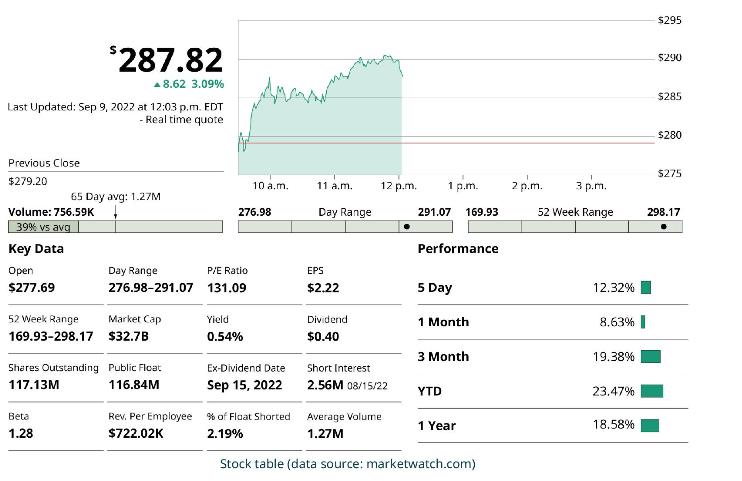
Use the given stock table to answer the following:a. What was the 52 -week low?b. What was the dividend?c. What is its year-to-date performance?d. What is its yield? $287.82 8.62 3.09% Last Updated: Sep 9, 2022 at 12:03 p.m. EDT - Real time quote $295 $290 $285 $280 Previous Close $275 $279.20 10
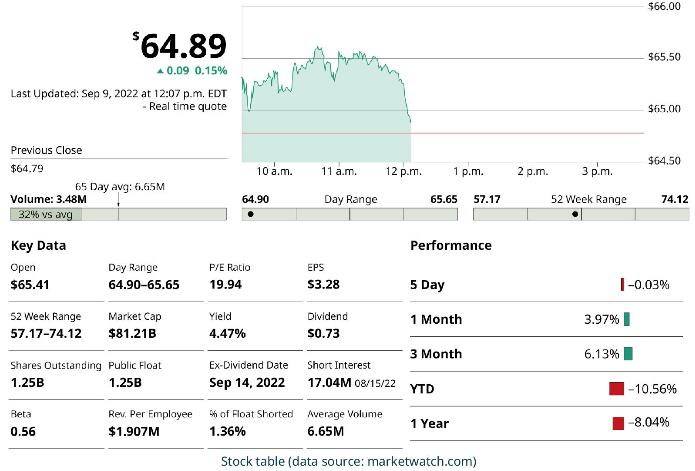
Use the given stock table to answer the following:a. What was the 52 -week low?b. What was the dividend?c. What is its year-to-date performance?d. What is its yield? $64.89 0.09 0.15% Last Updated: Sep 9, 2022 at 12:07 p.m. EDT - Real time quote $66.00 $65.50 $65,00 Previous Close $64.50 $64.79 10
IRA, annual deposit \(=\$ 6,000,25\) years, assumed percentage rate of \(11.3 \%\)Find the future value of the mutual fund or IRA with the given annual deposit, the duration of the investment, and the assumed annual, compounded, percentage rate.
IRA, annual deposit \(=\$ 4,800,15\) years, assumed percentage rate of \(9.7 \%\)Find the future value of the mutual fund or IRA with the given annual deposit, the duration of the investment, and the assumed annual, compounded, percentage rate.
Mutual fund, annual deposit \(=\$ 7,500,35\) years, assumed percentage rate of \(10 \%\)Find the future value of the mutual fund or IRA with the given annual deposit, the duration of the investment, and the assumed annual, compounded, percentage rate.
Mutual find, annual deposit \(=\$ 12,000,40\) years, assumed percentage rate of \(9 \%\)Find the future value of the mutual fund or IRA with the given annual deposit, the duration of the investment, and the assumed annual, compounded, percentage rate.
Mutual fund, goal \(=\$ 1,000,000,25\) years, assumed percentage rate of \(11.3 \%\)Find the annual deposit necessary, into an IRA or mutual fund, to reach the stated financial goal, given the assumed annual, compounded, interest rate, and the duration of the deposits. Convert that annual deposit
Mutual fund, goal \(=\$ 100,000,15\) years, assumed percentage rate of \(9.7 \%\)Find the annual deposit necessary, into an IRA or mutual fund, to reach the stated financial goal, given the assumed annual, compounded, interest rate, and the duration of the deposits. Convert that annual deposit to a
IRA, goal \(=\$ 750,000,35\) years, assumed percentage rate of \(10 \%\)Find the annual deposit necessary, into an IRA or mutual fund, to reach the stated financial goal, given the assumed annual, compounded, interest rate, and the duration of the deposits. Convert that annual deposit to a monthly
IRA, goal \(=\$ 1,750,000,40\) years, assumed percentage rate of \(9 \%\)Find the annual deposit necessary, into an IRA or mutual fund, to reach the stated financial goal, given the assumed annual, compounded, interest rate, and the duration of the deposits. Convert that annual deposit to a monthly
Francis's employer matches 401 (k) contributions up to \(7 \%\) of annual salary. She makes \(\$ 98,500\). What is the maximum amount that the company will match for Francis?
Miles' employer matches 401 (k) contributions up to \(4 \%\) of annual salary. He makes \(\$ 38,500\). What is the maximum amount that the company will match for Miles?
Ila's employer matches 401 (k) contributions, up to \(4 \%\) of salary. She makes \(\$ 49,000\). She wants to deposit \(\$ 3,000\) of her own earnings per year ( \(\$ 250\) per month). How much, including her employer's matching funds, will be deposited into Ila's account each year?
Georgia works at a company that matches \(401(\mathrm{k})\) contributions up to \(5.5 \%\) of salary. Georgia wants to deposit \(\$ 6,000\) of her own earnings per year ( \(\$ 500\) per month) in her 401 (k). If she makes \(\$ 65,000\) annually, how much, including employer contributions, will be
How much will the company match?Cheryl's company offers a 401(k) account to all employees. The company will match employee contributions up to \(6 \%\) of the employee's salary. She earns \(\$ 81,000\) per year. Cheryl decides to deposit, or contribute, \(\$ 10,000\) annually in the
What is her total contribution per year?Cheryl's company offers a 401(k) account to all employees. The company will match employee contributions up to \(6 \%\) of the employee's salary. She earns \(\$ 81,000\) per year. Cheryl decides to deposit, or contribute, \(\$ 10,000\) annually in the
If she deposits into the account for 25 years, how much will her \(401(\mathrm{k})\) be worth?Cheryl's company offers a 401(k) account to all employees. The company will match employee contributions up to \(6 \%\) of the employee's salary. She earns \(\$ 81,000\) per year. Cheryl decides to
How much will the company match?Lavanya's company offers a \(401(k)\) account to all employees. Her annual salary is \(\$ 58,000\). The company will match employee contributions up to \(7 \%\) of the employee's salary. Lavanya decides to deposit \(\$ 3,200\) annually in the 401 (k). She expects a
What is her total contribution per year?Lavanya's company offers a \(401(k)\) account to all employees. Her annual salary is \(\$ 58,000\). The company will match employee contributions up to \(7 \%\) of the employee's salary. Lavanya decides to deposit \(\$ 3,200\) annually in the 401 (k). She
If she deposits into the account for 20 years, how much will her \(401(\mathrm{k})\) be worth?Lavanya's company offers a \(401(k)\) account to all employees. Her annual salary is \(\$ 58,000\). The company will match employee contributions up to \(7 \%\) of the employee's salary. Lavanya decides to
How much total will need to be added to her account each year to reach her goal?Ruslana wants to use her \(401(\mathrm{k})\) to save \(\$ 1,400,000\) when she retires in 36 years. She assumes the plan will yield \(11 \%\) compounded annually. Her company will match contributions up to \(5 \%\) of
What is \(5 \%\) of Ruslana's salary?Ruslana wants to use her \(401(\mathrm{k})\) to save \(\$ 1,400,000\) when she retires in 36 years. She assumes the plan will yield \(11 \%\) compounded annually. Her company will match contributions up to \(5 \%\) of annual salary. Her salary is \(\$ 48,000\).
The company will match up to \(5 \%\) of Ruslana's salary, which means half the payment (up to \(5 \%\) of salary) will be contributed by the company. How much is half the necessary payment?Ruslana wants to use her \(401(\mathrm{k})\) to save \(\$ 1,400,000\) when she retires in 36 years. She
Does the answer to Exercise 51 exceed the result from Exercise 50?Ruslana wants to use her \(401(\mathrm{k})\) to save \(\$ 1,400,000\) when she retires in 36 years. She assumes the plan will yield \(11 \%\) compounded annually. Her company will match contributions up to \(5 \%\) of annual salary.
If the answer to Exercise 52 is no, then the company contributes half the deposit in the 401 (k). How much will the company contribute annually to the 401 ( \(\mathrm{k}\) ) if this is the case?Ruslana wants to use her \(401(\mathrm{k})\) to save \(\$ 1,400,000\) when she retires in 36 years. She
If the answer to Exercise 52 is yes, then the company contributes only the \(5 \%\) match of Ruslana's salary. In this case, how much does the company contribute?Ruslana wants to use her \(401(\mathrm{k})\) to save \(\$ 1,400,000\) when she retires in 36 years. She assumes the plan will yield \(11
How much will Ruslana need to contribute per year, after the employer contribution?Ruslana wants to use her \(401(\mathrm{k})\) to save \(\$ 1,400,000\) when she retires in 36 years. She assumes the plan will yield \(11 \%\) compounded annually. Her company will match contributions up to \(5 \%\)
Divide the answer to Exercise 55 by 12 to find the monthly contribution Ruslana will make.Ruslana wants to use her \(401(\mathrm{k})\) to save \(\$ 1,400,000\) when she retires in 36 years. She assumes the plan will yield \(11 \%\) compounded annually. Her company will match contributions up to \(5
How much total will need to be added to his account each year to reach his goal?Remy wants to use his 401 (k) to save \(\$ 1,750,000\) when he retires in 30 years. He assumes the plan will yield \(10.4 \%\) compounded annually. His company will match contributions up to \(6 \%\) of annual salary.
What is \(6 \%\) of Remy's salary?Remy wants to use his 401 (k) to save \(\$ 1,750,000\) when he retires in 30 years. He assumes the plan will yield \(10.4 \%\) compounded annually. His company will match contributions up to \(6 \%\) of annual salary. His salary is \(\$ 78,000\).
The company will match up to \(6 \%\) of Remy's salary, which means half the payment (up to \(6 \%\) of salary) will be contributed by the company. How much is half the necessary payment?Remy wants to use his 401 (k) to save \(\$ 1,750,000\) when he retires in 30 years. He assumes the plan will
Does the answer to Exercise 59 exceed the result from Exercise 58?Remy wants to use his 401 (k) to save \(\$ 1,750,000\) when he retires in 30 years. He assumes the plan will yield \(10.4 \%\) compounded annually. His company will match contributions up to \(6 \%\) of annual salary. His salary is
If the answer to Exercise 60 is no, then the company contributes half the deposit in the 401 (k). How much will the company contribute annually to the 401 (k) if this is the case?Remy wants to use his 401 (k) to save \(\$ 1,750,000\) when he retires in 30 years. He assumes the plan will yield
If the answer to Exercise 60 is yes, then the company contributes only the \(6 \%\) of Remy's salary. In this case, how much does the company contribute?Remy wants to use his 401 (k) to save \(\$ 1,750,000\) when he retires in 30 years. He assumes the plan will yield \(10.4 \%\) compounded
How much will Remy need to contribute per year, after the employer contribution?Remy wants to use his 401 (k) to save \(\$ 1,750,000\) when he retires in 30 years. He assumes the plan will yield \(10.4 \%\) compounded annually. His company will match contributions up to \(6 \%\) of annual salary.
Divide the answer to Exercise 63 by 12 to find the monthly contribution Remy will make.Remy wants to use his 401 (k) to save \(\$ 1,750,000\) when he retires in 30 years. He assumes the plan will yield \(10.4 \%\) compounded annually. His company will match contributions up to \(6 \%\) of annual
What is a direct way to compare accounts with different interest rates and number of compounding periods?
Which type of account grows in value faster, one with simple interest or one with compound interest?
Daily How many periods are there if interest is compounded?
Weekly How many periods are there if interest is compounded?
Monthly How many periods are there if interest is compounded?
Showing 3600 - 3700
of 6887
First
30
31
32
33
34
35
36
37
38
39
40
41
42
43
44
Last
Step by Step Answers

 Get 50% OFF
Claim Now
Get 50% OFF
Claim Now