New Semester
Started
Get
50% OFF
Study Help!
--h --m --s
Claim Now
Question Answers
Textbooks
Find textbooks, questions and answers
Oops, something went wrong!
Change your search query and then try again
S
Books
FREE
Study Help
Expert Questions
Accounting
General Management
Mathematics
Finance
Organizational Behaviour
Law
Physics
Operating System
Management Leadership
Sociology
Programming
Marketing
Database
Computer Network
Economics
Textbooks Solutions
Accounting
Managerial Accounting
Management Leadership
Cost Accounting
Statistics
Business Law
Corporate Finance
Finance
Economics
Auditing
Tutors
Online Tutors
Find a Tutor
Hire a Tutor
Become a Tutor
AI Tutor
AI Study Planner
NEW
Sell Books
Search
Search
Sign In
Register
study help
mathematics
contemporary mathematics
Contemporary Mathematics 1st Edition OpenStax - Solutions
\(x^{2}-5 x+5=0\) can be solved using the square root method.a. Trueb. False
\(x^{2}-5 x+5=0\) can be solved using the quadratic formula.a. Trueb. False
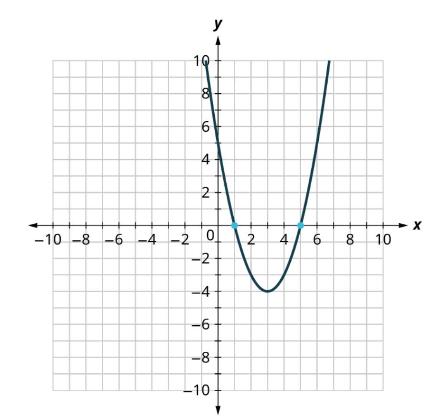
\(x^{2}-5 x+5=0\) can be graphed as:a. Trueb. False 10 8 6 +4 2 -10-8-6-4-20 -2 2 4 -4 -6 -8 -10 6 00 8 10 x
Using the square root method, find the solutions to \(x^{2}-5 x+5=0\).
If \(f(x)=2 x-8\) then \(f(3)=-2\).a. Trueb. False
\(\{(1,2),(2,3),(3,4),(2,1),(3,2),(4,3)\}\) represent the ordered pairs of a function.a. Trueb. False
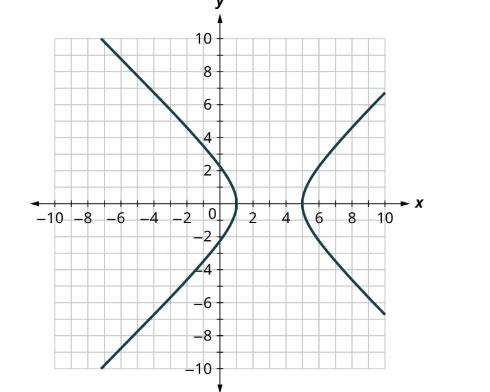
The graph shown represents the graph of a function:a. Trueb. False -10-8-6-4-20 4 2 10 8 6 2 4 6 8 10 -2 24 -6 -8 -10
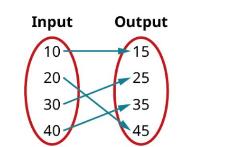
The figure shown represents the mapping of a function.a. Trueb. False Input Output 10- 15 20 25 30 35 40 45
The domain of the mapping in the figure is \(\{15,25,35,45\}\).a. Trueb. False
True or False. The \(x\)-intercept of \(y=2 x-8\) is \((0,-8)\).a. Trueb. False
True or False. The slope of the line containing the points \((1,2)\) and \((2,4)\) is 1.a. Trueb. False
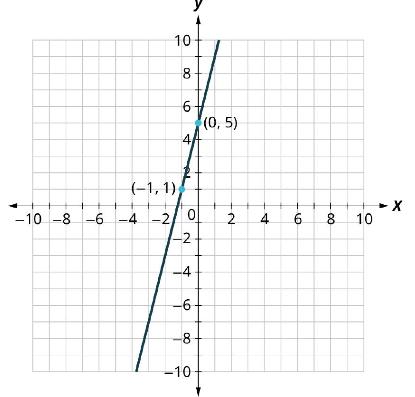
True or False. This graph has a slope of 5 .a. Trueb. False Use the graph shown. 10 8 00 6- 16 4 (0,5) (-1, 1) -10-8-6-4-20 -2 -4 -6- -8- -10 2 4 6 8 10 10 X
True or False. This is the graph of the equation \(y=4 x+5\).a. Trueb. False Use the graph shown. 10 8 00 6- 16 4 (0,5) (-1, 1) -10-8-6-4-20 -2 -4 -6- -8- -10 2 4 6 8 10 10 X
True or False. All vertical lines have a slope of zero.a. Trueb. False
\(\left\{\begin{aligned} 8 x-15 y & =-32 \\ 6 x+3 y & =-5\end{aligned}\right.\)Decide whether it would be more convenient to solve the system of equations by substitution or elimination.
\(\left\{\begin{aligned} x & =4 y-3 \\ 4 x-2 y & =-6\end{aligned}\right.\)Decide whether it would be more convenient to solve the system of equations by substitution or elimination.
\(\left\{\begin{aligned} y & =7 x-5 \\ 3 x-2 y & =16\end{aligned}\right.\)Decide whether it would be more convenient to solve the system of equations by substitution or elimination.
\(\left\{\begin{aligned} 12 x-5 y & =-42 \\ 3 x+7 y & =-15\end{aligned}\right.\)Decide whether it would be more convenient to solve the system of equations by substitution or elimination.
\(\left\{\begin{aligned} y & =4 x+9 \\ 5 x-2 y & =-21\end{aligned}\right.\)Decide whether it would be more convenient to solve the system of equations by substitution or elimination.
\(\left\{\begin{array}{l}9 x-4 y=24 \\ 3 x+5 y=14\end{array}\right.\)Decide whether it would be more convenient to solve the system of equations by substitution or elimination.
\(\left\{\begin{aligned} 14 x-15 y & =-30 \\ 7 x+2 y & =10\end{aligned}\right.\)Decide whether it would be more convenient to solve the system of equations by substitution or elimination.
\(\left\{\begin{aligned} x & =9 y-11 \\ 2 x-7 y & =-27\end{aligned}\right.\)Decide whether it would be more convenient to solve the system of equations by substitution or elimination.
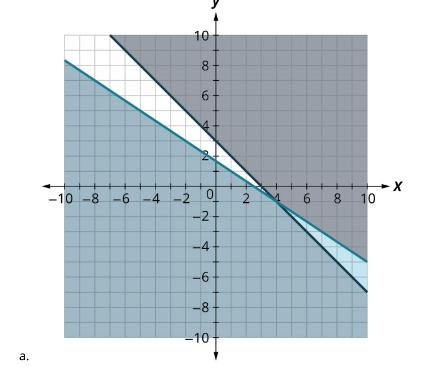
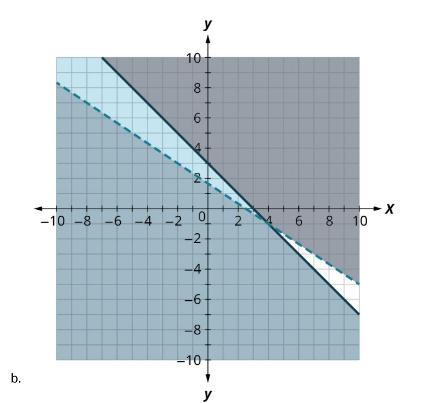
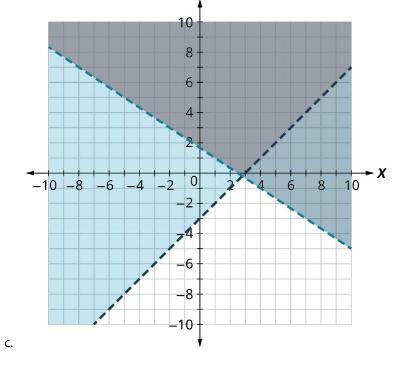
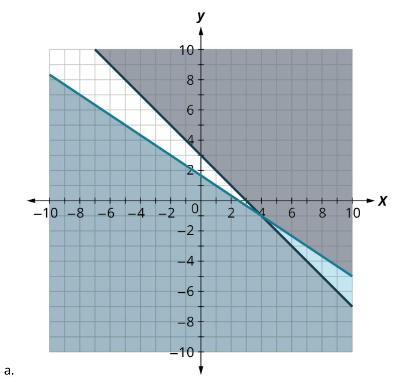
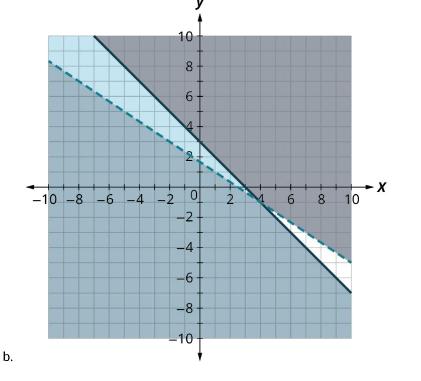
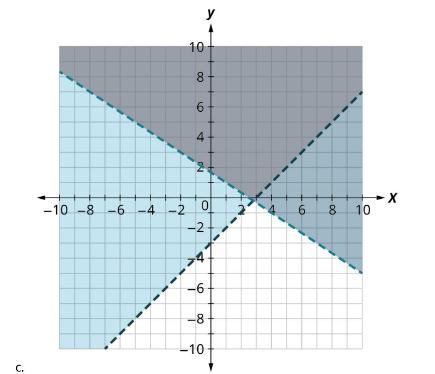
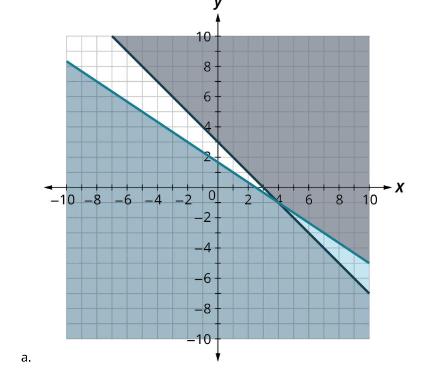
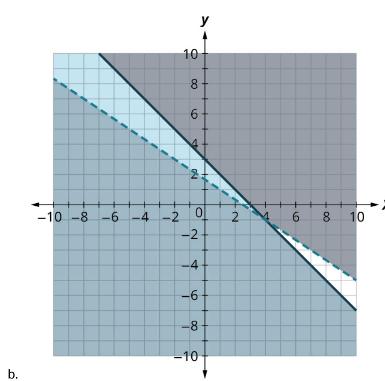
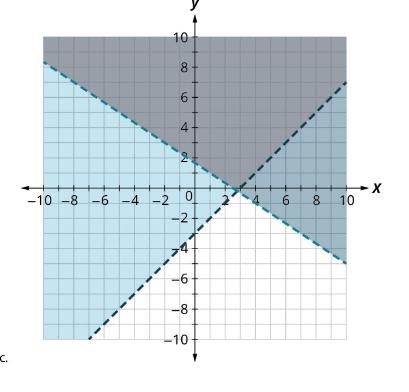
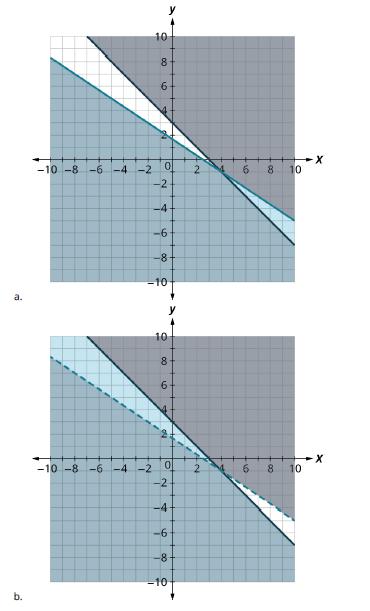
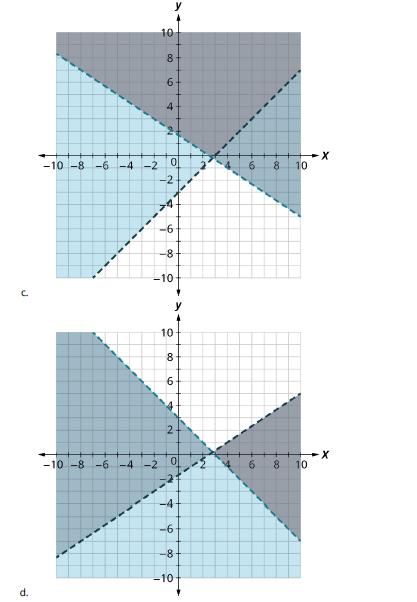
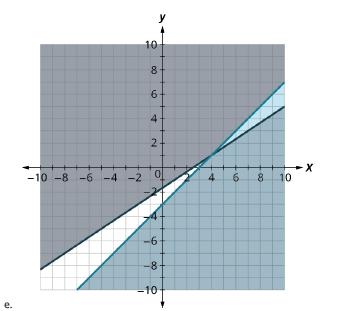
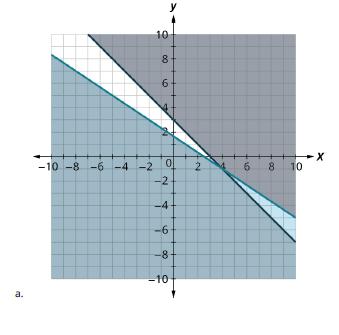
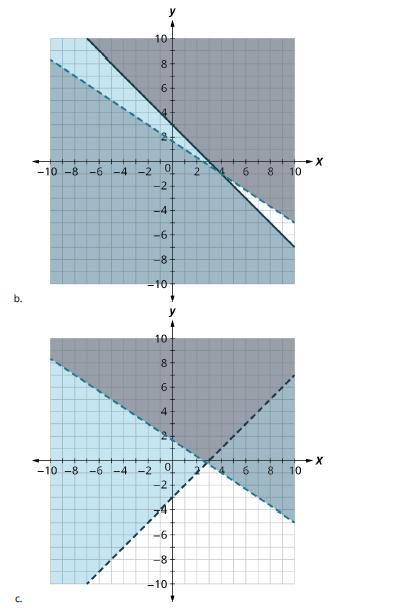
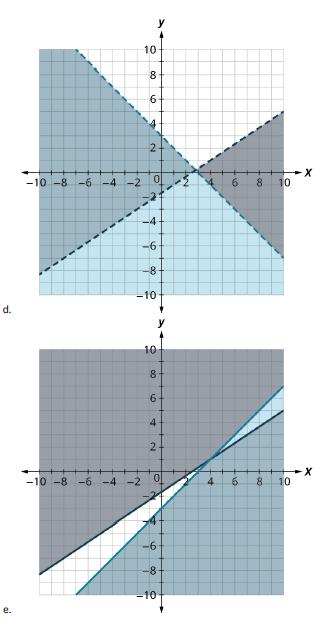
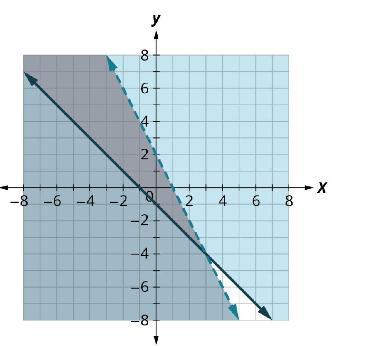
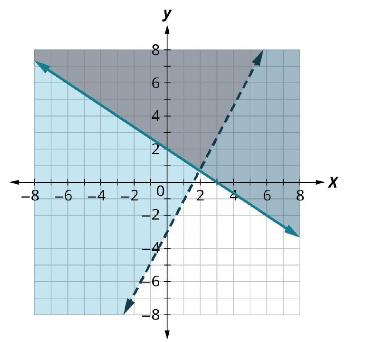
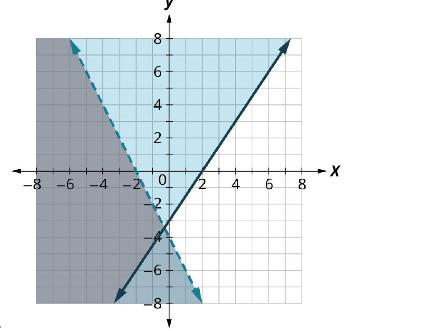
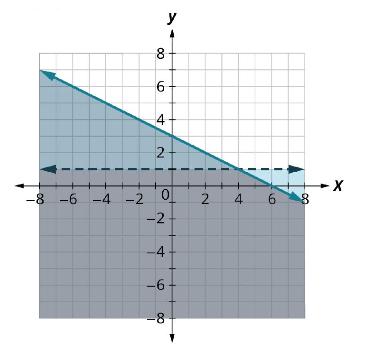
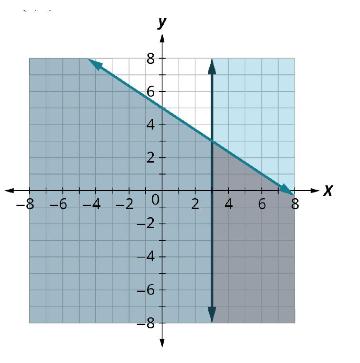
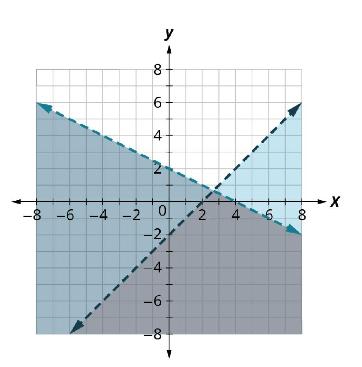
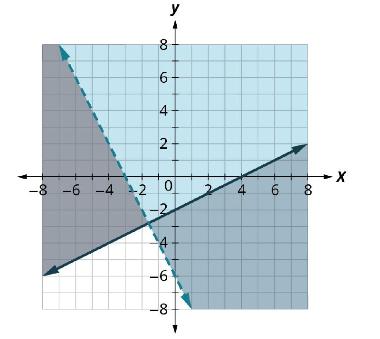
\(\left\{\begin{array}{r}2 x+3 y3\end{array}\right.\)Match the correct graph to its system of inequalities. -10-8-6-4-2 -2 -4 -6 -8 -10 a. 94 0 10 8 6 0 2 4 6 00 8 X 10
\(\left\{\begin{array}{r}2 x-3 y \leq 5 \\ x-y \geq 3\end{array}\right.\)Match the correct graph to its system of inequalities. M 10 8 00 y 6 -x -10-8-6-4 -4 -2 0 2 4 6 8 10 -2 -4 -6 -8- -10 a.
\(\left\{\begin{array}{r}2 x-3 y>5 \\ x+y.\)Match the correct graph to its system of inequalities. 10 8 6 st -10-8 -6-4 -2 0 2 -2 -4 -6+ -8 -10 a. 6 00 10 X
\(\left\{\begin{array}{r}2 x+3 y>5 \\ x+y \leq 3\end{array}\right.\)Match the correct graph to its system of inequalities. -10-8-6-4-2 10 00 8 6 0 2 6 -2- -4 -6 -8- -10 a. 10 8 8 10 -10-8-6 -4 -2 0 2 6. 8 10: -2- -4- -6 -8- -10 b. x x
\(\left\{\begin{array}{r}2 x+3 y \leq 5 \\ x+y \geq 3\end{array}\right.\)Match the correct graph to its system of inequalities. a. -10-8-6-4-2 -2- 10 8- 6 0 2 6 94. -4 -6 -8 -10- 00 8 x 10
Kellie makes tables and chairs. Kellie profits \(\$ 20\) from a table \((t)\), and \(\$ 10\) from a chair (c). The objective function for profit in this situation is:a. \(P=20 t-10 c\)b. \(P=20 c+10 t\)c. \(P=20 t+10 c\)d. \(P=20 c-10 t\)
Dave grows wheat \((w)\) and barley \((b)\) on a farm. Dave expects to profit \(\$ 150\) per acre for wheat and \(\$ 180\) per acre for barley. The objective function for profit in this situation is:a. \(P=150 w+180 b\)b. \(P=150 b+180 w\)c. \(P=180 w+150 b\)d. \(P=150 w-180 b\)
An antique music store sells two types of vinyl records; \(45 \mathrm{rpm}\) records \((f)\) and \(33 \mathrm{rpm}\) records ( \(t\) ). It makes a profit of \(\$ 2.50\) for each \(45 \mathrm{rpm}\) record and \(\$ 6.75\) for each \(33 \mathrm{rpm}\) record. The objective function for profit in this
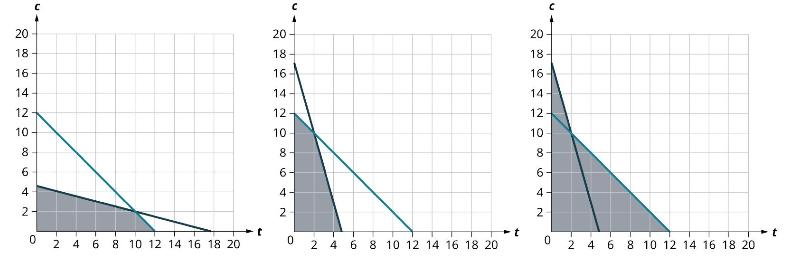
Kellie makes tables and chairs. Kellie profits \(\$ 20\) from a table \((t)\), and \(\$ 10\) from a chair (c). A table requires 15 board feet of wood, while a chair requires 4 board feet of wood. Kellie has 70 board feet available. What is the constraint inequality in this situation?a. \(20 t+10 c
Kellie makes tables and chairs. Kellie profits \(\$ 20\) from a table ( \(t\) ), and \(\$ 10\) from a chair (c). The maximum number of tables and chairs Kellie can make in any one day is 12 . What is the constraint inequality in this situation?a. \(t+c \leq 12\)b. \(20 t+10 c \leq 12\)c. \(20 t+10
Dave grows wheat \((w)\) and barley \((b)\) on a farm. Dave expects to profit \(\$ 150\) per acre for wheat and \(\$ 180\) per acre for barley. The cost of seed is \(\$ 10\) per acre for wheat and \(\$ 15\) per acre for barley. Dave can only afford to spend \(\$ 945\) on seed. What is the
Dave grows wheat \((w)\) and barley \((b)\) on a farm. Dave expects to profit \(\$ 150\) per acre for wheat and \(\$ 180\) per acre for barley. The cost of raising each crop is \(\$ 30\) per acre for wheat and \(\$ 25\) per acre for barley. Dave budgets \(\$ 1,635\) for the raising of both crops.
Kellie makes tables and chairs. Kellie profits \(\$ 20\) from a table \((t)\), and \(\$ 10\) from a chair (c). A table requires 15 board feet of wood, while a chair requires 4 board feet of wood. Kellie has 70 board feet available. The maximum number of tables and chairs Kellie can make in any one
Kellie makes tables and chairs. Kellie profits \(\$ 20\) from a table \((t)\), and \(\$ 10\) from a chair (c). A table requires 15 board feet of wood, while a chair requires 4 board feet of wood. Kellie has 70 board feet available. The maximum number of tables and chairs Kellie can make in any one
Kellie makes tables and chairs. Kellie profits \(\$ 20\) from a table \((t)\), and \(\$ 10\) from a chair (c). A table requires 15 board feet of wood, while a chair requires 4 board feet of wood. Kellie has 70 board feet available. The maximum number of tables and chairs Kellie can make in any one
\(\left\{\begin{array}{l}3 x+y>5 \\ 2 x-y \leq 10\end{array}\right.\)A: \((3,-3)\)B: \((7,1)\)Determine whether each ordered pair is a solution to the system.
\(\left\{\begin{array}{l}y
\(\left\{\begin{array}{l}4 x-y-8\end{array}\right.\)A: \((5,-2)\)B: \((-1,3)\)Determine whether each ordered pair is a solution to the system.
\(\left\{\begin{array}{l}y>\frac{2}{3} x-5 \\ x+\frac{1}{2} y \leq 4\end{array}\right.\)A: \((6,-4)\)B: \((3,0)\)Determine whether each ordered pair is a solution to the system.
\(\left\{\begin{array}{l}6 x-5 y-8\end{array}\right.\)A: \((1,-3)\)B: \((-4,4)\)Determine whether each ordered pair is a solution to the system.
\(\left\{\begin{array}{l}7 x+2 y>14 \\ 5 x-y \leq 8\end{array}\right.\)A: \((2,3)\)B: \((7,-1)\)Determine whether each ordered pair is a solution to the system.
Determine whether each ordered pair is a solution to the darkest shaded region of the graph.A: \((0,0)\)B: \((6,-8)\) -8 -6-4-2 8 00 6 + 2 2 4 -2 -4 -6 -8 6 8 X
Determine whether each ordered pair is a solution to the darkest shaded region of the graph.A: \((0,0)\)B: \((2,-4)\) 8 6 4 2 -8-6 -6-4-2 -4 -2 0 -2 -4 6 9 -8- 6 8 X
Determine whether each ordered pair is a solution to the darkest shaded region of the graph.A: \((0,0)\)B: \((2,2)\) 8 6 4 2 -8-6-4 -2 0 2 4 2 -6 -8 00 6 8 X
Determine whether each ordered pair is a solution to the darkest shaded region of the graph.A: \((0,0)\)B: \((2,3)\) T 4 2 00 8 6 y -8 -6 -4 -2 0 2 4 6 8 -2 -4 -6 -8
Determine whether each ordered pair is a solution to the darkest shaded region of the graph.A: \((0,0)\)B: \((6,0)\) 8 00 6 4 2 -8 -6 -4 -2 0 -2 -4 -6 -8 2 4 6 8
Determine whether each ordered pair is a solution to the darkest shaded region of the graph.A: \((0,0)\)B: \((6,2)\) N -8-6-4-20 8 6 4 y 2 4 6 -2 4 -6 -8 X 00 8
Determine whether each ordered pair is a solution to the darkest shaded region of the graph.A: \((0,0)\)B: \((2,2)\) 8 y 6 4 2 -8-6-4 20 4 6 8 00 -2 4 -6 -8 -x
\(\left\{\begin{array}{l}y \leq 3 x+2 \\ y>x-1\end{array}\right.\)Solve the systems of linear equations by graphing.
\(\left\{\begin{array}{l}y
\(\left\{\begin{aligned} x-y & >1 \\ y &
\(\left\{\begin{aligned} 3 x-y & \geq 6 \\ y & \geq-\frac{1}{2} x\end{aligned}\right.\)Solve the systems of linear equations by graphing.
\(\left\{\begin{aligned} 2 x+4 y & \geq 8 \\ y & \leq \frac{3}{4} x\end{aligned}\right.\)Solve the systems of linear equations by graphing.
\(\left\{\begin{array}{l}2 x-5 y
\(\left\{\begin{aligned} 2 x+2 y & >-4 \\ -x+3 y & \geq 9\end{aligned}\right.\)Solve the systems of linear equations by graphing.
\(\left\{\begin{aligned} x-2 y &
\(\left\{\begin{aligned} x-3 y & >4 \\ y & \leq-1\end{aligned}\right.\)Solve the systems of linear equations by graphing.
\(\left\{\begin{array}{l}y \geq-\frac{1}{2} x-3 \\ x \leq 2\end{array}\right.\)Solve the systems of linear equations by graphing.
\(\left\{\begin{aligned} x-3 y & \geq 6 \\ y & >\frac{1}{3} x+1\end{aligned}\right.\)Solve the systems of linear equations by graphing.
\(\left\{\begin{array}{l}y \geq \frac{3}{4} x-2 \\ y
\(\left\{\begin{aligned} 3 x-4 y &
\(\left\{\begin{aligned}-3 x+5 y & >10 \\ x & >-1\end{aligned}\right.\)Solve the systems of linear equations by graphing.
\(\left\{\begin{array}{l}x \geq 3 \\ y \leq 2\end{array}\right.\)Solve the systems of linear equations by graphing.
\(\left\{\begin{array}{l}x \leq-1 \\ y \geq 3\end{array}\right.\)Solve the systems of linear equations by graphing.
\(\left\{\begin{aligned} 2 x+4 y & >4 \\ y & \leq-\frac{1}{2} x-2\end{aligned}\right.\)Solve the systems of linear equations by graphing.
Write a system of inequalities to model this situation.Translate to a system of inequalities and solve.A gardener does not want to spend more than \(\$ 50\) on bags of fertilizer and peat moss for their garden. Fertilizer costs \(\$ 2\) a bag and peat moss costs \(\$ 5\) a bag. The gardener's van
Graph the system.Translate to a system of inequalities and solve.A gardener does not want to spend more than \(\$ 50\) on bags of fertilizer and peat moss for their garden. Fertilizer costs \(\$ 2\) a bag and peat moss costs \(\$ 5\) a bag. The gardener's van can hold at most 20 bags.
Can they buy 15 bags of fertilizer and 4 bags of peat moss?Translate to a system of inequalities and solve.A gardener does not want to spend more than \(\$ 50\) on bags of fertilizer and peat moss for their garden. Fertilizer costs \(\$ 2\) a bag and peat moss costs \(\$ 5\) a bag. The gardener's
Can they buy 10 bags of fertilizer and 10 bags of peat moss?Translate to a system of inequalities and solve.A gardener does not want to spend more than \(\$ 50\) on bags of fertilizer and peat moss for their garden. Fertilizer costs \(\$ 2\) a bag and peat moss costs \(\$ 5\) a bag. The gardener's
Write a system of inequalities to model this situation.Translate to a system of inequalities and solve.A student is studying for their final exams in chemistry and algebra. They only have 24 hours to study, and it will take them at least 3 times as long to study for algebra than chemistry.
Graph the system.Translate to a system of inequalities and solve.A student is studying for their final exams in chemistry and algebra. They only have 24 hours to study, and it will take them at least 3 times as long to study for algebra than chemistry.
Can they spend 4 hours on chemistry and 20 hours on algebra?Translate to a system of inequalities and solve.A student is studying for their final exams in chemistry and algebra. They only have 24 hours to study, and it will take them at least 3 times as long to study for algebra than chemistry.
Can they spend 6 hours on chemistry and 18 hours on algebra?Translate to a system of inequalities and solve.A student is studying for their final exams in chemistry and algebra. They only have 24 hours to study, and it will take them at least 3 times as long to study for algebra than chemistry.
Write a system of inequalities to model this situation.Translate to a system of inequalities and solve.Mara is attempting to build muscle mass. To do this, she needs to eat an additional 80 grams of protein or more in a day. A bottle of protein water costs \(\$ 3.20\) and a protein bar costs \(\$
Graph the system.Translate to a system of inequalities and solve.Mara is attempting to build muscle mass. To do this, she needs to eat an additional 80 grams of protein or more in a day. A bottle of protein water costs \(\$ 3.20\) and a protein bar costs \(\$ 1.75\). The protein water supplies 27
Could she buy 3 bottles of protein water and 1 protein bar?Translate to a system of inequalities and solve.Mara is attempting to build muscle mass. To do this, she needs to eat an additional 80 grams of protein or more in a day. A bottle of protein water costs \(\$ 3.20\) and a protein bar costs
Could she buy no bottles of protein water and 5 protein bars?Translate to a system of inequalities and solve.Mara is attempting to build muscle mass. To do this, she needs to eat an additional 80 grams of protein or more in a day. A bottle of protein water costs \(\$ 3.20\) and a protein bar costs
Write a system of inequalities to model this situation.Translate to a system of inequalities and solve.Mark is increasing his exercise routine by running and walking at least 4 miles each day. His goal is to burn a minimum of 1,500 calories from this exercise. Walking burns 270 calories/mile and
Graph the system.Translate to a system of inequalities and solve.Mark is increasing his exercise routine by running and walking at least 4 miles each day. His goal is to burn a minimum of 1,500 calories from this exercise. Walking burns 270 calories/mile and running burns 650 calories/mile.
Could he meet his goal by walking 3 miles and running 1 mile?Translate to a system of inequalities and solve.Mark is increasing his exercise routine by running and walking at least 4 miles each day. His goal is to burn a minimum of 1,500 calories from this exercise. Walking burns 270 calories/mile
Could he meet his goal by walking 2 miles and running 2 miles?Translate to a system of inequalities and solve.Mark is increasing his exercise routine by running and walking at least 4 miles each day. His goal is to burn a minimum of 1,500 calories from this exercise. Walking burns 270 calories/mile
Write a system of inequalities that models this situation.Translate to a system of inequalities and solve.Tension needs to eat at least an extra 1,000 calories a day to prepare for running a marathon. He has only \(\$ 25\) to spend on the extra food he needs and will spend it on \(\$ 0.75\) donuts,
Graph the system.Translate to a system of inequalities and solve.Tension needs to eat at least an extra 1,000 calories a day to prepare for running a marathon. He has only \(\$ 25\) to spend on the extra food he needs and will spend it on \(\$ 0.75\) donuts, which have 360 calories each, and \(\$
Can he buy 8 donuts and 4 energy drinks and satisfy his caloric needs?Translate to a system of inequalities and solve.Tension needs to eat at least an extra 1,000 calories a day to prepare for running a marathon. He has only \(\$ 25\) to spend on the extra food he needs and will spend it on \(\$
Can he buy 1 donut and 3 energy drinks and satisfy his caloric needs?Translate to a system of inequalities and solve.Tension needs to eat at least an extra 1,000 calories a day to prepare for running a marathon. He has only \(\$ 25\) to spend on the extra food he needs and will spend it on \(\$
\((w+5)(w+7)\)Multiply the binomials.
\((y+9)(y+3)\)Multiply the binomials.
\((p+11)(p-4)\)Multiply the binomials.
\((q+4)(q-8)\)Multiply the binomials.
\((x+8)(x+3)\)Multiply the binomials.
\((2 x-1)(x+6)\)Multiply the binomials.
\(a^{2}-5 a-14\)Factor the trinomials.
\(n^{2}+10 n+24\)Factor the trinomials.
\(u^{2}-16\)Factor the trinomials.
\(x^{2}+4 x-21\)Factor the trinomials.
\(y^{2}-8 y+15\)Factor the trinomials.
\(x^{2}-25\)Factor the trinomials.
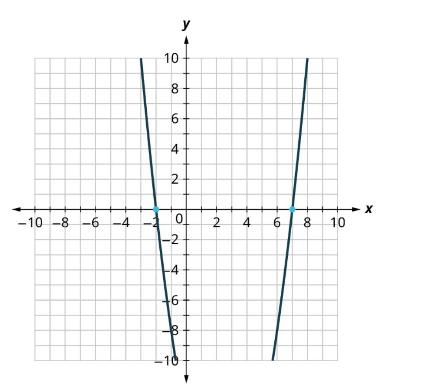
Graph and list the solutions to the quadratic equation \(x^{2}-5 x-14=0\).Solve the quadratic equations by graphing. 10 10 y 00 8 6 4 2 -10-8-6-4-0 -2 -4 6 B -10 2 4 6 00 10 X
Showing 4200 - 4300
of 6887
First
36
37
38
39
40
41
42
43
44
45
46
47
48
49
50
Last
Step by Step Answers

 Get 50% OFF
Claim Now
Get 50% OFF
Claim Now