New Semester
Started
Get
50% OFF
Study Help!
--h --m --s
Claim Now
Question Answers
Textbooks
Find textbooks, questions and answers
Oops, something went wrong!
Change your search query and then try again
S
Books
FREE
Study Help
Expert Questions
Accounting
General Management
Mathematics
Finance
Organizational Behaviour
Law
Physics
Operating System
Management Leadership
Sociology
Programming
Marketing
Database
Computer Network
Economics
Textbooks Solutions
Accounting
Managerial Accounting
Management Leadership
Cost Accounting
Statistics
Business Law
Corporate Finance
Finance
Economics
Auditing
Tutors
Online Tutors
Find a Tutor
Hire a Tutor
Become a Tutor
AI Tutor
AI Study Planner
NEW
Sell Books
Search
Search
Sign In
Register
study help
mathematics
precalculus 1st
Precalculus 1st Edition Jay Abramson - Solutions
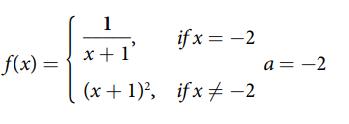
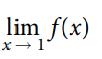
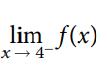
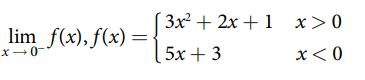
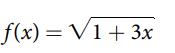
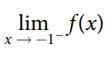
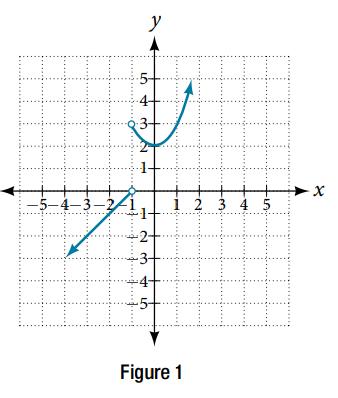
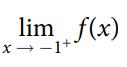
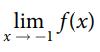
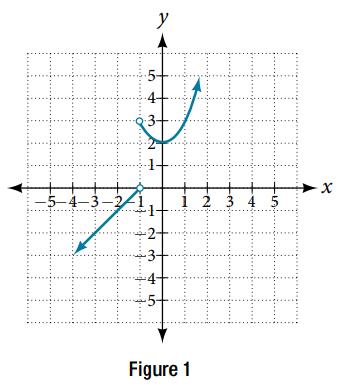
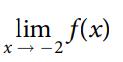
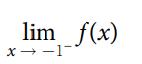
For the following exercises, with the use of a graphing utility, use numerical or graphical evidence to determine the left- and right-hand limits of the function given as x approaches a. If the function has limit as x approaches a, state it. If not, discuss why there is no limit. f(x)
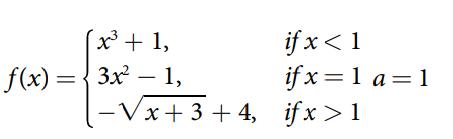
For the following exercises, with the use of a graphing utility, use numerical or graphical evidence to determine the left- and right-hand limits of the function given as x approaches a. If the function has a limit as x approaches a, state it. If not, discuss why there is no limit. x³ +
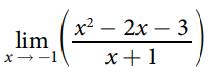
For the following exercises, evaluate the limits algebraically. lim x-1 x² - 2x - 3 x + 1
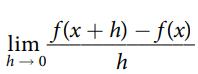
For the following exercises, use the definition of derivative to calculate the derivative of each function.f(x) = x2 − 2x + 1 lim h→0 f(x+h)-f(x) h
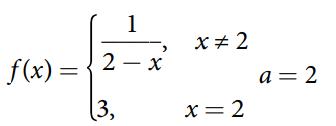
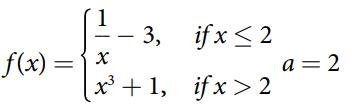
For the following exercises, determine why the function f is discontinuous at a given point a on the graph. State which condition fails. f(x) = 1 2-x (3, x = 2 x = 2 a=2
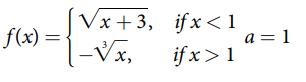
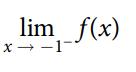
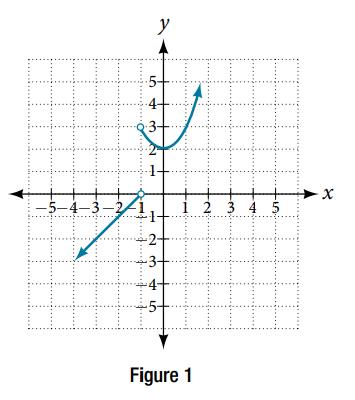
For the following exercises, with the use of a graphing utility, use numerical or graphical evidence to determine the left- and right-hand limits of the function given as x approaches a. If the function has limit as x approaches a, state it. If not, discuss why there is no limit. f(x)
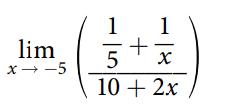
For the following exercises, evaluate each limit using algebraic techniques. lim x→-5 151 -18 + X 10 + 2x
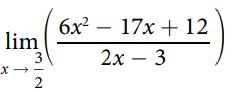
For the following exercises, evaluate the limits algebraically. lim 3 2 x 6x 17x + 12 2x - 3
For the following exercises, use the definition of derivative to calculate the derivative of each function.f(x) = 2x2 + x − 3 lim h→0 f(x+h)-f(x) h
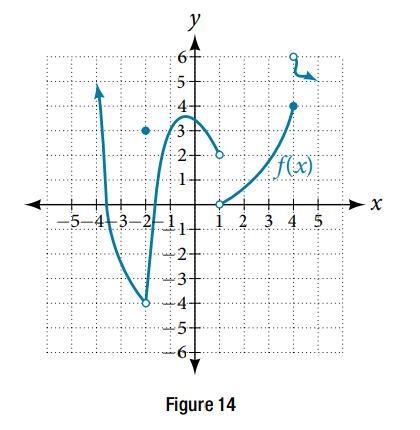
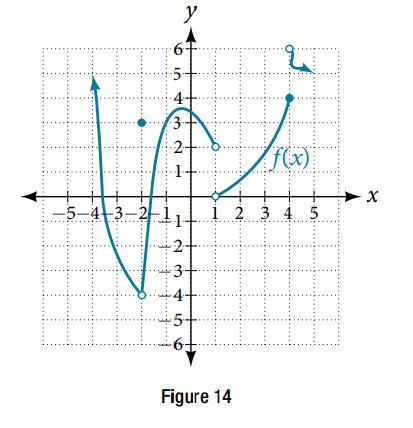
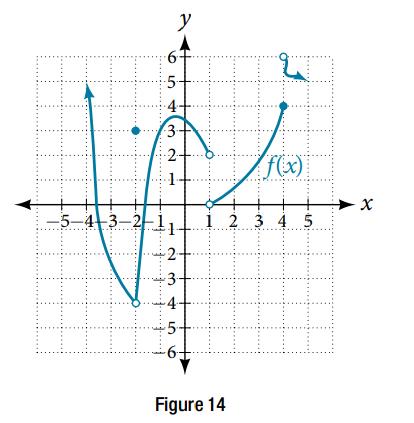
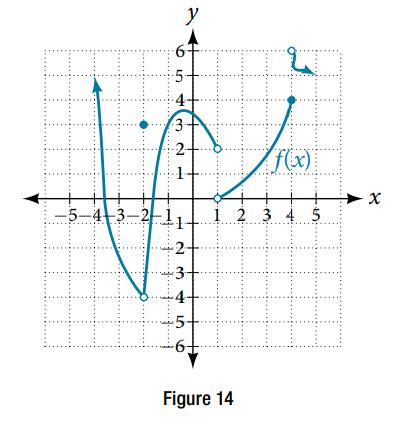
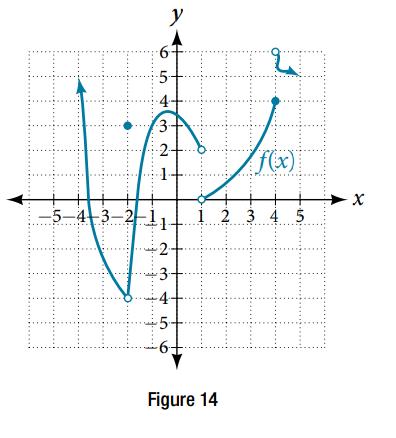
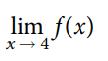
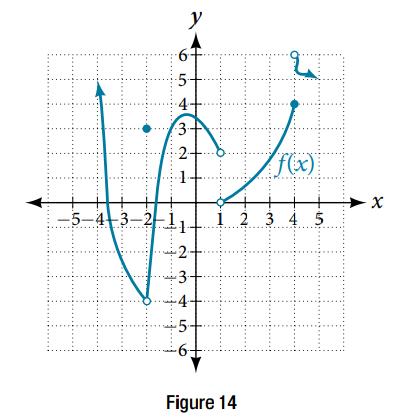
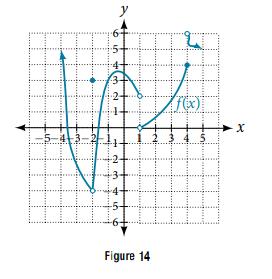
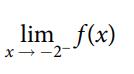
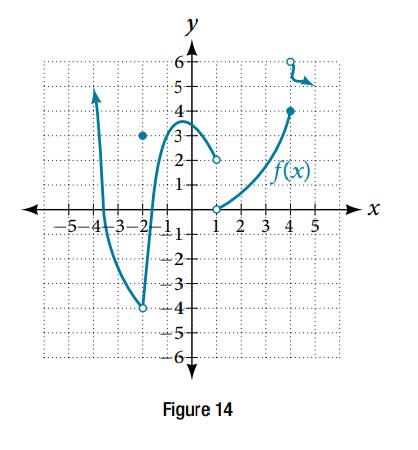
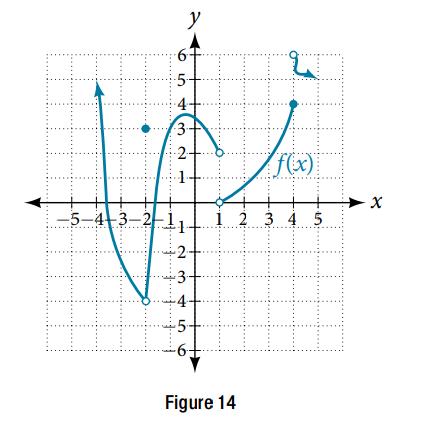
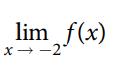
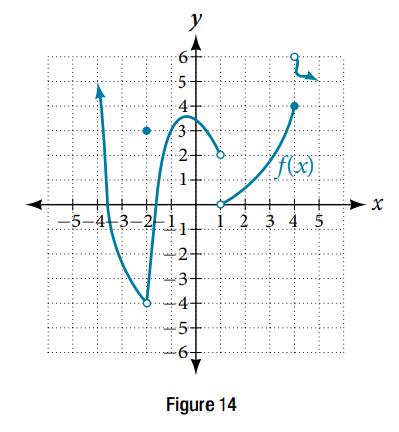
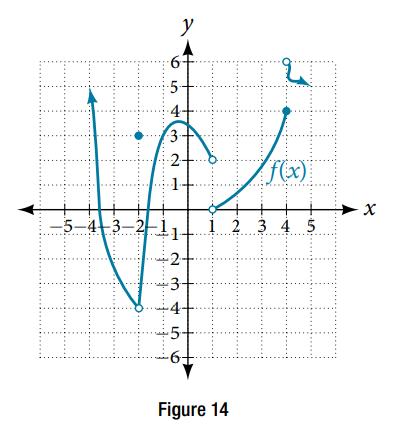
For the following exercises, estimate the functional values and the limits from the graph of the function f provided in Figure 14. Figure 14 345 23 -5-4-3-2-1 III 1 NWAsia 8 H y
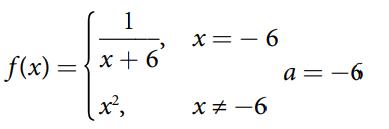
For the following exercises, determine why the function f is discontinuous at a given point a on the graph. State which condition fails. 1 f(x)=√x+6' x², x=-6 x=-6 a=-6
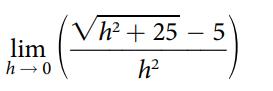
For the following exercises, evaluate each limit using algebraic techniques. lim h0 h + 25 - 5 h
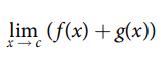
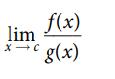
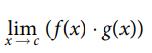
For the following exercises, find the limits if lim f(x) = -3 and lim g(x) = 5. xc x → C
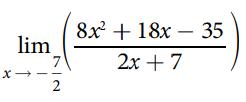
For the following exercises, evaluate the limits algebraically. x lim 7 2 8x² 18x35 2x + 7
For the following exercises, use the definition of derivative to calculate the derivative of each function.f(x) = 2x2 + 5 lim h→0 f(x+h)-f(x) h
For the following exercises, estimate the functional values and the limits from the graph of the function f provided in Figure 14.f(1) I y 5+ 3 2 -5-4-3-2-1 1 2 3 4 5 -2 -3+ 45 -4- f(x) Figure 14 ID
For the following exercises, find the limits if lim f(x) = -3 and lim g(x) = 5. xc x → C
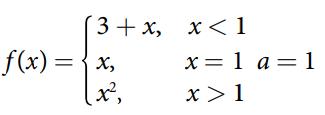
For the following exercises, determine why the function f is discontinuous at a given point a on the graph. State which condition fails. [3+x, f(x) = {x, x², x 1
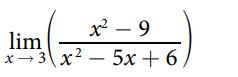
For the following exercises, evaluate the limits algebraically. lim x+3x 2 x9 5x+6,
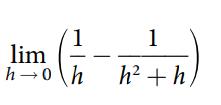
For the following exercises, evaluate each limit using algebraic techniques. 1 lim h→0 h 1 h² +h,
For the following exercises, use the definition of derivative to calculate the derivative of each function.f(x) = −1/x − 2 lim h→0 f(x+h)-f(x) h
For the following exercises, estimate the functional values and the limits from the graph of the function f provided in Figure 14. y 6 -5 2- 3- 4 5- -6- In -5-4-3-2-1. 1 2 3 4 5 Figure 14 (f(x) X
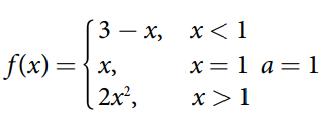
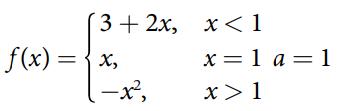
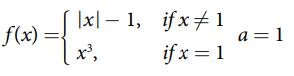
For the following exercises, determine why the function f is discontinuous at a given point a on the graph. State which condition fails. 3-x, f(x) = x, 2x², x < 1 x = 1 a = 1 x>1
For the following exercises, find the limits if lim f(x) = -3 and lim g(x) = 5. xc x → C
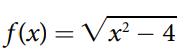
For the following exercises, determine whether or not the given function f is continuous. If it is continuous, show why. If it is not continuous, state which conditions fail. f(x)=√x² - 4
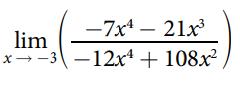
For the following exercises, evaluate the limits algebraically. -7x4- 21x³ + 108x² lim x-3-12x¹ →
For the following exercises, use the definition of derivative to calculate the derivative of each function.f(x) = 2 + x/1 − x lim h→0 f(x+h)-f(x) h
For the following exercises, estimate the functional values and the limits from the graph of the function f provided in Figure 14. II -5-4-3-2 6- -5 y 3 -2- 3- L Figure 14 f(x) 1 2 3 4 5 X
For the following exercises, determine why the function f is discontinuous at a given point a on the graph. State which condition fails. f(x)= (3 + 2x, x < 1 X, -x², x = 1 a = 1 x> 1
For the following exercises, find the limits if lim f(x) = -3 and lim g(x) = 5. xc x → C
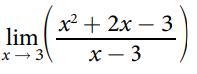
For the following exercises, evaluate the limits algebraically. lim x 3 x² + 2x - 3 x-3
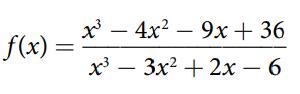
For the following exercises, determine whether or not the given function f is continuous. If it is continuous, show why. If it is not continuous, state which conditions fail. f(x) = = x³ 4x²9x +36 3x² + 2x - 6 - x³ -
For the following exercises, use the definition of derivative to calculate the derivative of each function.f(x) = 5 − 2x/3 + 2x lim h→0 f(x+h)-f(x) h
For the following exercises, estimate the functional values and the limits from the graph of the function f provided in Figure 14. I -5-4-3-2 y 6- -5- -2- +H I L 1 2 3 4 5 Figure 14 f(x) X
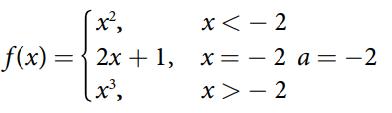
For the following exercises, determine why the function f is discontinuous at a given point a on the graph. State which condition fails. (x², f(x)=2x+1, (x³, x-2
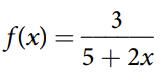
For the following exercises, use the definition of a derivative to find the derivative of the given function at x = a. f(x) = 3 5 + 2x
For the following exercises, find the limits if lim f(x) = -3 and lim g(x) = 5. xc x → C
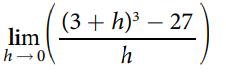
For the following exercises, evaluate the limits algebraically. lim h→0 (3 + h)³ - 27 h
For the following exercises, use the definition of derivative to calculate the derivative of each function. lim h→0 f(x+h)-f(x) h
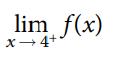
For the following exercises, estimate the functional values and the limits from the graph of the function f provided in Figure 14.f(4) Figure 14 ம் ம் 345 56 D 23 I -5-4-3-2- 2 3 4 5 X 32 54 4- -9- y
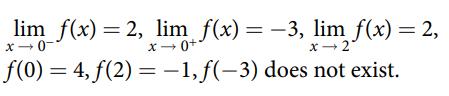
For the following exercises, draw the graph of a function from the functional values and limits provided. lim f(x) = 2, lim f(x) = −3, lim f(x) = 2, x 0- x0+ x 2° f(0) = 4, f(2)=-1, f(-3) does not exist.
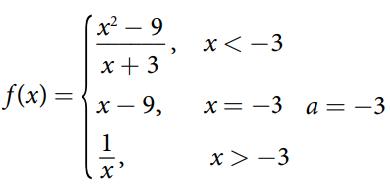
For the following exercises, determine why the function f is discontinuous at a given point a on the graph. State which condition fails. f(x) = x² - 9 x + 3 x - 9, 1 X x -3
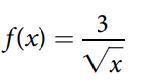
For the following exercises, use the definition of a derivative to find the derivative of the given function at x = a. f(x) = 3 Vx
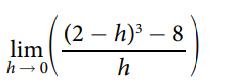
For the following exercises, evaluate the limits algebraically. lim h→0 (2-h)³-8 h
For the following exercises, find the limits if lim f(x) = -3 and lim g(x) = 5. xc x → C
For the following exercises, use the definition of derivative to calculate the derivative of each function.f(x) = 3x3 − x2 + 2x + 5 lim h→0 f(x+h)-f(x) h
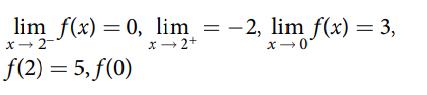
For the following exercises, draw the graph of a function from the functional values and limits provided. lim_ f(x) = 0, lim = -2, lim f(x) = 3, x-2- x → 2+ x-0 ƒ(2) = 5,ƒ(0)
For the following exercises, assume two die are rolled.What is the probability that a roll includes neither a 5 nor a 6?
Use the following scenario for the exercises that follow: In the game of Keno, a player starts by selecting 20 numbers from the numbers 1 to 80. After the player makes his selections, 20 winning numbers are randomly selected from numbers 1 to 80. A win occurs if the player has correctly selected 3,
For the following exercises, use the following data: An elementary school survey found that 350 of the 500 students preferred soda to milk. Suppose 8 children from the school are attending a birthday party. (Show calculations and round to the nearest tenth of a percent.) What is the percent
Use the following scenario for the exercises that follow: In the game of Keno, a player starts by selecting 20 numbers from the numbers 1 to 80. After the player makes his selections, 20 winning numbers are randomly selected from numbers 1 to 80. A win occurs if the player has correctly selected 3,
For the following exercises, use the following data: An elementary school survey found that 350 of the 500 students preferred soda to milk. Suppose 8 children from the school are attending a birthday party. (Show calculations and round to the nearest tenth of a percent.)What is the percent chance
Use this data for the exercises that follow: In 2013, there were roughly 317 million citizens in the United States, and about 40 million were elderly (aged 65 and over).If you meet a U.S. citizen, what is the percent chance that the person is elderly? (Round to the nearest tenth of a percent.)
For the following exercises, use the following data: An elementary school survey found that 350 of the 500 students preferred soda to milk. Suppose 8 children from the school are attending a birthday party. (Show calculations and round to the nearest tenth of a percent.)What is the percent chance
Use this data for the exercises that follow: In 2013, there were roughly 317 million citizens in the United States, and about 40 million were elderly (aged 65 and over).If you meet five U.S. citizens, what is the percent chance that exactly one is elderly? (Round to the nearest tenth of a
For the following exercises, use the following data: An elementary school survey found that 350 of the 500 students preferred soda to milk. Suppose 8 children from the school are attending a birthday party. (Show calculations and round to the nearest tenth of a percent.)What is the percent chance
Use this data for the exercises that follow: In 2013, there were roughly 317 million citizens in the United States, and about 40 million were elderly (aged 65 and over).If you meet five U.S. citizens, what is the percent chance that three are elderly? (Round to the nearest tenth of a percent.)
Use this data for the exercises that follow: In 2013, there were roughly 317 million citizens in the United States, and about 40 million were elderly (aged 65 and over).If you meet five U.S. citizens, what is the percent chance that four are elderly? (Round to the nearest thousandth of a percent.)
Use this data for the exercises that follow: In 2013, there were roughly 317 million citizens in the United States, and about 40 million were elderly (aged 65 and over).It is predicted that by 2030, one in five U.S. citizens will be elderly. How much greater will the chances of meeting an elderly
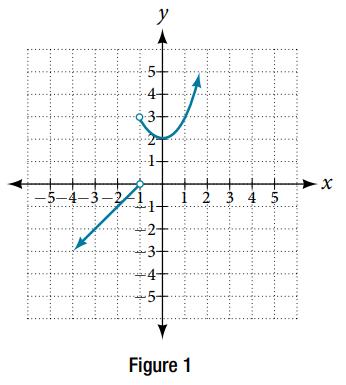
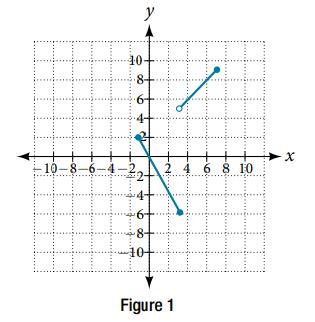
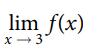
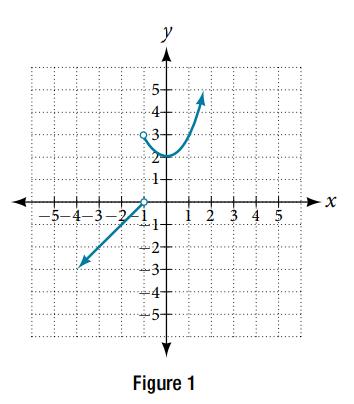
For the following exercises, use the graph of f in Figure 1.f(1) -5-4-3-2 y 5- 4 + 1 2 3 4 5 Figure 1 -X
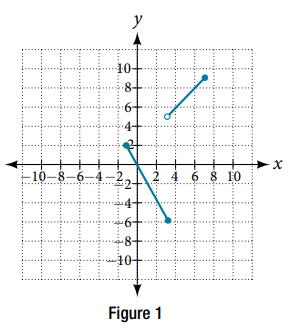
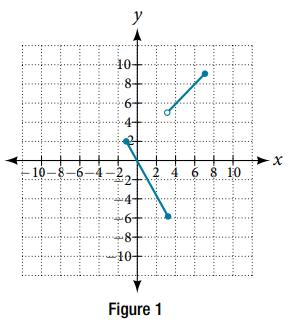
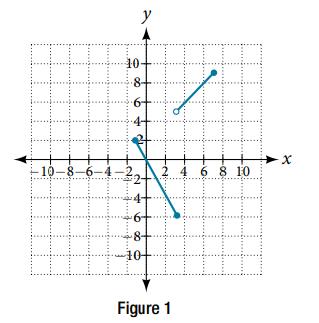
For the following exercises, use Figure 1. LI -10-8-6- II 10- .... 00 680 Figure 1 a. ·00 III x
Give an example of a type of function f whose limit, as x approaches a, is f(a).
How is the slope of a linear function similar to the derivative?
State in your own words what it means for a function f to be continuous at x = c.
For the following exercises, use Figure 1. 10- ·8+ 2 y 680 Figure 1 ·00 IIII x
Explain the difference between a value at x = a and the limit as x approaches a.
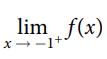
For the following exercises, use the graph of f in Figure 1.
When direct substitution is used to evaluate the limit of a rational function as x approaches a and the result is f(a) = 0/0 , does this mean that the limit of f does not exist?
What is the difference between the average rate of change of a function on the interval [x, x + h] and the derivative of the function at x?
State in your own words what it means for a function to be continuous on the interval (a, b).
For the following exercises, use Figure 1. H 10-8-6-4 y 10- D J 2 4 6 8 10 Figure 1 -x
For the following exercises, use the graph of f in Figure 1. +-+-+ -5-4-3-2-1 D y 5- 4 Figure 1 2 3 4 5 I X
Explain why we say a function does not have a limit as x approaches a if, as x approaches a, the left-hand limit is not equal to the right-hand limit.
What does it mean to say the limit of f(x), as x approaches c, is undefined?
A car traveled 110 miles during the time period from 2:00 P.M. to 4:00 P.M. What was the car's average velocity? At exactly 2:30 P.M., the speed of the car registered exactly 62 miles per hour. What is another name for the speed of the car at 2:30 P.M.? Why does this speed differ from the average
For the following exercises, determine why the function f is discontinuous at a given point a on the graph. State which condition fails. f(x) = ln |x + 3|, a = − 3
For the following exercises, determine why the function f is discontinuous at a given point a on the graph. State which condition fails. f(x) = ln |5x − 2|, a = 2/5
For the following exercises, use the graph of f in Figure 1. -5-4-3-2 y 5- 2- -3- 4 5- Figure 1 2 3 4 5 X
For the following exercises, estimate the functional values and the limits from the graph of the function f provided in Figure 14. -5-4-3- y Figure 14 LT (f(x) ➤X
For the following exercises, use Figure 1. y 10 8- L 10-8-6-4-2 2 4 6 8 10 8- Figure 1 # →x
For the following exercises, estimate the functional values and the limits from the graph of the function f provided in Figure 14. -5-4-3-2-1 y -5-- m 2 2 3 III (f(x) 1 2 3 4 5 Figure 14 X
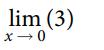
For the following exercises, evaluate the limits algebraically. lim (3) x → 0
For the following exercises, use the graph of f in Figure 1. -5-4-3-2-1 7 y 5- 2- 1 2 3 4 5 -5- IIIII Figure 1 X
For the following exercises, estimate the functional values and the limits from the graph of the function f provided in Figure 14. III -5-4-3-2 H 6 5- 32 y 3- 2- 2- 3- -4- 5 f(x) 1 2 3 4 5 Figure 14 X
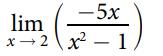
For the following exercises, evaluate the limits algebraically. -5x lim x 2x-1
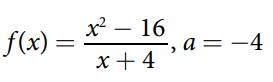
For the following exercises, determine why the function f is discontinuous at a given point a on the graph. State which condition fails. f(x) x 16 x + 4 - a = -4
Explain the concept of the slope of a curve at point x.
For the following exercises, use the definition of derivative to calculate the derivative of each function.f(x) = 3x − 4 lim h→0 f(x+h)-f(x) h
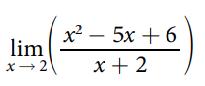
For the following exercises, evaluate the limits algebraically. lim x 2 x² x – 5x+6 x + 2
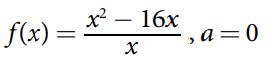
For the following exercises, determine why the function f is discontinuous at a given point a on the graph. State which condition fails. f(x) = x² - 16x X , a = 0
For the following exercises, with the use of a graphing utility, use numerical or graphical evidence to determine the left- and right-hand limits of the function given as x approaches a. If the function has a limit as x approaches a, state it. If not, discuss why there is no limit. f(x)
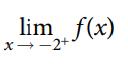
For the following exercises, estimate the functional values and the limits from the graph of the function f provided in Figure 14.f(−2) I y 6- -5-- 4+ 3 -2-- -5-4-3-2-11- 1 2 3 4 5 -3+ 345 4- 5- -6+ (f(x) www. Figure 14
Suppose water is flowing into a tank at an average rate of 45 gallons per minute. Translate this statement into the language of mathematics.
For the following exercises, with the use of a graphing utility, use numerical or graphical evidence to determine the left- and right-hand limits of the function given as x approaches a. If the function has limit as x approaches a, state it. If not, discuss why there is no limit. x) =
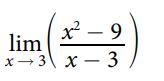
For the following exercises, evaluate the limits algebraically. lim x 3 x² - 9 x 3
For the following exercises, use the definition of derivative to calculate the derivative of each function.f(x) = −2x + 1 lim h→0 f(x+h)-f(x) h
For the following exercises, estimate the functional values and the limits from the graph of the function f provided in Figure 14. -5-4-3-2 6- -5-- 32 y 3- 2- 2- 3- A 5 ·6+ IT I Figure 14 (f(x) 1 2 3 4 5 X
For the following exercises, find the indicated term of each binomial without fully expanding the binomial.The fifth term of (x − y)7
Calculate P(18, 4).
For the following exercises, two dice are rolled, and the results are summed.Find the probability of rolling an odd sum less than 9.
Showing 3000 - 3100
of 8578
First
24
25
26
27
28
29
30
31
32
33
34
35
36
37
38
Last
Step by Step Answers

 Get 50% OFF
Claim Now
Get 50% OFF
Claim Now