New Semester
Started
Get
50% OFF
Study Help!
--h --m --s
Claim Now
Question Answers
Textbooks
Find textbooks, questions and answers
Oops, something went wrong!
Change your search query and then try again
S
Books
FREE
Study Help
Expert Questions
Accounting
General Management
Mathematics
Finance
Organizational Behaviour
Law
Physics
Operating System
Management Leadership
Sociology
Programming
Marketing
Database
Computer Network
Economics
Textbooks Solutions
Accounting
Managerial Accounting
Management Leadership
Cost Accounting
Statistics
Business Law
Corporate Finance
Finance
Economics
Auditing
Tutors
Online Tutors
Find a Tutor
Hire a Tutor
Become a Tutor
AI Tutor
AI Study Planner
NEW
Sell Books
Search
Search
Sign In
Register
study help
mathematics
precalculus
Thomas Calculus Early Transcendentals 13th Edition Joel R Hass, Christopher E Heil, Maurice D Weir - Solutions
Assume that y = sin-1 x is a differentiable function of x. By differentiating the equation x = sin y implicitly, show that dy/dx = 1/√1 - x2.
The radius r of a circle is measured with an error of at most 2%. What is the maximum corresponding percentage error in computing the circle’sa. Circumference? b. Area?
Find the derivatives of the function -1 y = z cos¹z-VI-z² Z Z
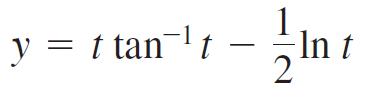
Find the derivatives of the function. y = 1 tan¯¹1 — 2/1 In 1
The edge x of a cube is measured with an error of at most 0.5%. What is the maximum corresponding percentage error in computing the cube’sa. Surface area? b. Volume?
Find the derivatives of the function. y = z sec¹z -√₂² − 1, z> 1 -
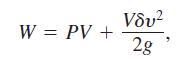
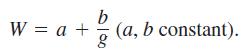
The amount of work done by the heart’s main pumping chamber, the left ventricle, is given by the equationwhere W is the work per unit time, P is the average blood pressure, V is the volume of blood pumped out during the unit of time, δ (“delta”) is the weight density of the blood, v is the
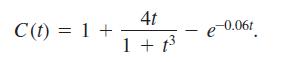
The concentration C in milligrams per milliliter (mg/ml) of a certain drug in a person’s bloodstream t hrs after a pill is swallowed is modeled by the approximationEstimate the change in concentration when t changes from 20 to 30 min. C (t) = 1 + 4t 1 + 1³ 3 e-0.06t
The height and radius of a right circular cylinder are equal, so the cylinder’s volume is V = πh3. The volume is to be calculated with an error of no more than 1% of the true value. Find approximately the greatest error that can be tolerated in the measurement of h, expressed as a percentage of
Find the derivatives of the function.y = ln cos-1 x
a. About how accurately must the interior diameter of a 10-m-high cylindrical storage tank be measured to calculate the tank’s volume to within 1% of its true value?b. About how accurately must the tank’s exterior diameter be measured to calculate the amount of paint it will take to paint the
The diameter of a sphere is measured as 100 ± 1 cm and the volume is calculated from this measurement. Estimate the percentage error in the volume calculation.
Find the derivatives of the function. y = 2√x 1 sec¹ √x 21 –
Find the derivatives of the function.y = (1 + t2) cot-1 2t
Estimate the allowable percentage error in measuring the diameter D of a sphere if the volume is to be calculated correctly to within 3%.
Use your graphing utility.Graph y = sec (sec-1 x) = sec (cos-1(1/x)). Explain what you see.
The formula V = kr4, discovered by the physiologist Jean Poiseuille (1797–1869), allows us to predict how much the radius of a partially clogged artery has to be expanded in order to restore normal blood flow. The formula says that the volume V of blood flowing through the artery in a unit of
Use your graphing utility.Graph Newton’s serpentine, y = 4x/(x2 + 1). Then graph y = 2 sin (2 tan-1 x) in the same graphing window. What do you see? Explain.
Find the derivatives of the function. y = csc (sec 0), 0
Use your graphing utility.Graph the rational function y = (2 - x2)/x2. Then graph y = cos (2 sec-1 x) in the same graphing window. What do you see? Explain.
Find the derivatives of the function y = (1 + x²) etan ¹x
Use a CAS to estimate the magnitude of the error in using the linearization in place of the function over a specified interval I. Perform the following steps:a. Plot the function ƒ over I.b. Find the linearization L of the function at the point a.c. Plot ƒ and L together on a single graph.d. Plot
Find dy/dx by implicit differentiation.xy + 2x + 3y = 1
Use your graphing utility.Graph ƒ(x) = sin-1 x together with its first two derivatives. Comment on the behavior of ƒ and the shape of its graph in relation to the signs and values of ƒ′ and ƒ″.
Use a CAS to estimate the magnitude of the error in using the linearization in place of the function over a specified interval I. Perform the following steps:a. Plot the function ƒ over I.b. Find the linearization L of the function at the point a.c. Plot ƒ and L together on a single graph.d. Plot
Use a CAS to estimate the magnitude of the error in using the linearization in place of the function over a specified interval I. Perform the following steps:a. Plot the function ƒ over I.b. Find the linearization L of the function at the point a.c. Plot ƒ and L together on a single graph.d. Plot
Find dy/dx by implicit differentiation.x2 + xy + y2 - 5x = 2
Use your graphing utility.Graph ƒ(x) = tan-1 x together with its first two derivatives. Comment on the behavior of ƒ and the shape of its graph in relation to the signs and values of ƒ′ and ƒ″.
a. Find the linearization of ƒ(x) = 2x at x = 0. Then round its coefficients to two decimal places.b. Graph the linearization and function together for -3 ≤ x ≤ 3 and -1 ≤ x ≤ 1.
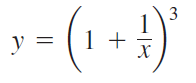
Find y″. y || 1 + X 3
Find dy/dx by implicit differentiation.x3 + 4xy - 3y4/3 = 2x
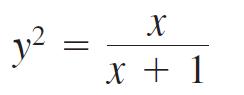
Find dy/dx by implicit differentiation. 2 || X x +1
a. Find the linearization of ƒ(x) = log3 x at x = 3. Then round its coefficients to two decimal places.b. Graph the linearization and function together in the window 0 ≤ x ≤ 8 and 2 ≤ x ≤ 4.
Use a CAS to estimate the magnitude of the error in using the linearization in place of the function over a specified interval I. Perform the following steps:a. Plot the function ƒ over I.b. Find the linearization L of the function at the point a.c. Plot ƒ and L together on a single graph.d. Plot
Find dy/dx by implicit differentiation.5x4/5 + 10y6/5 = 15
Use a CAS to estimate the magnitude of the error in using the linearization in place of the function over a specified interval I. Perform the following steps:a. Plot the function ƒ over I.b. Find the linearization L of the function at the point a.c. Plot ƒ and L together on a single graph.d. Plot
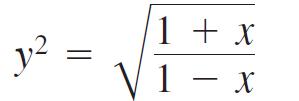
Find dy/dx by implicit differentiation. y² 1 + x 1 - X
Use a CAS to estimate the magnitude of the error in using the linearization in place of the function over a specified interval I. Perform the following steps:a. Plot the function ƒ over I.b. Find the linearization L of the function at the point a.c. Plot ƒ and L together on a single graph.d. Plot
Find dy/dx by implicit differentiation.√xy = 1
Find dy/dx by implicit differentiation.x2y2 = 1
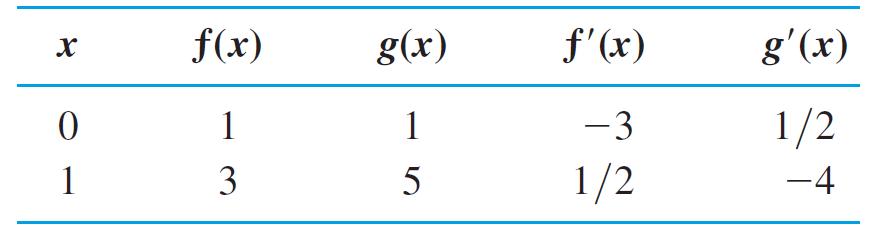
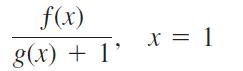
Suppose that functions ƒ(x) and g(x) and their first derivatives have the following values at x = 0 and x = 1.Find the first derivatives of the following combinations at the given value of x.a. 6ƒ(x) - g(x), x = 1b. ƒ(x)g2(x), x = 0c.d. ƒ(g(x)), x = 0e. g(ƒ(x)), x = 0f. (x + ƒ(x))3/2, x = 1g.
Find dy/dx by implicit differentiation.ex+2y = 1
Find dy/dx by implicit differentiation.y2 = 2e-1/x
Find dy/dx by implicit differentiation.ln (x/y) = 1
Find dy/dx by implicit differentiation.x sin-1 y = 1 + x2
Find dy/dx by implicit differentiation.yetan-1 x = 2
Find dy/dx by implicit differentiation.xy = √2
Find dp/dq.p3 + 4pq - 3q2 = 2
Find dp/dq.q = (5p2 + 2p)-3/2
Find dr/ds.r cos 2s + sin2 s = π
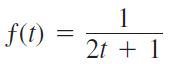
Find the derivative using the definition. f(t) || 1 2t + 1
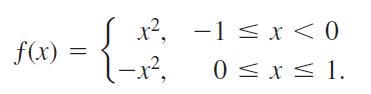
a. Graph the functionb. Is ƒ continuous at x = 0?c. Is ƒ differentiable at x = 0?Give reasons for your answers. f(x) = x², -x², -1 < x < 0 0≤x≤ 1.
Find dr/ds.2rs - r - s + s2 = -3
Find d2y/dx2 by implicit differentiation:a. x3 + y3 = 1 b. y2 = 1 - 2/x
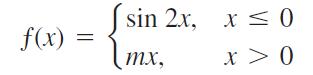
For what value or values of the constant m, if any, isa. Continuous at x = 0?b. Differentiable at x = 0?Give reasons for your answers. f(x) = (sin 2x, x ≤ 0 mx, x > 0
a. By differentiating x2 - y2 = 1 implicitly, show that dy/dx = x/y.b. Then show that d2y/dx2 = -1/y3.
a. Graph the functionb. Is ƒ continuous at x = 0?c. Is ƒ differentiable at x = 0?Give reasons for your answers. f(x) = X, tan X, -1 ≤ x < 0 0≤x≤ π/4.
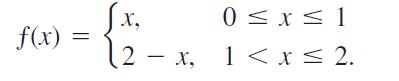
a. Graph the functionb. Is ƒ continuous at x = 1?c. Is ƒ differentiable at x = 1?Give reasons for your answers. f(x) Jx, 0≤x≤1 √2-x₂ 1 < x≤ 2.
Find the value of dw/ds at s = 0 if w = sin (e√r) and r = 3sin (s + π/6).
Find the value of dr/dt at t = 0 if r = (u2 + 7)1/3 and θ2t + θ = 1.
If y3 + y = 2 cos x, find the value of d2y/dx2 at the point (0, 1).
If x1/3 + y1/3 = 4, find d2y/dx2 at the point (8, 8).
Find the derivative using the definition.g(x) = 2x2 + 1
Are there any points on the curve y = (x/2) + 1/(2x - 4) where the slope is -3/2? If so, find them.
Are there any points on the curve y = x - e-x where the slope is 2? If so, find them.
Find the points on the curve y = 2x3 - 3x2 - 12x + 20 where the tangent is parallel to the x-axis.
Find the x- and y-intercepts of the line that is tangent to the curve y = x3 at the point (-2, -8).
Find the points on the curve y = 2x3 - 3x2 - 12x + 20 where the tangent isa. Perpendicular to the line y = 1 - (x/24).b. Parallel to the line y = √2 - 12x.
Show that the tangents to the curve y = (πsin x)/x at x = π and x = -π intersect at right angles.
Find the points on the curve y = tan x, -π/2 < x < π/2, where the normal is parallel to the line y = -x/2. Sketch the curve and normals together, labeling each with its equation.
Find equations for the tangent and normal to the curve y = 1 + cos x at the point (π/2, 1). Sketch the curve, tangent, and normal together, labeling each with its equation.
The parabola y = x2 + C is to be tangent to the line y = x. Find C.
Show that the tangent to the curve y = x3 at any point (a, a3) meets the curve again at a point where the slope is four times the slope at (a, a3).
For what value of c is the curve y = c/(x + 1) tangent to the line through the points (0, 3) and (5, -2)?
Show that the normal line at any point of the circle x2 + y2 = a2 passes through the origin.
Find equations for the lines that are tangent and normal to the curve at the given point.x2 + 2y2 = 9, (1, 2)
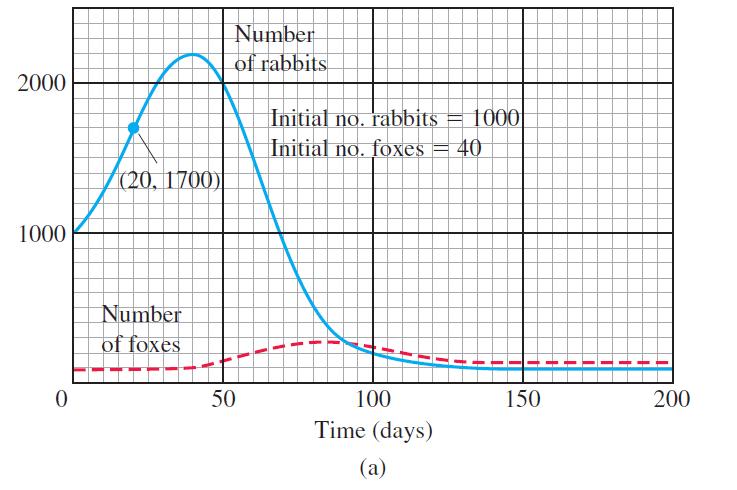
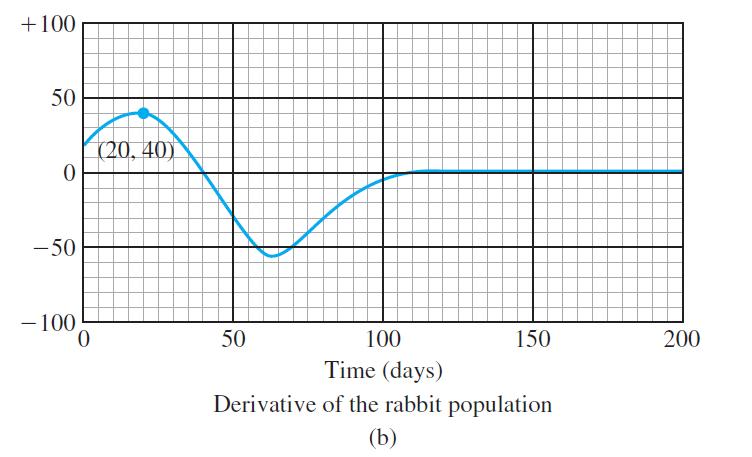
The accompanying graphs. The graphs in part (a) show the numbers of rabbits and foxes in a small arctic population. They are plotted as functions of time for 200 days. The number of rabbits increases at first, as the rabbits reproduce. But the foxes prey on rabbits and, as the number of foxes
Find equations for the lines that are tangent and normal to the curve at the given point.ex + y2 = 2, (0, 1)
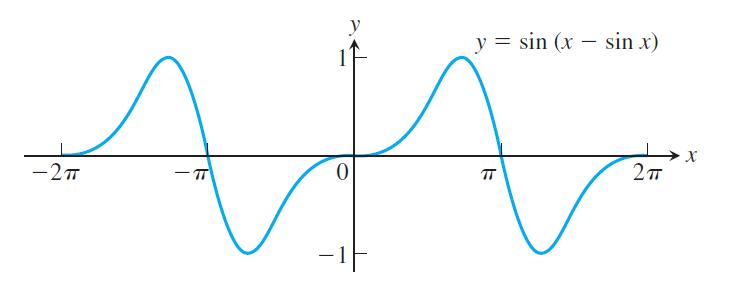
The graph shown suggests that the curve y = sin (x - sin x) might have horizontal tangents at the x-axis. Does it? Give reasons for your answer. -2π 1 F 0 -1 y sin (xsin x) TT 2 TT X
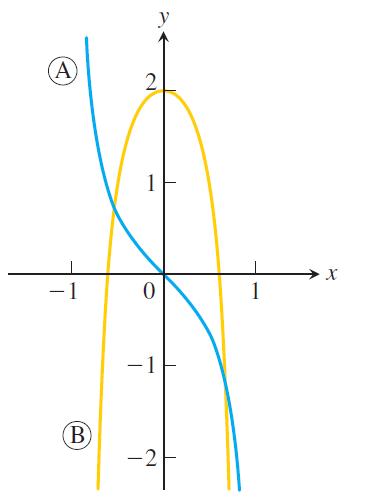
Each of the figures shows two graphs, the graph of a function y = ƒ(x) together with the graph of its derivative ƒ′(x). Which graph is which? How do you know? A – 1 B 2 0 −1 -2 1 X
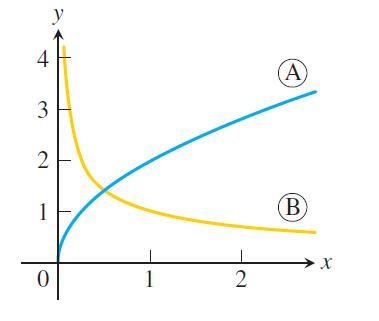
Each of the figures shows two graphs, the graph of a function y = ƒ(x) together with the graph of its derivative ƒ′(x). Which graph is which? How do you know? 4 3 2 1 y 0 1 2 A (B) X
Find equations for the lines that are tangent and normal to the curve at the given point.xy + 2x - 5y = 2, (3, 2)
Find equations for the lines that are tangent and normal to the curve at the given point.(y - x)2 = 2x + 4, (6, 2)
Find equations for the lines that are tangent and normal to the curve at the given point.x + √xy = 6, (4, 1)
Find equations for the lines that are tangent and normal to the curve at the given point.x3/2 + 2y3/2 = 17, (1, 4)
Find the slope of the curve x3y3 + y2 = x + y at the points (1, 1) and (1, -1).
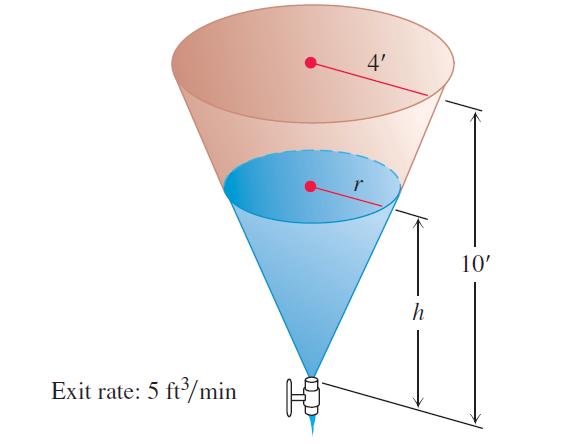
Water drains from the conical tank shown in the accompanying figure at the rate of 5 ft3/min.a. What is the relation between the variables h and r in the figure?b. How fast is the water level dropping when h = 6 ft? Exit rate: 5 ft³/min r 4' h 10'
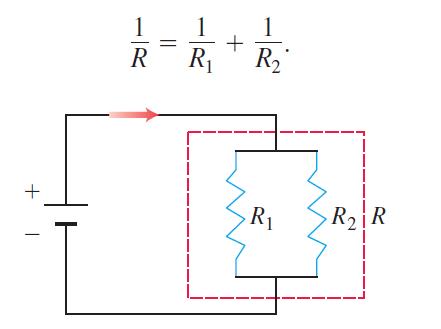
If two resistors of R1 and R2 ohms are connected in parallel in an electric circuit to make an R-ohm resistor, the value of R can be found from the equationIf R1 is decreasing at the rate of 1 ohm / sec and R2 is increasing at the rate of 0.5 ohm / sec, at what rate is R changing when R1 = 75 ohms
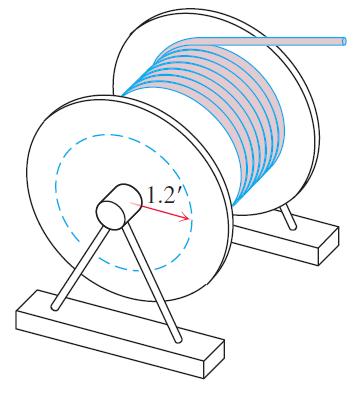
As television cable is pulled from a large spool to be strung from the telephone poles along a street, it unwinds from the spool in layers of constant radius (see accompanying figure). If the truck pulling the cable moves at a steady 6 ft / sec (a touch over 4 mph), use the equation s = rθ to find
The accompanying graphs. The graphs in part (a) show the numbers of rabbits and foxes in a small arctic population. They are plotted as functions of time for 200 days. The number of rabbits increases at first, as the rabbits reproduce. But the foxes prey on rabbits and, as the number of foxes
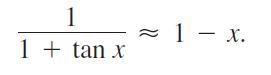
We can obtain a useful linear approximation of the function ƒ(x) = 1/(1 + tan x) at x = 0 by combining the approximationsto getShow that this result is the standard linear approximation of 1/(1 + tan x) at x = 0. 1 1 + x 1 - x and tan x x
The total surface area S of a right circular cylinder is related to the base radius r and height h by the equation S = 2πr2 + 2πrh.a. How is dS/dt related to dr/dt if h is constant?b. How is dS/dt related to dh/dt if r is constant?c. How is dS/dt related to dr/dt and dh/dt if neither r nor h is
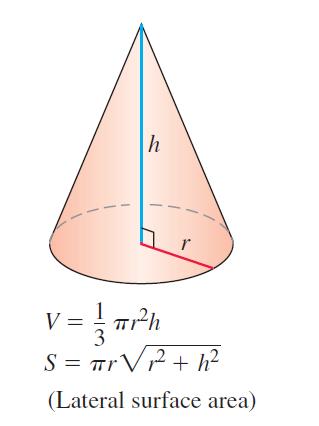
The lateral surface area S of a right circular cone is related to the base radius r and height h by the equation S = πr√r2 + h2.a. How is dS/dt related to dr/dt if h is constant?b. How is dS/dt related to dh/dt if r is constant?c. How is dS/dt related to dr/dt and dh/dt if neither r nor h is
The radius of a circle is changing at the rate of -2/π m/sec. At what rate is the circle’s area changing when r = 10 m?
The volume of a cube is increasing at the rate of 1200 cm3/min at the instant its edges are 20 cm long. At what rate are the lengths of the edges changing at that instant?
Write a formula that estimates the change that occurs in the lateral surface area of a right circular cone when the height changes from h0 to h0 + dh and the radius does not change. h V= v=1/12 ₁ Tr²h 3 S = πr√₁²2² +h² (Lateral surface area)
The coordinates of a particle moving in the metric xy-plane are differentiable functions of time t with dx/dt = 10 m/sec and dy/dt = 5 m/sec. How fast is the particle moving away from the origin as it passes through the point (3, -4)?
A particle moves along the curve y = x3/2 in the first quadrant in such a way that its distance from the origin increases at the rate of 11 units per second. Find dx/dt when x = 3.
Find the linearizations ofa. Tan x at x = -π/4 b. Sec x at x = -π/4.Graph the curves and linearizations together.
a. How accurately should you measure the edge of a cube to be reasonably sure of calculating the cube’s surface area with an error of no more than 2%?b. Suppose that the edge is measured with the accuracy required in part (a). About how accurately can the cube’s volume be calculated from the
Showing 12800 - 12900
of 29454
First
122
123
124
125
126
127
128
129
130
131
132
133
134
135
136
Last
Step by Step Answers

 Get 50% OFF
Claim Now
Get 50% OFF
Claim Now