New Semester
Started
Get
50% OFF
Study Help!
--h --m --s
Claim Now
Question Answers
Textbooks
Find textbooks, questions and answers
Oops, something went wrong!
Change your search query and then try again
S
Books
FREE
Study Help
Expert Questions
Accounting
General Management
Mathematics
Finance
Organizational Behaviour
Law
Physics
Operating System
Management Leadership
Sociology
Programming
Marketing
Database
Computer Network
Economics
Textbooks Solutions
Accounting
Managerial Accounting
Management Leadership
Cost Accounting
Statistics
Business Law
Corporate Finance
Finance
Economics
Auditing
Tutors
Online Tutors
Find a Tutor
Hire a Tutor
Become a Tutor
AI Tutor
AI Study Planner
NEW
Sell Books
Search
Search
Sign In
Register
study help
mathematics
precalculus
Precalculus 9th edition Michael Sullivan - Solutions
In problem, find the distance d(P1 , P2) between the points P1 and P2.P1 = (2, -3); P2 = (4, 2)
In problem, find the distance d(P1 , P2) between the points P1 and P2.P1 = (-3, 2); P2 = (6, 0)
In problem, find the distance d(P1 , P2) between the points P1 and P2.P1 = (-1, 0); P2 = (2, 4)
In problem, find the distance d(P1 , P2) between the points P1 and P2.P1 = (3, -4); P2 = (5, 4)
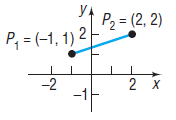
In problem, find the distance d(P1 , P2) between the points P1 and P2. y. P2 = (2, 2) P, = (-1, 1) 2 | -2 2 х
In problem, find the standard form of the equation of the circle whose center and radius are given.(h, k) = (2, -4); r = 3
In problem, plot each pair of points and determine the slope of the line containing them. Graph the line.(4, 2); (-5, 2)
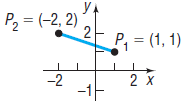
In problem, find the distance d(P1 , P2) between the points P1 and P2. P = (-2, 2) P, = (1, 1) -2 -1
In problem, find the standard form of the equation of the circle whose center and radius are given.(h, k) = (-1, -2); r = 1
In problem, plot each pair of points and determine the slope of the line containing them. Graph the line.(-3, -1); (2, -1)
In problem, find the standard form of the equation of the circle whose center and radius are given.(h, k) = (3, 4); r = 4
In problem, plot each pair of points and determine the slope of the line containing them. Graph the line.(-1, 1); (2, 3)
In problem, find the standard form of the equation of the circle whose center and radius are given.(h, k) = (-2, 3); r = 4
In problem, plot each pair of points and determine the slope of the line containing them. Graph the line.(-2, 3); (2, 1)
In problem, plot each pair of points and determine the slope of the line containing them. Graph the line.(4, 2); (3, 4)
In problem, plot each pair of points and determine the slope of the line containing them. Graph the line.(2, 3); (4, 0)
If 3 and 4 are the legs of a right triangle, the hypotenuse is _________.
If -3 and 5 are the coordinates of two points on the real number line, the distance between these points is ____________ .
On the real number line the origin is assigned the number ____________.
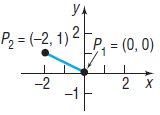
In problem, find the distance d(P1 , P2) between the points P1 and P2. УА P2 = (-2, 1) 2 P, = (0, 0) -2 -1 2 х
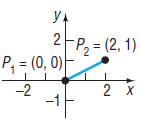
In problem, find the distance d(P1 , P2) between the points P1 and P2. УА 2P, = (2, 1) P, = (0, 0)- -2 -1 2 х
True or False Two triangles are congruent if two angles and the included side of one equals two angles and the included side of the other.
In problem, draw each angle.-π/6
A ________ ________ is a positive angle whose vertex is at the center of a circle.
In problem, use a calculator to evaluate each expression. Round your answer to three decimal places.log3 21
In problem, evaluate each expression. Do not use a calculator.log2 (1/8)
In problem, evaluate each expression. Do not use a calculator.log2 2√3
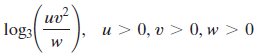
In problem, write each expression as the sum and/or difference of logarithms. Express powers as factors. uv? log3 u > 0, v > 0, w > 0
In problem, write each expression as the sum and/or difference of logarithms. Express powers as factors. loga (aVb)*, a > 0, b > 0 a²-
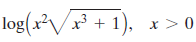
In problem, write each expression as the sum and/or difference of logarithms. Express powers as factors. x > 0 log(xVx3 + 1),
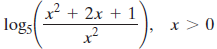
In problem, write each expression as the sum and/or difference of logarithms. Express powers as factors. x² + 2x + 1 logs
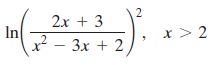
In problem, write each expression as the sum and/or difference of logarithms. Express powers as factors. 2x + 3 In x² – 3x + 2 x > 2
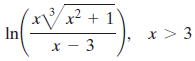
In problem, write each expression as the sum and/or difference of logarithms. Express powers as factors. ,2 Vx² + 1 x > 3 In
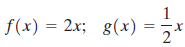
In problem, show that (f ° g)(x) = (g ° f)(x) = x. f(x) = 2x; g(x) 8(x)
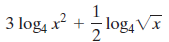
In problem, write each expression as a single logarithm. + log4 Vr | 3 log4 -
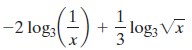
In problem, write each expression as a single logarithm. log; V 3 |-2 log3
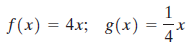
In problem, show that (f ° g)(x) = (g ° f)(x) = x. f(x) = 4x; g(x) %3D 4
In problem, write each expression as a single logarithm. (-) - In(x? – 1) + In х In х +1 х
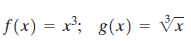
In problem, show that (f ° g)(x) = (g ° f)(x) = x. Г) %— х*; g(x) %3D $х
In problem, write each expression as a single logarithm. log(x² – 9) – log(x² + 7x + 12)
In problem, show that (f ° g)(x) = (g ° f)(x) = x.f(x) = x + 5; g(x) = x - 5
In problem, write each expression as a single logarithm. [log(x + 3) + log(x – 2)] 2 log 2 + 3 log x
In problem, use a calculator to evaluate each expression. Round your answer to three decimal places.ln 5/3
In problem, show that (f ° g)(x) = (g ° f)(x) = x. f(x) = 2x – 6; g(x) = 5(x + %3D
In problem, write each expression as a single logarithm. In(x² + 1) – 4 In, - - In(x – 4) + In x]
In problem, use a calculator to evaluate each expression. Round your answer to three decimal places.ln5 /3
In problem, show that (f ° g)(x) = (g ° f)(x) = x. f(x) = 4 – 3x; g(x) = (4 – x)
In problem, use the Change-of-Base Formula and a calculator to evaluate each logarithm. Round your answer to three decimal places.log4 19
In problem, use a calculator to evaluate each expression. Round your answer to three decimal places. 10 In 3 0.04
In problem, show that (f ° g)(x) = (g ° f)(x) = x. f(x) 3 ах + b; g(x) — — (х — b) а #0
In problem, use the Change-of-Base Formula and a calculator to evaluate each logarithm. Round your answer to three decimal places.log2 21
In problem, use a calculator to evaluate each expression. Round your answer to three decimal places. 2 In -0.1
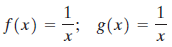
In problem, show that (f ° g)(x) = (g ° f)(x) = x. f(x) = 8(x)
In problem, graph each function using a graphing utility and the Change-of-Base Formula.y = log3 x
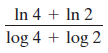
In problem, use a calculator to evaluate each expression. Round your answer to three decimal places. In 4 + In 2 log 4 + log 2
In problem, graph each function using a graphing utility and the Change-of-Base Formula.y = log7 x
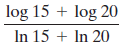
In problem, use a calculator to evaluate each expression. Round your answer to three decimal places. + log 20 log 15 In 15 + In 20
In problem, graph each function and its inverse on the same Cartesian plane.
In problem, graph each function and its inverse on the same Cartesian plane. f(x) = 4*; f'(x) = log4 x
What is the domain and the range of y = sec x?
If f(x) = x +1/x - 1, find (f ° f)(x).
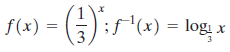
In problem, graph each function and its inverse on the same Cartesian plane.
In problem, graph each function and its inverse on the same Cartesian plane. (금) :r(x) = log, x f(x) =
(a) Find a polynomial function of degree 3 whose y-intercept is 5 and whose x-intercepts are -2, 3, and 5.Graph the function.(b) Find a rational function whose y-intercept is Sand whose x-intercepts are -2, 3, and 5 that has the line x = 2 as a vertical asymptote. Graph the function.
Find the exact value of expression. Do not use a calculator.sin 270° + cos(-180°)
In problem, find the exact value. Do not use a calculator.cos (7π)
In problem, convert each angle to D°M'S'' form. Round your answer to the nearest second.29.411°
In problem, find the exact value of each expression. Do not use a calculator.sin 30° - cos 45°
In problem, convert each angle to D°M'S'' form. Round your answer to the nearest second.19.99°
In problem, convert each angle to D°M'S'' form. Round your answer to the nearest second.44.01°
In problem, convert each angle in degrees to radians. Express your answer as a multiple of π.30°
In problem, convert each angle in degrees to radians. Express your answer as a multiple of π.120°
In problem, convert each angle in degrees to radians. Express your answer as a multiple of π.240°
In problem, convert each angle in degrees to radians. Express your answer as a multiple of π.330°
In problem, convert each angle in degrees to radians. Express your answer as a multiple of π.-60°
In problem, convert each angle in degrees to radians. Express your answer as a multiple of π.-30°
In problem, convert each angle in degrees to radians. Express your answer as a multiple of π.180°
In problem, convert each angle in degrees to radians. Express your answer as a multiple of π.270°
In problem, convert each angle in degrees to radians. Express your answer as a multiple of π.-135°
In problem, convert each angle in degrees to radians. Express your answer as a multiple of π.-225°
In problem, convert each angle in degrees to radians. Express your answer as a multiple of π.-90°
In problem, convert each angle in degrees to radians. Express your answer as a multiple of π.-180°
In problem, convert each angle in radians to degrees.π/3
In problem, convert each angle in radians to degrees.5π/6
In problem, convert each angle in radians to degrees.-5π/4
In problem, convert each angle in radians to degrees.-2π/3
In problem, convert each angle in radians to degrees.π/2
In problem, convert each angle in radians to degrees.4π
In problem, convert each angle in radians to degrees.π/12
In problem, convert each angle in radians to degrees.5π/12
What is 1 radian? What is 1 degree?
In problem, convert each angle in degrees to radians. Express your answer in decimal form, rounded to two decimal places.350°
In problem, convert each angle in degrees to radians. Express your answer in decimal form, rounded to two decimal places.125°
In problem, convert each angle in degrees to radians. Express your answer in decimal form, rounded to two decimal places.-51°
In problem, convert each angle in degrees to radians. Express your answer in decimal form, rounded to two decimal places.-40°
In problem, convert each angle in degrees to radians. Express your answer in decimal form, rounded to two decimal places.73°
In problem, convert each angle in degrees to radians. Express your answer in decimal form, rounded to two decimal places.17°
Write the equation of a sine function that has the given characteristics.Amplitude: 3Period: 2
In problem, convert each angle in radians to degrees.-3π/4
Write the equation of a sine function that has the given characteristics.Amplitude: 4Period: 1
Showing 25800 - 25900
of 29454
First
252
253
254
255
256
257
258
259
260
261
262
263
264
265
266
Last
Step by Step Answers

 Get 50% OFF
Claim Now
Get 50% OFF
Claim Now





![[log(x + 3) + log(x – 2)] 2 log 2 + 3 log x](https://dsd5zvtm8ll6.cloudfront.net/si.question.images/images/question_images/1547/5/5/3/0825c3dc93ad81ba1547582620173.jpg)

![In(x² + 1) – 4 In, - - In(x – 4) + In x]](https://dsd5zvtm8ll6.cloudfront.net/si.question.images/images/question_images/1547/5/5/3/0965c3dc9480a1ef1547582633328.jpg)