New Semester
Started
Get
50% OFF
Study Help!
--h --m --s
Claim Now
Question Answers
Textbooks
Find textbooks, questions and answers
Oops, something went wrong!
Change your search query and then try again
S
Books
FREE
Study Help
Expert Questions
Accounting
General Management
Mathematics
Finance
Organizational Behaviour
Law
Physics
Operating System
Management Leadership
Sociology
Programming
Marketing
Database
Computer Network
Economics
Textbooks Solutions
Accounting
Managerial Accounting
Management Leadership
Cost Accounting
Statistics
Business Law
Corporate Finance
Finance
Economics
Auditing
Tutors
Online Tutors
Find a Tutor
Hire a Tutor
Become a Tutor
AI Tutor
AI Study Planner
NEW
Sell Books
Search
Search
Sign In
Register
study help
mathematics
precalculus
Precalculus 9th edition Michael Sullivan - Solutions
Find the derivative of the function.y = √x/x + 1
Find an equation of the tangent line to the curve at the given point.y = sin x + cos x, (0, 1)
Differentiate.f (t) = 3√t/t - 3
Compute Δy and dy for the given values of x and dx = Δx. Then sketch a diagram like Figure 5 showing the linesegments with lengths dx, dy, and Δy.y = x - x3, x = 0, Δx = 20.3
If tanh x = 12/13, find the values of the other hyperbolic functions at x.
Differentiate the function.S(R) = 4πR2
Calculate y'.y = ex sec x
Find the derivative of the function.F(t) = (3g - 1)4 (2g + 1)-3
Prove, using the definition of derivative, that if f (x) = cos x, then f'(x) = -sin x.
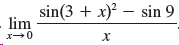
Evaluate + x)? – sin 9 sin(3 lim
Differentiate.y = (z2 + ez)√z
Dinosaur fossils are often dated by using an element other than carbon, such as potassium-40, that has a longer half-life (in this case, approximately 1.25 billion years). Suppose the minimum detectable amount is 0.1% and a dinosaur is dated with 40K to be 68 million years old. Is such a dating
Dinosaur fossils are too old to be reliably dated using carbon-14. (See Exercise 11.) Suppose we had a 68-millionyear- old dinosaur fossil. What fraction of the living dinosaur’s 14C would be remaining today? Suppose the minimum detectable amount is 0.1%. What is the maximum age of a fossil that
A sample of tritium-3 decayed to 94.5% of its original amount after a year.(a) What is the half-life of tritium-3?(b) How long would it take the sample to decay to 20% of its original amount?
Strontium-90 has a half-life of 28 days.(a) A sample has a mass of 50 mg initially. Find a formula for the mass remaining after t days.(b) Find the mass remaining after 40 days.(c) How long does it take the sample to decay to a mass of 2 mg?(d) Sketch the graph of the mass function.
The table gives the population of Indonesia, in millions, for the second half of the 20th century.Year ................ Population1950 ................ 831960 ................1001970 ................ 1221980 ................ 1501990 ................ 1822000 ................ 214(a) Assuming the
A bacteria culture grows with constant relative growth rate. The bacteria count was 400 after 2 hours and 25,600 after 6 hours.(a) What is the relative growth rate? Express your answer as a percentage.(b) What was the intitial size of the culture?(c) Find an expression for the number of bacteria
A bacteria culture initially contains 100 cells and grows at a rate proportional to its size. After an hour the population has increased to 420.(a) Find an expression for the number of bacteria after t hours.(b) Find the number of bacteria after 3 hours.(c) Find the rate of growth after 3 hours.(d)
A common inhabitant of human intestines is the bacterium Escherichia coli, named after the German pediatrician Theodor Escherich, who identified it in 1885. A cell of this bacterium in a nutrient-broth medium divides into two cells every 20 minutes. The initial population of a culture is 50
Invasive species often display a wave of advance as they colonize new areas. Mathematical models based on random dispersal and reproduction have demonstrated that the speed with which such waves move is given by the function f (r) = 2√Dr , where r is the reproductive rate of individuals and D is
Patients undergo dialysis treatment to remove urea from their blood when their kidneys are not functioning properly. Blood is diverted from the patient through a machine that filters out urea. Under certain conditions, the duration of dialysis required, given that the initial urea concentration is
The cost function for a certain commodity is C(q) = 84 + 0.16q - 0.0006q2 + 0.000003q3(a) Find and interpret C'(100).(b) Compare C'(100) with the cost of producing the 101st item.
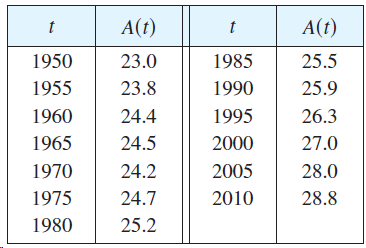
The table shows how the average age of first marriage of Japanese women has varied since 1950.(a) Use a graphing calculator or computer to model these data with a fourth-degree polynomial.(b) Use part (a) to find a model for A'(t).(c) Estimate the rate of change of marriage age for women in
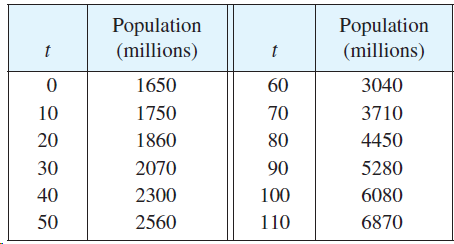
The table gives the population of the world P(t), in millions, where t is measured in years and t = 0 corresponds to the year 1900.(a) Estimate the rate of population growth in 1920 and in 1980 by averaging the slopes of two secant lines.(b) Use a graphing device to find a cubic function (a
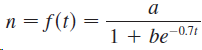
The number of yeast cells in a laboratory culture increases rapidly initially but levels off eventually. The population is modeled by the functionwhere t is measured in hours. At time t = 0 the population is 20 cells and is increasing at a rate of 12 cells/hour. Find the values of a and b.
If, in Example 4, one molecule of the product C is formed from one molecule of the reactant A and one molecule of the reactant B, and the initial concentrations of A and B have a common value [A] = [B] = a moles/L, then [C] = a2kt/(akt + 1) where k is a constant.(a) Find the rate of reaction at
Some of the highest tides in the world occur in the Bay of Fundy on the Atlantic Coast of Canada. At Hopewell Cape the water depth at low tide is about 2.0 m and at high tide it is about 12.0 m. The natural period of oscillation is a little more than 12 hours and on June 30, 2009, high tide
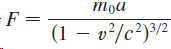
The force F acting on a body with mass m and velocity v is the rate of change of momentum: F = (d/dt)(mv). If m is constant, this becomes F = ma, where a = dv/dt is the acceleration. But in the theory of relativity the mass of a particle varies with v as follows: m = m0/√1 - v2/c2 , where m0 is
If a tank holds 5000 gallons of water, which drains from the bottom of the tank in 40 minutes, then Torricelli’s Law gives the volume V of water remaining in the tank after t minutes asFind the rate at which water is draining from the tank after(a) 5 min,(b) 10 min,(c) 20 min, and(d) 40 min.At
(a) The volume of a growing spherical cell is V = 4/3πr3, where the radius r is measured in micrometers (1 μm = 10-6 m). Find the average rate of change of V with respect to r when r changes from(i) 5 to 8 μm (ii) 5 to 6 μm (iii) 5 to 5.1 μm(b) Find the instantaneous rate of change of V with
A particle moves with position functions = t4 - 4t3 - 20t2 + 20t t > 0(a) At what time does the particle have a velocity of 20 mys?(b) At what time is the acceleration 0? What is the significance of this value of t?
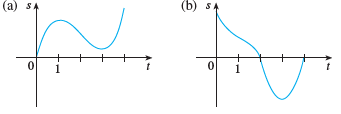
Graphs of the position functions of two particles are shown, where t is measured in seconds. When is each particle speeding up? When is it slowing down? Explain. (b) s (a) SA 1.
A particle moves according to a law of motion s = f (t), t > 0, where t is measured in seconds and s in feet.(a) Find the velocity at time t.(b) What is the velocity after 1 second?(c) When is the particle at rest?(d) When is the particle moving in the positive direction?(e) Find the total
A particle moves according to a law of motion s = f (t), t > 0, where t is measured in seconds and s in feet.(a) Find the velocity at time t.(b) What is the velocity after 1 second?(c) When is the particle at rest?(d) When is the particle moving in the positive direction?(e) Find the total
Show that lim n→∞ (1 + x/n)n = ex for any x > 0.
Find d9/dx9 (x8 ln x).
Find y' if xy = yx.
Use logarithmic differentiation to find the derivative of the function.y = (ln x)cos x
Use logarithmic differentiation to find the derivative of the function.y = (tan x)1/x
Use logarithmic differentiation to find the derivative of the function.y = (sin x)ln x
Use logarithmic differentiation to find the derivative of the function.y = (cos x)x
Use logarithmic differentiation to find the derivative of the function.y = √xx
Use logarithmic differentiation to find the derivative of the function.y = xsin x
Use logarithmic differentiation to find the derivative of the function.y = xcos x
Use logarithmic differentiation to find the derivative of the function.y = xx
Use logarithmic differentiation to find the derivative of the function.y = √x ex2-x(x + 1)2/3
Use logarithmic differentiation to find the derivative of the function.y = √x - 1/x4 + 1
Use logarithmic differentiation to find the derivative of the function.y = e-x cos2x / x2 + x + 1
Let f (x) = logb(3x2 - 2). For what value of b is f'(1) = 3?
Let f (x) = cx + ln (cos x). For what value of c is f' (π/4) = 6?
Find equations of the tangent lines to the curve y = (ln x)/x at the points (1, 0) and (e, 1/e). Illustrate by graphing the curve and its tangent lines.
Find an equation of the tangent line to the curve at the given point.y = x2 ln x, (1, 0)
If f (x) = cos(ln x2), find f'(1).
If f (x) = ln(x + ln x), find f'(1).
Differentiate f and find the domain of f.f (x) = ln ln ln x
Differentiate f and find the domain of f.f (x) = ln(x2 - 2x)
Differentiate f and find the domain of f.f (x) = √2 + ln x
Differentiate f and find the domain of f.f (x) = x /1 - ln (x - 1)
Find y' and y''.y = ln(1 + ln x)
Find y' and y''.y = ln |sec x|
Find y' and y''.y = ln x/1 + ln x
Find y' and y''.y = √x ln x
Differentiate the function.y = log2 (x log5 x)
Differentiate the function.y = tan[ln(ax + b)]
Differentiate the function.H(z) = ln√a2 - z2/a2 + z2
Differentiate the function.y = ln(e-x + xe-x)
Differentiate the function.y = ln(csc x - cot x)
Differentiate the function.T(z) = 2z log2 z
Differentiate the function.y = ln |1 + t - t3|
Differentiate the function.F(s) = ln ln s
Differentiate the function.P(v) = ln v / 1 - v
Differentiate the function.G(y) = ln (2y + 1)5 / √y2 + 1
Differentiate the function.h(x) = ln (x + √x2 - 1)
Differentiate the function.F(t) = (ln t)2 sin t
Differentiate the function.g(t) = √1 + ln t
Differentiate the function.g(x) = ln(xe-2x)
Differentiate the function.f (x) = log10√x
Differentiate the function.f (x) = log10 (1 + cos x)
Differentiate the function.y = 1/ln x
Differentiate the function.f (x) = ln 1/x
Differentiate the function.f (x) = ln (sin2x)
Differentiate the function.f (x) = sin(ln x)
Differentiate the function.f (x) = x ln x - x
Explain why the natural logarithmic function y = ln x is used much more frequently in calculus than the other logarithmic functions y = logb x.
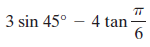
Find the exact value of expression. Do not use a calculator. 3 sin 45° – 4 tan 6.
In problem, find the distance d(P1 , P2) between the points P1 and P2.P1 = (a, a); P2 = (0, 0)
In problem, plot each point. Then plot the point that is symmetric to it with respect to(a) The x-axis;(b) The y-axis;(c) The origin.(3, 4)
In problem, plot each point. Then plot the point that is symmetric to it with respect to(a) The x-axis;(b) The y-axis;(c) The origin.(5, 3)
In problem, plot each point. Then plot the point that is symmetric to it with respect to(a) The x-axis;(b) The y-axis;(c) The origin.(-2, 1)
In problem, plot each point. Then plot the point that is symmetric to it with respect to(a) The x-axis;(b) The y-axis;(c) The origin.(4, -2)
In problem, plot each point. Then plot the point that is symmetric to it with respect to(a) The x-axis;(b) The y-axis;(c) The origin.(5, -2)
In problem, plot each point. Then plot the point that is symmetric to it with respect to(a) The x-axis;(b) The y-axis;(c) The origin.(-1, -1)
In problem, plot each point. Then plot the point that is symmetric to it with respect to(a) The x-axis;(b) The y-axis;(c) The origin.(-3, -4)
In problem, plot each point. Then plot the point that is symmetric to it with respect to(a) The x-axis;(b) The y-axis;(c) The origin.(4, 0)
In problem, plot each point. Then plot the point that is symmetric to it with respect to(a) The x-axis;(b) The y-axis;(c) The origin.(0, -3)
In problem, plot each point. Then plot the point that is symmetric to it with respect to(a) The x-axis;(b) The y-axis;(c) The origin.(-3, 0)
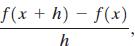
In problem, find the difference quotient of f; that is, findfor each function. Be sure to simplify.f(x) = 1/x + 3 f(x + h) - f(x) h
In problem, find the distance d(P1 , P2) between the points P1 and P2.P1 = (a, b); P2 = (0, 0)
In problem, find the distance d(P1 , P2) between the points P1 and P2.P1 = (-4, -3); P2 = (6, 2)
In problem, find the distance d(P1 , P2) between the points P1 and P2.P1 = (4, -3); P2 = (6, 4)
Showing 25700 - 25800
of 29454
First
251
252
253
254
255
256
257
258
259
260
261
262
263
264
265
Last
Step by Step Answers

 Get 50% OFF
Claim Now
Get 50% OFF
Claim Now