New Semester
Started
Get
50% OFF
Study Help!
--h --m --s
Claim Now
Question Answers
Textbooks
Find textbooks, questions and answers
Oops, something went wrong!
Change your search query and then try again
S
Books
FREE
Study Help
Expert Questions
Accounting
General Management
Mathematics
Finance
Organizational Behaviour
Law
Physics
Operating System
Management Leadership
Sociology
Programming
Marketing
Database
Computer Network
Economics
Textbooks Solutions
Accounting
Managerial Accounting
Management Leadership
Cost Accounting
Statistics
Business Law
Corporate Finance
Finance
Economics
Auditing
Tutors
Online Tutors
Find a Tutor
Hire a Tutor
Become a Tutor
AI Tutor
AI Study Planner
NEW
Sell Books
Search
Search
Sign In
Register
study help
mathematics
precalculus
Precalculus 9th edition Michael Sullivan - Solutions
The concentration C of a certain drug in a patient’s bloodstream t minutes after injection is given byC(t) = 50t/t2 + 25(a) Find the horizontal asymptote of C(t).What happens to the concentration of the drug as t increases?(b) Using your graphing utility, graph C = C(t).(c) Determine the time at
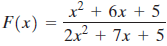
In problem, find the vertical, horizontal, and oblique asymptotes, if any, of each rational function. x + 6x + 5 F(x) 2x2 + 7x + 5
In problem, for each polynomial function:(a) List each real zero and its multiplicity.(b) Determine whether the graph crosses or touches the x-axis at each x-intercept.(c) Determine the behavior of the graph near each x-intercept (zero).(d) Determine the maximum number of turning points on the
In problem, solve each inequality algebraically.(2x - 1)(x + 2)(x + 5) < 0
Find the value of f(x) = -16x3 + 18x2 - x + 2 at x = -2.
In problem, use the Rational Zeros Theorem to find all the real zeros of each polynomial function. Use the zeros to factor f over the real numbers.f(x) = 3x3 + 6x2 - 15x - 30
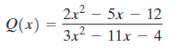
In problem, find the vertical, horizontal, and oblique asymptotes, if any, of each rational function. 2x2 - 5x - 12 Q(x) 3x - 11x - 4
The concentration C of a certain drug in a patient’s bloodstream t hours after injection is given byC(t) = 1/2t2 + 1(a) Find the horizontal asymptote of C(t).What happens to the concentration of the drug as t increases?(b) Using your graphing utility, graph C = C(t).(c) Determine the time at
In problem, solve each inequality algebraically.(x + 1)(x - 3)(x - 5) > 0
Find the value of f(x) = 12x6 - 8x4 + 1 at x = 4.
In problem, for each polynomial function:(a) List each real zero and its multiplicity.(b) Determine whether the graph crosses or touches the x-axis at each x-intercept.(c) Determine the behavior of the graph near each x-intercept (zero).(d) Determine the maximum number of turning points on the
In problem, use the Rational Zeros Theorem to find all the real zeros of each polynomial function. Use the zeros to factor f over the real numbers.f(x) = 2x3 - 4x2 - 10x + 20
In problem, find the vertical, horizontal, and oblique asymptotes, if any, of each rational function.P(x) = 4x2/x2 - 1
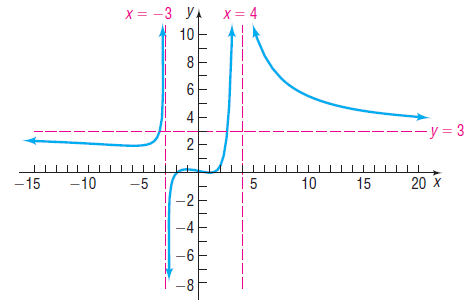
In problem, find a rational function that might have the given graph.. X = -3 YA x = 4 10 8 4 --y = 3 20 x | 5 -15 -10 -5 10 15 -6 -8 2. 2. 4.
In problem, find the remainder R when f(x) is divided by g(x). Is g a factor of f?f(x) = x4 - x2 + 2x + 2; g(x) = x + 1
In problem, form a polynomial function whose real zeros and degree are given.Zeros: -2, multiplicity 2; 4, multiplicity 1; degree 3
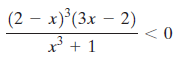
In problem, solve each inequality algebraically. (2 – x)°(3x – 2) x + 1
In problem, use the Rational Zeros Theorem to find all the real zeros of each polynomial function. Use the zeros to factor f over the real numbers.f(x) = 2x3 + x2 + 2x + 1
In problem, use the Rational Zeros Theorem to find all the real zeros of each polynomial function. Use the zeros to factor f over the real numbers.f(x) = 2x3 - x2 + 2x - 1
In problem, find the vertical, horizontal, and oblique asymptotes, if any, of each rational function.T(x) = x3/x4 - 1
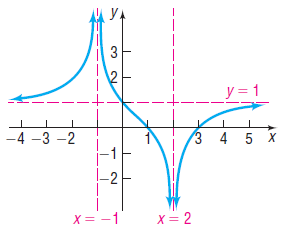
In problem, find a rational function that might have the given graph. 3 y = 1 3 4 5 x -4 -3 -2 -2 X =-1
In problem, form a polynomial function whose real zeros and degree are given.Zeros: -1, multiplicity 1; 3, multiplicity 2; degree 3
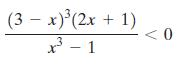
In problem, solve each inequality algebraically. x)³(2x + 1) (3 – x - 1
In problem, list the potential rational zeros of each polynomial function. Do not attempt to find the zeros.f(x) = 6x4 - x2 + 9
In problem, solve each inequality algebraically.x3 > 1
In problem, find the complex zeros of each polynomial function f(x).Write f in factored form.f(x) = x4 + 6x3 + 11x2 + 12x + 18
In problem, analyze each polynomial function by following Steps 1 through 6.f(x) = (x - 2)2 (x + 2)(x + 4)
In problem, each equation has a solution r in the interval indicated. Use the method of Example 9 to approximate this solution correct to two decimal places.8x4 - 2x2 + 5x - 1 = 0; 0 ≤ r ≤ 1
In problem, find the complex zeros of each polynomial function f(x).Write f in factored form.f(x)= x4 - 4x3 + 9x2 - 20x + 20
In problem, analyze each polynomial function by following Steps 1 through 6.f(x) = (x + 2)2 (x - 4)2
In problem, find the complex zeros of each polynomial function f(x).Write f in factored form.f(x) = 4x3 - 4x2 - 7x - 2
In problem, use the Intermediate Value Theorem to show that each polynomial function has a zero in the given interval.f(x) = x5 - 3x4 - 2x3 + 6x2 + x + 2; [1.7, 1.8]
In problem, analyze each polynomial function by following Steps 1 through 6.f(x) = x2 (x - 3)(x - 1)
In problem, find the complex zeros of each polynomial function f(x).Write f in factored form.f(x) = 4x3 + 4x2 - 7x + 2
In problem, use the Intermediate Value Theorem to show that each polynomial function has a zero in the given interval.f(x) = x5 - x4 + 7x3 - 7x2 - 18x + 18; [1.4, 1.5]
In problem, analyze each polynomial function by following Steps 1 through 6.f(x) = x2 (x - 3)(x + 1)
In problem, find the complex zeros of each polynomial function f(x).Write f in factored form.f(x) = x3 - x2 - 10x - 8
In problem, use the Intermediate Value Theorem to show that each polynomial function has a zero in the given interval.f(x) = 3x3 - 10x + 9; [-3, -2]
In problem, analyze each polynomial function by following Steps 1 through 6.f(x) = (x +1)3(x - 3)
In problem, find the complex zeros of each polynomial function f(x).Write f in factored form.f(x) = x3 - 3x2 - 6x + 8
In problem, use the Intermediate Value Theorem to show that each polynomial function has a zero in the given interval.f(x) = 2x3 + 6x2 - 8x + 2; [-5, -4]
In problem, analyze each polynomial function by following Steps 1 through 6.f(x) = (x + 1)2 (x - 2)2
Write a rational inequality whose solution set is {x|-3 < x ≤ 5}.
In problem, information is given about a complex polynomial f(x) whose coefficients are real numbers. Find the remaining zeros of f. Then find a polynomial function with real coefficients that has the zeros.Degree 4; zeros: 1, 2, 1 + i
In problem, use the Intermediate Value Theorem to show that each polynomial function has a zero in the given interval.f(x) = x4 + 8x3 - x2 + 2; [-1, 0]
In problem, analyze each polynomial function by following Steps 1 through 6.f(x) = x2 (x - 3)(x + 4)
A student attempted to solve the inequality x + 4/x – 3 ≤ 0 by multiplying both sides of the inequality by x - 3 to get x + 4 ≤ 0. This led to a solution of {xlx ≤ -4}. Is the student correct? Explain.
In problem, information is given about a complex polynomial f(x) whose coefficients are real numbers. Find the remaining zeros of f. Then find a polynomial function with real coefficients that has the zeros.Degree 4; zeros: i, 1 + i
In problem, use the Intermediate Value Theorem to show that each polynomial function has a zero in the given interval.f(x) = 8x4 - 2x2 + 5x - 1; [0, 1]
In problem, analyze each polynomial function by following Steps 1 through 6.f(x) = x2 (x - 2)(x + 2)
The inequality x4 + 1 < -5 has no solution. Explain why.
In problem, information is given about a complex polynomial f(x) whose coefficients are real numbers. Find the remaining zeros of f. Then find a polynomial function with real coefficients that has the zeros.Degree 3; zeros: 3 + 4i, 5
In problem, analyze each polynomial function by following Steps 1 through 6.f(x) = (x - 1)(x + 4)(x - 3)
In problem, find bounds on the real zeros of each polynomial function.f(x) = 4x5 + x4 + x3 + x2 - 2x - 2
Make up an inequality that has no solution. Make up one that has exactly one solution.
In problem, analyze each polynomial function by following Steps 1 through 6.f(x) = (x +1)(x - 2)(x + 4)
In problem, information is given about a complex polynomial f(x) whose coefficients are real numbers. Find the remaining zeros of f. Then find a polynomial function with real coefficients that has the zeros.Degree 3; zeros: 4 + i, 6
In problem, find bounds on the real zeros of each polynomial function.f(x) = 4x5 - x4 + 2x3 - 2x2 + x - 1
Mrs. West has decided to take her fifth grade class to a play.The manager of the theater agreed to discount the regular $40 price of the ticket by $0.20 for each ticket sold. The cost of the bus, $500, will be split equally among each of the students. How many students must attend to keep the cost
In problem, each polynomial function has exactly one positive zero. Approximate the zero correct to two decimal places.f(x) = 3x4 + 4x3 - 8x - 2
In problem, analyze each polynomial function by following Steps 1 through 6.f(x) = -1/2 (x + 4)(x - 1)3
In problem, find bounds on the real zeros of each polynomial function.f(x) = 3x4 - 3x3 - 5x2 + 27x - 36
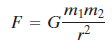
According to Newton???s Law of universal gravitation, the attractive force F between two bodies is given by ? where m1, m2 = the masses of the two bodies r = distance between the two bodies G = gravitational constant = 6.6742 ?? 10-11 newtons meter2 ki1ogram-2 Suppose an object is traveling
Originating on Pentecost Island in the Pacific, the practice of a person jumping from a high place harnessed to a flexible attachment was introduced to western culture in 1979 by the Oxford University Dangerous Sport Club. One important parameter to know before attempting a bungee jump is the
In problem, each polynomial function has exactly one positive zero. Approximate the zero correct to two decimal places.f(x) = 8x4 - 4x3 - 2x – 1
In problem, analyze each polynomial function by following Steps 1 through 6.f(x) = -2(x + 2)(x - 2)3
In problem, find bounds on the real zeros of each polynomial function.f(x) = 3x4 + 3x3 - x2 - 12x - 12
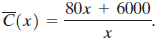
Average Cost See Problem 71. Suppose that the government imposes a $1000 per day tax on the bicycle manufacturer so that the daily cost C of manufacturing x bicycles is now given by C(x) = 80x + 6000. Now the average daily cost CÌ… is given by How many bicycles must be produced
In problem, each polynomial function has exactly one positive zero. Approximate the zero correct to two decimal places.f(x) = 2x3 - x2 - 3
In problem, analyze each polynomial function by following Steps 1 through 6.f(x) = (x - 1)(x + 3)2
In problem, find bounds on the real zeros of each polynomial function.f(x) = x4 - x3 + x - 1
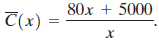
Average Cost Suppose that the daily cost C of manufacturing bicycles is given by C(x) = 80x + 5000. Then the average daily cost CÌ… is given by. How many bicycles must be produced each day for the average cost to be no more than $100? 80x + 5000 C(x)
In problem, each polynomial function has exactly one positive zero. Approximate the zero correct to two decimal places.f(x) = x3 - x – 2
In problem, analyze each polynomial function by following Steps 1 through 6.f(x) = (x + 4)(x - 2)2
In problem, find bounds on the real zeros of each polynomial function.f(x) = x4 + x3 - x - 1
In problem, determine where the graph of f is below the graph of g by solving the inequality f(x) ≤ g(x). Graph f and g together.f(x) = x4g(x) = 2 – x2
In problem, analyze each polynomial function by following Steps 1 through 6.f(x) = x(x + 2)2
In problem, use the Intermediate Value Theorem to show that each polynomial function has a zero in the given interval.f(x) = 3x4 + 4x3 - 8x -2; [1, 2]
In problem, find bounds on the real zeros of each polynomial function.f(x) = x4 - 5x2 - 36
In problem, analyze each polynomial function by following Steps 1 through 6.f(x) = x2(x - 3)
In problem, determine where the graph of f is below the graph of g by solving the inequality f(x) ≤ g(x). Graph f and g together.f(x) = x4 – 4g(x) = 3x2
In problem, use the Intermediate Value Theorem to show that each polynomial function has a zero in the given interval.f(x) = 8x4 - 4x3 - 2x -1; [0, 1]
In problem, find bounds on the real zeros of each polynomial function.f(x) = x4 - 3x2 - 4
In problem, determine where the graph of f is below the graph of g by solving the inequality f(x) ≤ g(x). Graph f and g together.f(x) = x4 - 1g(x) = x – 1
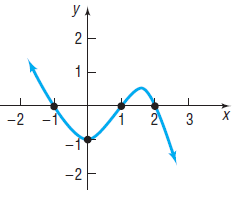
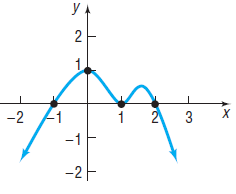
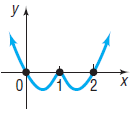
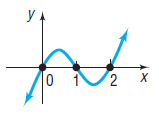
In problem, construct a polynomial function that might have the given graph. y 2 2 -1 -2 3 -2
In problem, use the Intermediate Value Theorem to show that each polynomial function has a zero in the given interval.f(x) = 2x3 - x2 - 3; [1, 2]
In problem, solve each equation in the real number system.2x4 + x3 - 24x2 + 20x + 16 = 0
In problem, determine where the graph of f is below the graph of g by solving the inequality f(x) ≤ g(x). Graph f and g together.f(x) = x4 - 1g(x) = -2x2 + 2
In problem, construct a polynomial function that might have the given graph. y 2 -1 -2 3 -1 -2F
In problem, use the Intermediate Value Theorem to show that each polynomial function has a zero in the given interval.f(x) = 3x3 - x - 1; [0, 1]
In problem, solve each equation in the real number system.2x4 - 19x3 + 57x2 - 64x + 20 = 0
What is the domain of the function f(x) = √x – 1/x + 4?
In problem, construct a polynomial function that might have the given graph. х
In problem, find bounds to the real zeros of each polynomial function.f(x) = 3x3 - 7x2 - 6x + 14
In problem, solve each equation in the real number system.x3 + 3/2x2 + 3x - 2 = 0
What is the domain of the function f(x) = √x – 2/x + 4?
In problem, construct a polynomial function that might have the given graph.
In problem, find bounds to the real zeros of each polynomial function.f(x) = 2x3 - 7x2 - 10x + 35
In problem, solve each equation in the real number system.x3 - 2/3x2 + 8/3x + 1 = 0
What is the domain of the function f(x) = √x3 - 3x2?
Showing 27500 - 27600
of 29454
First
269
270
271
272
273
274
275
276
277
278
279
280
281
282
283
Last
Step by Step Answers

 Get 50% OFF
Claim Now
Get 50% OFF
Claim Now