



Question: Monotone classes (2). Recall from Problem 3.14 that a monotone class (mathscr{M} subset mathscr{P}(X)) is a family which contains (X) and is stable under countable
Monotone classes (2). Recall from Problem 3.14 that a monotone class \(\mathscr{M} \subset \mathscr{P}(X)\) is a family which contains \(X\) and is stable under countable unions of increasing sets and countable intersections of decreasing sets; denote by \(\mathfrak{m}(\mathscr{G})\) the smallest monotone class containing the family \(\mathscr{G} \subset \mathscr{P}(X)\). Show the following analogues of Lemma 5.4 and Theorem 5.5 .
(i) \(\mathscr{M}\) is a \(\sigma\)-algebra if, and only if, it is stable under the formation of complements.
(ii) If \(\mathscr{G}\) is stable under the formation of complements and finite intersections, then \(\mathscr{M}=\) \(\mathfrak{m}(\mathscr{G})\) is a \(\sigma\)-algebra (namely \(\sigma(\mathscr{G})\) ).
[use the monotone class theorem from Problem 3.14 .]
Data from problem 3.14
Monotone classes (1). A family \(\mathscr{M} \subset \mathscr{P}(X)\) which contains \(X\) and is stable under countable unions of increasing sets and countable intersections of decreasing sets
\[
\begin{array}{ll}
\left(A_{n}ight)_{n \in \mathbb{N}} \subset \mathscr{M}, & A_{1} \subset \cdots \subset A_{n} \subset A_{n+1} \uparrow A=\bigcup_{n \in \mathbb{N}} A_{n} \Longrightarrow A \in \mathscr{M} \\
\left(B_{n}ight)_{n \in \mathbb{N}} \subset \mathscr{M}, & B_{1} \supset \cdots \supset B_{n} \supset B_{n+1} \downarrow B=\bigcap_{n \in \mathbb{N}} B_{n} \Longrightarrow B \in \mathscr{M}
\end{array}
\]
is called a monotone class. Assume that \(\mathscr{M}\) is a monotone class and \(\mathscr{F} \subset \mathscr{P}(X)\) any family of sets.
(i) Mimic the proof of Theorem 3.4 to show that there is a minimal monotone class \(\mathfrak{m}(\mathscr{F})\) such that \(\mathscr{F} \subset \mathfrak{m}(\mathscr{F})\).
(ii) If \(\mathscr{F}\) is stable w.r.t. complements, i.e. \(F \in \mathscr{F} \Longrightarrow F^{c} \in \mathscr{F}\), then so is \(\mathfrak{m}(\mathscr{F})\).
(iii) If \(\mathscr{F}\) is \(\cap\)-stable, i.e. \(F, G \in \mathscr{F} \Longrightarrow F \cap G \in \mathscr{F}\), then so is \(\mathfrak{m}(\mathscr{F})\).
[ show that the families
\[
\begin{aligned}
\Sigma & :=\{M \in \mathfrak{m}(\mathscr{F}): M \cap F \in \mathfrak{m}(\mathscr{F}) \forall F \in \mathscr{F}\} \\
\Sigma^{\prime} & :=\{M \in \mathfrak{m}(\mathscr{F}): M \cap N \in \mathfrak{m}(\mathscr{F}) \forall N \in \mathfrak{m}(\mathscr{F})\}
\end{aligned}
\]
are again monotone classes satisfying \(\mathscr{F} \subset \Sigma, \Sigma^{\prime}\).]
(iv) Use (i)-(iii) to prove the following.
Monotone class theorem. Let \(\mathscr{F} \subset \mathscr{P}(X)\) be a family of sets which is stable under the formation of complements and intersections. If \(\mathscr{M} \supset \mathscr{F}\) is a monotone class, then \(\mathscr{M} \supset \sigma(\mathscr{F})\).
Data from lemma 5.4
Data from theorem 5.5
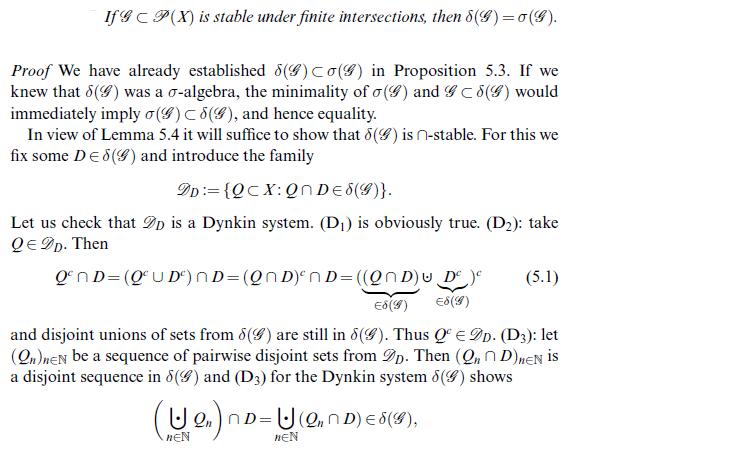
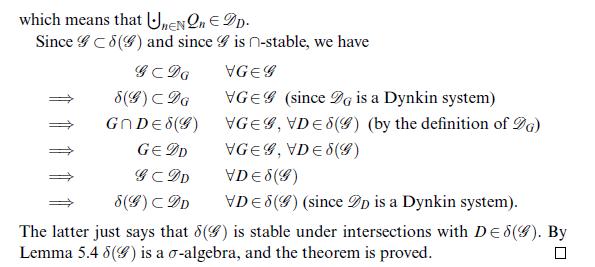
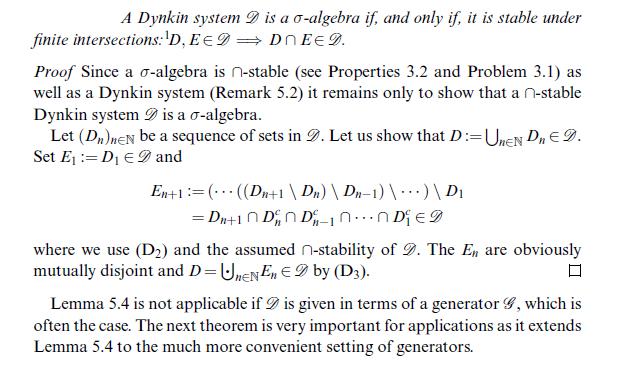
A Dynkin system D is a o-algebra if, and only if, it is stable under finite intersections: D, E DnEED. Proof Since a o-algebra is n-stable (see Properties 3.2 and Problem 3.1) as well as a Dynkin system (Remark 5.2) it remains only to show that a n-stable Dynkin system is a o-algebra. Let (Dn)neN be a sequence of sets in 9. Let us show that D:=UNEN D ED. Set E=D and En+1=(((Dn+1 \ Dn) \ Dn-1) \) \ D =D+1DD-1... DiED where we use (D) and the assumed n-stability of 9. The En are obviously mutually disjoint and D= UNENE E by (D3). Lemma 5.4 is not applicable if is given in terms of a generator, which is often the case. The next theorem is very important for applications as it extends Lemma 5.4 to the much more convenient setting of generators.
Step by Step Solution
3.33 Rating (153 Votes )
There are 3 Steps involved in it
i ii mind the misprint we also need stability of M under finite intersections Clearly any oal... View full answer

Get step-by-step solutions from verified subject matter experts