







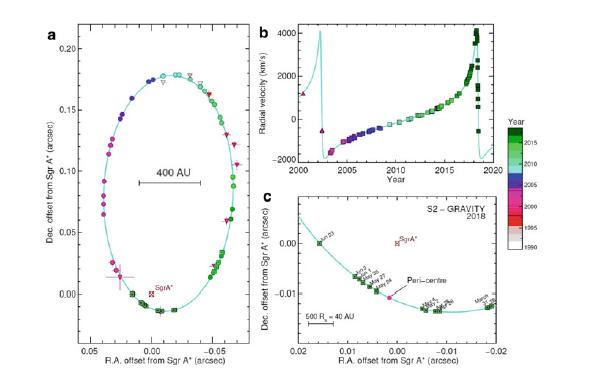
Question: As the Earth revolves around the Sun, the Sun revolves around the center of our Galaxy (where the black hole described in Fig. 11.12 resides).
As the Earth revolves around the Sun, the Sun revolves around the center of our Galaxy (where the black hole described in Fig. 11.12 resides). The Sun's distance from the Galactic center is \(D=8.5 \mathrm{kpc}\left(1 \mathrm{pc}=3.010^{16} \mathrm{~m}\right)\), and the speed of solar revolution is \(v_{\odot}=220 \mathrm{~km} / \mathrm{s}\). Using these data, estimate the total mass \(M_{s}\) of the Galaxy matter enclosed in the sphere of radius \(D\). Assuming that the stars all have the same mass as the Sun, \(M_{\odot}=210^{30} \mathrm{~kg}\), estimate the number \(N_{s}\) of stars in the Galaxy if all the mass determined above were concentrated in the stars. The estimated number of stars in our Galaxy by electromagnetic radiation is between 100 and 400 billion stars. Is the result obtained compatible with this estimate?
Fig. 11.12
Dec. offset from Sgr A" (arcsec) b 4000 a 0.20 0.15 0.10 400 AU 0.05 SgrA 0.00 0.05 0.00 -0.05 R.A. offset from Sgr A (arcsec) Dec. offset from Sgr A' (arcsec) Radial velocity (km/s) 2000- 0 Year 2015 20001 2010 2000 2005 2010 2015 2020 Year 0.00 A 0.01 500 R-40 AU S2-GRAVITY 2000 2018 1305 Pari-cent 0.02 0.01 0.00 -0.01 R.A. offset from Sgr A' (arcsec) -0.02 1990
Step by Step Solution
3.44 Rating (167 Votes )
There are 3 Steps involved in it

Get step-by-step solutions from verified subject matter experts
 Study Help